


For years, Bitcoin ran on a predictable clock. Every four years, a halving event slashed new supply, retail investors piled in, prices exploded, and the whole thing collapsed 80% before starting again. Analysts could map it. Traders could position for it. It was practically a given.
Key Takeaways
Bitcoin’s max drawdown in the 2025 cycle was 52%, versus the historical ~80%, signaling a maturing market
Institutional vehicles (ETFs, public companies) now hold roughly 12% of circulating Bitcoin supply
The halving’s impact is shrinking — 2024’s event cut inflation from ~1.7% to ~0.85%, a fraction of earlier shocks
JPMorgan raised its long-term Bitcoin target to $266,000 in February 2026, citing its competition with gold
That clock is no longer keeping accurate time — or at least, that’s what a growing number of institutional analysts argued heading into 2026. The reality, as fresh data makes clear, is more complicated.
The Pattern, and Why It Held
To understand what may be changing, it helps to understand what drove the cycle in the first place.
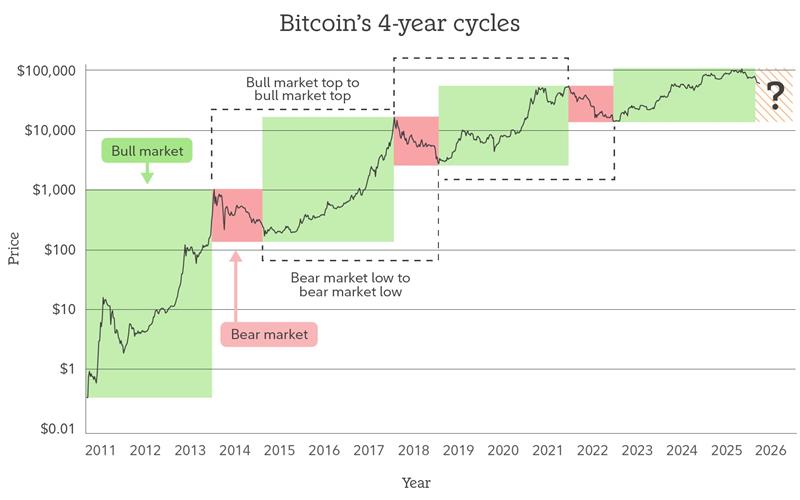
Bitcoin formed bull market tops in November 2013 ($1,150), December 2017 ($19,800), and November 2021 ($69,000) — each roughly four years apart. Bear market bottoms followed the same cadence: January 2015, December 2018, November 2022. The mechanism behind this rhythm was never a mystery. Bitcoin’s programmed halving events, which cut mining rewards approximately every four years, reduced the rate of new supply entering the market. Combine that with loose monetary policy — the Fed cutting rates, injecting liquidity — and investor psychology doing the rest, and you had a reliable boom-bust engine.
The 2025 peak at $126,200 landed almost exactly on schedule, just under four years from the November 2021 high. On the surface, the cycle appeared intact.
Beneath the Surface, Something Shifted
But almost everything beneath that headline figure looked different from prior cycles.
Maximum drawdown from the 2025 peak came in at 52% — painful by conventional asset standards, but a marked departure from the 80%-plus crashes that defined 2018 and 2022. Fidelity
Digital Assets recorded 17 new all-time lows in volatility following the October 2025 peak. The firm’s “Profit to Volatility Ratio” held above 0.015 since late 2023 — the longest stretch of market stability in Bitcoin’s history.
These aren’t minor deviations. They suggest something structural has changed. Some investors went further, arguing that any future drops would be small enough that they won’t register as full-blown bear markets at all — pointing to commodity supercycles, like the one in the 2000s that sustained a bull run for nearly a decade, as a possible template for where Bitcoin is headed.
Institutions Changed the Equation
The most straightforward explanation is supply absorption. Institutional vehicles — spot ETFs, public companies, and corporate treasuries — now control roughly 12% of Bitcoin’s circulating supply. U.S. spot ETFs alone pulled in over $40 billion in net inflows in a single year, according to Glassnode analysis from early 2025.
That kind of sustained demand doesn’t behave like retail. Institutional holders don’t panic-sell on bad tweets. They don’t chase pumps at 3 a.m. They use data-driven strategies and, critically, they don’t exit on the same schedule retail investors do. The result is that deep liquidity and steady inflows have smoothed out price swings that once rattled the entire market.
21Shares went further, arguing in November 2025 that the cycle may be stretching toward five years as institutional liquidity waves lengthen the typical timeline.
The Halving Is Losing Its Edge
The four-year cycle was always built around the halving. In 2012 and 2016, those events were seismic. The 2024 halving reduced Bitcoin’s inflation rate from approximately 1.7% to 0.85%. With 94% of all Bitcoin already mined, the marginal supply shock is a fraction of what it once was.
Analysts at Caleb & Brown have argued that global liquidity conditions — M2 money supply, Federal Reserve rate policy — now carry more weight than the halving in determining price direction.
That argument took a hit in December 2025, however, when Bitcoin’s price failed to rally after the Fed cut interest rates — a reminder that no single macro variable reliably drives the market anymore.
Diminishing Returns, Longer Horizons
The return data across cycles reinforces the trend. The 2013–2017 period produced roughly a 20x gain. The 2017–2021 cycle delivered approximately 3.5x. The most recent 2021–2025 cycle — from Bitcoin’s prior peak near $69,000 to its 2025 high around $126,200 — generated roughly 80% gain.
That’s not a crash. But it’s also not what drew most retail investors to Bitcoin in the first place.
Bitwise CEO Hunter Horsley stated in late 2025 that the market had undergone a “profound change” making the old four-year pattern inapplicable. JPMorgan raised its long-term theoretical price target to $266,000 in February 2026, framing Bitcoin as a competitor to gold on a volatility-adjusted basis rather than a speculative tech asset.
What the On-Chain Data Shows
Fidelity’s March 2026 report points to lower MVRV ratios, a stable Puell Multiple, and reduced volatility during high-profit periods as markers of a maturing asset class. A firm realized-price support floor has developed — meaning the average cost basis of existing holders provides a structural cushion that didn’t exist in earlier cycles.
Taken together, these metrics describe a Bitcoin that behaves less like a speculative vehicle and more like a large-cap technology stock. That’s a significant shift in identity — and in how the asset should be analyzed.
The Verdict Isn’t In Yet
Here’s where the narrative gets complicated. As of February 2026, Bitcoin’s price has been falling since its October peak in a way that looks less like a routine pullback and more like the early stages of a traditional bear market. In every prior cycle, Bitcoin dropped at least 77% from its all-time high before bottoming. The current decline, at 52%, hasn’t approached that threshold — but the price action since October doesn’t look like what you’d expect in a sustained bull market either.
That tension is unresolved. The supercycle thesis and the institutional maturity argument remain plausible. So does the possibility that the four-year cycle is simply playing out as it always has, just with softer edges — and that the bottom isn’t in yet.
Using cycles as a rigid investment framework has always been risky. The intervals have never been precisely four years. Someone who planned to sell exactly four years after the 2017 peak would have exited more than 30% below the 2021 high. The smarter application, analysts suggest, is treating cycle timing as one reference point among many — a rough bearing, not a map.
The Cycle Isn’t Gone – It’s Contested
None of this means Bitcoin won’t experience significant corrections. The 2025 drawdown already wiped out billions in value. Volatility, while lower by historical standards, remains elevated relative to traditional assets.
What’s less certain is whether the old framework — four years up, four years down, repeat — still applies cleanly. The era of 80% crashes and retail-driven parabolas may be giving way to something more institutionalized. Or the cycle may simply be mid-correction, with its final chapter still unwritten.
Either way, the analysts who spent years calling tops based on halving timelines alone are updating their models. The four-year clock hasn’t stopped. Whether it still tells the right time is the question nobody can fully answer yet.t place.


