


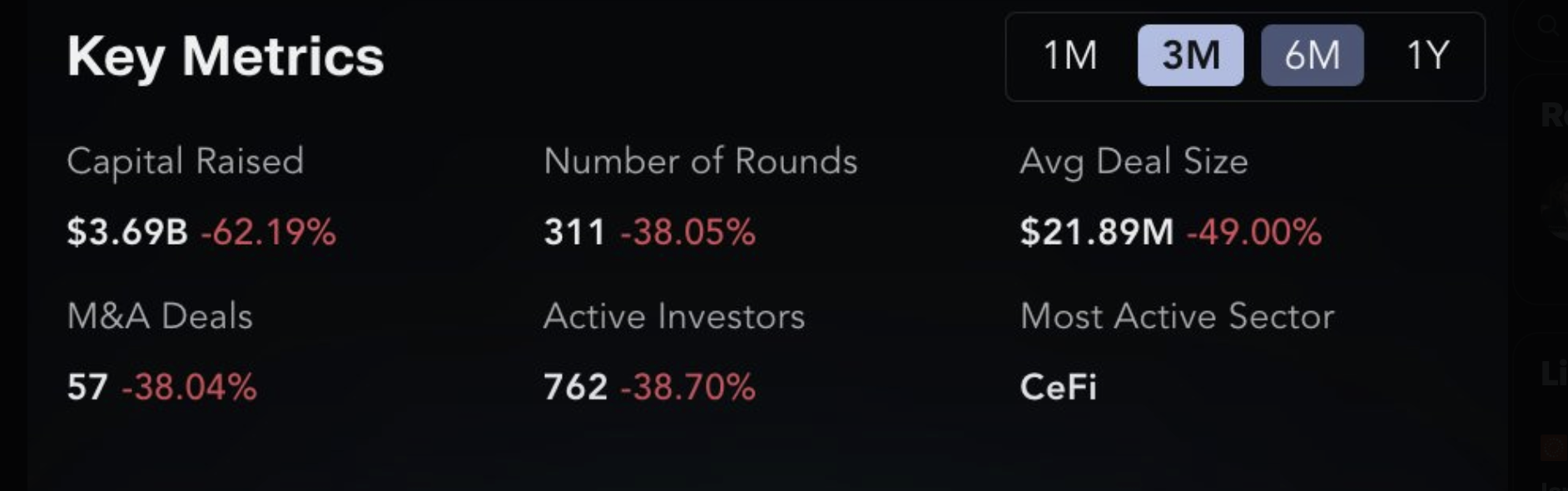
The last few months have been ugly for crypto fundraising. Capital raised across the industry cratered 62% in the most recent three-month window, deals fell 38%, and the average check size nearly halved to $21.89 million.
Key Takeaways
Crypto fundraising is down sharply – capital raised dropped 62%, deal count fell 38%, and average deal sizes nearly halved in the past 3 months
The few dollars flowing in are concentrating in massive strategic rounds, not early-stage startups
Major funds (a16z, Paradigm) are still raising but haven’t closed – leaving a meaningful capital gap in the market
CeFi is capturing the biggest checks while DeFi leads in deal volume but lags on valuations
With 762 active investors and only 311 rounds closed, the math doesn’t add up – and the industry knows it.
The headline problem isn’t a lack of interest. It’s a lack of deployment. Firms like Andreessen Horowitz and Paradigm are actively raising new funds but haven’t closed. Dragonfly is a notable exception, having shut its $650 million Fund IV in February 2026 – one of the few large vehicles to actually cross the finish line recently. Until more funds close, early-stage founders are stuck waiting.
What capital is moving has been moving upward. A single $200 million strategic investment by Tether into Whop accounted for nearly 45% of all tracked capital in the past 30 days. That’s not a healthy market. That’s a market propped up by one large check while everything below it goes dry.
The 2025 Number That Looks Great But Isn’t
Zoom out to full-year 2025 and the picture looks deceptively strong: $50.6 billion raised, a 226% jump over 2024’s $15.5 billion. But peel that back and most of it came from M&A activity – $22.1 billion worth, nearly 44% of the total. Actual venture funding grew more modestly to $23.3 billion, and the number of deals fell 21% year-over-year.
The industry raised more money while funding fewer companies. That’s consolidation, not growth.
Average deal sizes climbed to $28.1 million from $12.9 million the year prior, which sounds positive until you realize it reflects the death of small bets. Investors are writing bigger checks into fewer, more established players – and largely ignoring the rest.
CeFi vs. DeFi: A Widening Gap
The split between centralized and decentralized finance is becoming structural. DeFi projects still represent roughly 29% of all VC activity by deal count, but they’re raising at compressed valuations and smaller sizes. The narrative has shifted toward “Real-World Assets” – on-chain treasuries and money market instruments crossed $36 billion in early 2026 as institutional capital found the on-chain yield products it had been waiting for. Ethereum still commands 68% of the roughly $130–140 billion in total value locked across chains.
CeFi, by contrast, is attracting far fewer deals but capturing the largest capital injections. The M&A story here is significant: instead of funding new builds, major players are acquiring established infrastructure. Ripple and Coinbase have both moved toward vertical integration – buying prime brokerages and treasury software to position themselves as end-to-end financial platforms. Crypto M&A is projected to surpass $37 billion in 2026, breaking last year’s record.
What 2026 Is Actually Setting Up
Three things are converging that could change the fundraising picture in the second half of the year.
First, regulatory clarity. The proposed GENIUS Act in the U.S. has specifically emboldened stablecoin issuers and created a clearer runway for institutional capital that has been sitting on the sidelines. Fortune 500 companies are reportedly exploring branded Layer 1 blockchains off the back of it.
Second, the IPO pipeline. Circle’s 2025 public offering – which saw its stock run from $31 to over $230 – validated the public markets exit for crypto-native companies. Kraken, BitGo, and Chainalysis are now widely cited as 2026 listing candidates. If even two of those land cleanly, it resets expectations for what exits look like in this space.
Third, the AI overlap. Paradigm’s reported $1.5 billion raise specifically expands its mandate beyond crypto into AI and robotics – a signal that the most sophisticated crypto investors see blockchain primarily as infrastructure for AI verification and data provenance, not as an end unto itself. DePIN (Decentralized Physical Infrastructure) is getting serious VC attention as a result.
The industry’s most honest observers aren’t calling this a recovery. They’re calling it a maturation – one where the “spray-and-pray” era is over, the winners are getting bigger, and everyone else is being quietly filtered out. That’s not bearish, exactly. But it’s not the open market it used to be either.


