

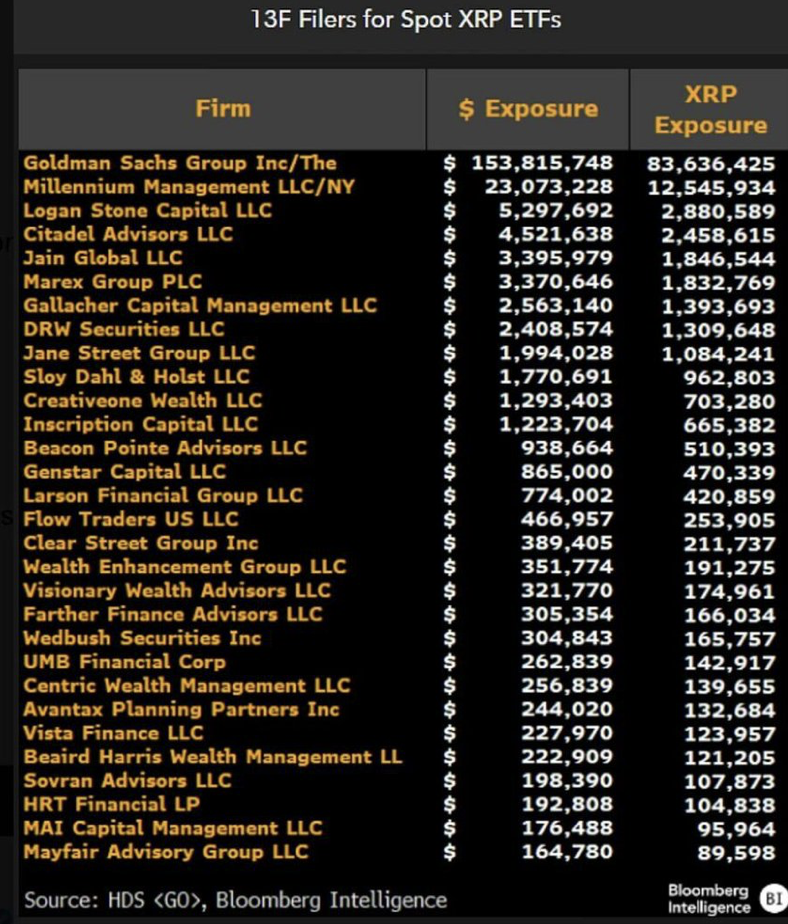
Goldman Sachs has emerged as the dominant institutional player in the nascent spot XRP ETF market, holding roughly $153.8 million in exposure as of its Q4 2025 13F filing - a position that dwarfs every other disclosed institution in the space.
Key Takeaways
Goldman Sachs holds ~$154M in spot XRP ETFs – nearly 73% of all reported institutional interest
XRP ETFs launched in November 2025 and have since accumulated $1.44B in total AUM
Standard Chartered targets XRP at $2.80; institutional consensus ranges up to $8.00 by end of 2026
84% of XRP ETF assets are estimated to be held by retail “super fans,” not institutions
The bank’s stake represents nearly 73% of the $211 million collectively held by the top 30 institutional investors. Its closest rival, Millennium Management, trails significantly at $23.1 million – less than one-sixth of Goldman’s reported position.
Rather than concentrating risk in a single product, Goldman spread its allocation across four issuers: approximately $40 million in the Bitwise XRP ETF, $38 million each in the Franklin XRP Trust and Grayscale XRP ETF, and $36 million in the 21Shares XRP ETF. The move reflects a deliberate portfolio construction approach, not a speculative bet on any one fund’s survival.
The XRP position sits inside a broader $2.3 billion crypto ETF book that also includes $1.1 billion in Bitcoin and $1 billion in Ethereum – suggesting the bank is building structured exposure across the major digital asset classes rather than cherry-picking.
A Market Still Finding Its Footing
Spot XRP ETFs only came to market in November 2025, following the resolution of the SEC’s long-running lawsuit against Ripple, which settled in August of the same year. In the four months since launch, the funds have pulled in $1.4 billion in net inflows, with total AUM reaching $1.44 billion by early March 2026. Notably, the funds recorded net outflows on just nine trading days during that stretch – a sign of relatively sticky demand despite ongoing volatility in crypto markets.
Bloomberg ETF analysts James Seyffart and Eric Balchunas offer an important caveat to the institutional narrative: an estimated 84% of XRP ETF assets are held by retail investors – the so-called “XRP super fans” – who fall below the 13F reporting threshold. In other words, the institutional figures, while striking, capture only a fraction of the actual investor base.
What Analysts Are Watching
Goldman’s entry has been interpreted by market observers as meaningful validation. When a firm of that standing takes a disclosed, nine-figure position in a newly approved crypto product, it tends to shift how other institutional allocators assess the risk.
Standard Chartered revised its XRP price target to $2.80, implying close to 100% upside from current levels. Broader institutional consensus for year-end 2026 sits in the $3.00–$8.00 range – a wide band that reflects genuine uncertainty but also suggests few serious analysts expect the asset to collapse from here. Prediction markets are currently pricing a 67% probability that XRP closes above $1.50 by end of March 2026.
On the infrastructure side, Binance recently integrated Ripple’s RLUSD stablecoin on the XRP Ledger, which now carries a market cap of $1.59 billion. Meanwhile, institutional use of XRP for cross-border settlements – through banks including SBI Holdings, Santander, and PNC – continues to grow, with monthly transaction flows reportedly exceeding $15 billion.
The ETF market may still be young, but the players moving into it are anything but small.


