


The U.S.-Israel strike campaign against Iran that began on February 28 sent Brent crude past $100 a barrel and froze tanker traffic through the Strait of Hormuz.
Key Takeaways
Only 8-10% of Bitcoin’s global hashrate sits in oil-sensitive grids; the other ~90% is largely insulated from the crude price shock
The real miner risk is Bitcoin’s price – not electricity bills – as geopolitical stress pushes capital out of risk assets
Iran’s mining capacity has effectively gone dark, but the network’s difficulty adjustment absorbs the hit automatically
Public miners are racing to repurpose their infrastructure for AI/HPC workloads, with over $65B in contracts already signed
Energy markets are still digesting the fallout. For Bitcoin miners, the instinct is to worry about power bills. That instinct is mostly wrong.
The Cost Side Is Largely a Non-Story
Crude oil barely touches the electricity that runs Bitcoin mining. According to a new report from Hashrate Index, the hashrate heatmap for Q1 2026 makes the geography plain: the United States leads with 37.5% of global hashrate (400 EH/s), followed by Russia at 16.4% and China at 11.7%. Paraguay runs almost entirely on Itaipu hydroelectric. Ethiopia is over 90% hydro. Kazakhstan, Norway, Iceland – none of these grids move meaningfully in step with crude.
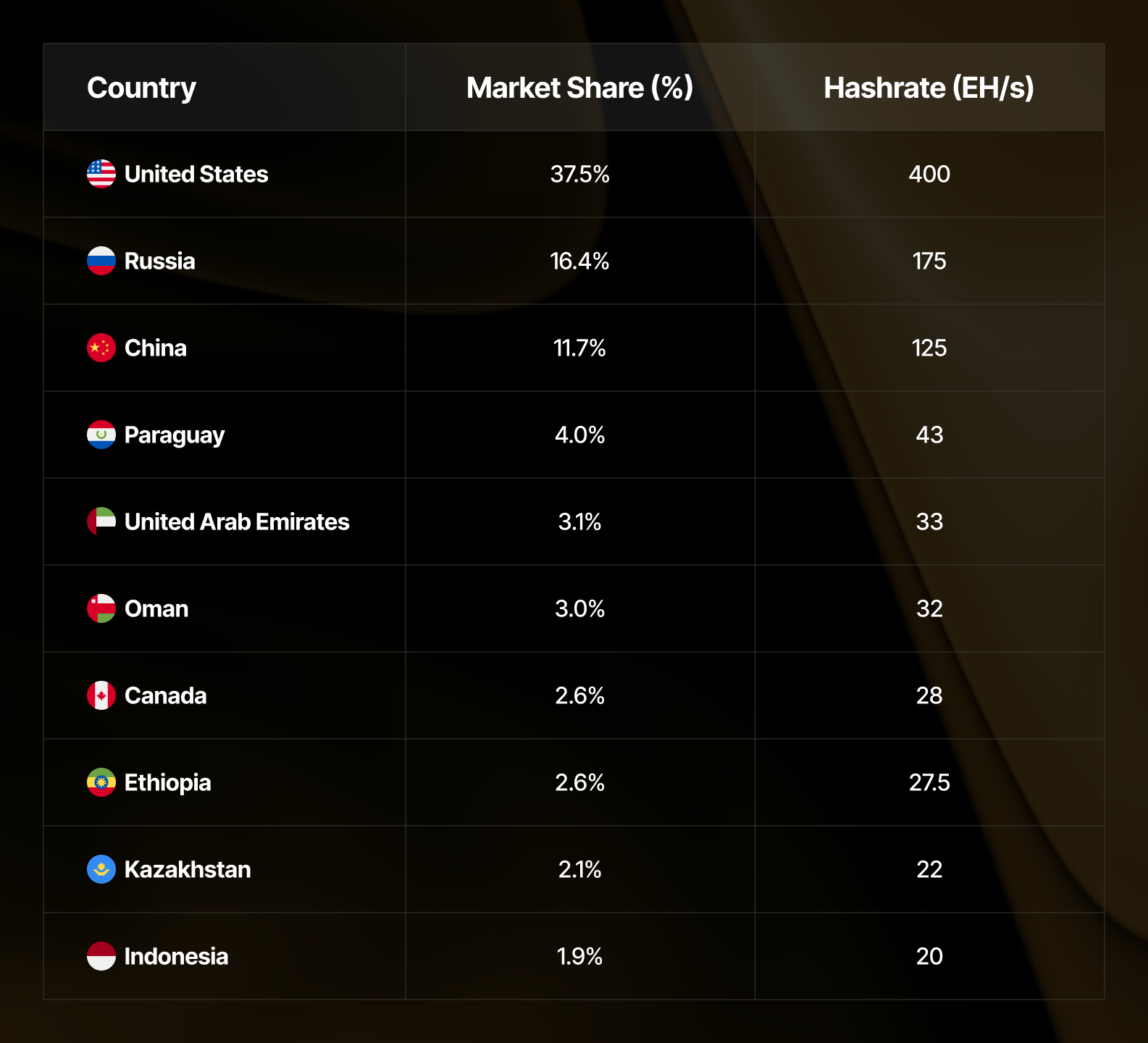
Even in the U.S., where some marginal correlation between oil prices and industrial electricity rates exists, that correlation runs between 0.1 and 0.3. Statistically detectable, practically marginal. And where transmission does occur, it moves slowly through utility rate-setting cycles – months, not days.
The genuinely exposed cohort is the Gulf states. The UAE (3.1%, 33 EH/s) and Oman (3.0%, 32 EH/s) operate grids powered primarily by natural gas derived from oil production. Add Iran’s estimated 9 EH/s and smaller contributors across Kuwait and Qatar, and total oil-sensitive hashrate lands around 8–10% of the global network. Real, but not a systemic threat.
Inside Iran, the damage is more immediate. Roughly 700,000 mining rigs have gone offline due to power grid instability and near-total internet disruption. The network’s difficulty adjustment – recalibrating every 2,016 blocks – absorbs that capacity drop automatically, redistributing profitability to surviving operators elsewhere.
Where the Shock Actually Lands: Revenue, Not Costs
Analysis from Luxor Technology’s Hashrate Index identifies the real exposure: miner profitability is far more sensitive to Bitcoin’s market price than to electricity costs. The metric that matters is hashprice – expected daily revenue per unit of hashrate.
February 2026 illustrated the asymmetry clearly. USD hashprice hit a new all-time daily low of $27.89 per PH/s/day on February 24, with a monthly average down 17.9% month-over-month. That collapse wasn’t driven by rising power costs. It was driven by a 23.8% decline in Bitcoin’s price, from $78,073 to $65,204.
A sustained oil shock above $100 per barrel injects inflationary pressure into global CPI. Central banks respond. Rate-cut expectations get pushed out. Capital rotates away from high-volatility assets toward cash and short-duration instruments. Bitcoin – which has increasingly traded as a risk-on asset during acute stress – gets repriced. The current cycle already saw a roughly 50% drawdown from the October 2025 peak near $126,000. Prior cycles confirm the pattern: COVID crashed BTC 62%, the 2022 tightening cycle produced a 77% peak-to-trough decline.
Some research suggests that if Brent crude sustains between $100 and $150, Bitcoin could face drawdowns up to 45% as monetary policy expectations shift. At current hashprice levels around $30 per PH/s/day, marginal operators running older 20–24 J/TH fleets are already at or near breakeven. A further BTC price decline doesn’t stress them – it shuts them down.
For Gulf-based miners, the scenario is a double exposure: rising power costs on one side, potential BTC price compression on the other. Luxor’s trailing twelve-month data shows USD-denominated forward hashrate sales outperformed spot mining across the board, with 4-month contracts delivering roughly 8.2% outperformance. In this environment, locking in a fixed hashprice before further deterioration is a straightforward risk management call.
Miners Are Becoming AI Infrastructure
The oil shock arrives at an industry already mid-pivot. Facing structurally low hashprices, public miners have spent the past year repurposing their most valuable asset – large-scale, grid-connected power infrastructure – for artificial intelligence and high-performance computing.
The financial logic is hard to argue with. AI workloads can generate roughly three times the revenue per megawatt compared to Bitcoin mining, with operating margins on secured colocation deals running between 80% and 90%. By October 2025, public miners had announced over $65 billion in AI and HPC contracts with the likes of Google, Microsoft, and Amazon.
The deals have reshaped sector valuations. Core Scientific signed a 12-year, $4.7 billion agreement with CoreWeave and is building 400 megawatts of dedicated AI capacity. Additionally, the company secured an investment from Morgan Stanley to further push their AI agenda.
IREN reached a $14 billion market cap in February 2026 following a near-$10 billion contract with Microsoft. Cipher Mining locked in a 15-year, 300-megawatt lease with AWS projected at $5.5 billion in revenue. Hut 8 partnered with Anthropic and Fluidstack – backstopped by Google – for a $7 billion, 15-year deal at its River Bend campus.
Analysts at CoinShares describe AI revenue as a structural floor – a way for miners to survive crypto winters without forced BTC sales. Wall Street is increasingly pricing these companies as infrastructure plays rather than Bitcoin proxies. That rerating is already reflected in share prices: TeraWulf and IREN both saw their valuations triple through 2025.
What Comes Next
Bitcoin is currently trading around $70,000, with hashprice hovering near $30 per PH/s/day. Luxor’s forward market is pricing an average of $29.50 per PH/s/day through August 2026 – the market is not pricing in a quick recovery.
The structural trajectory is clear: operators with large power footprints who can execute the technical shift to GPU-dense infrastructure will capture the AI premium. Those who can’t face a prolonged squeeze – one that $100 oil makes somewhat worse, but that started long before any missile was launched toward Isfahan.
The Iran conflict accelerated a stress test already underway. For the mining industry, the verdict is the same regardless of where crude settles: securing block rewards alone, at current economics, is an increasingly difficult business to defend.


