


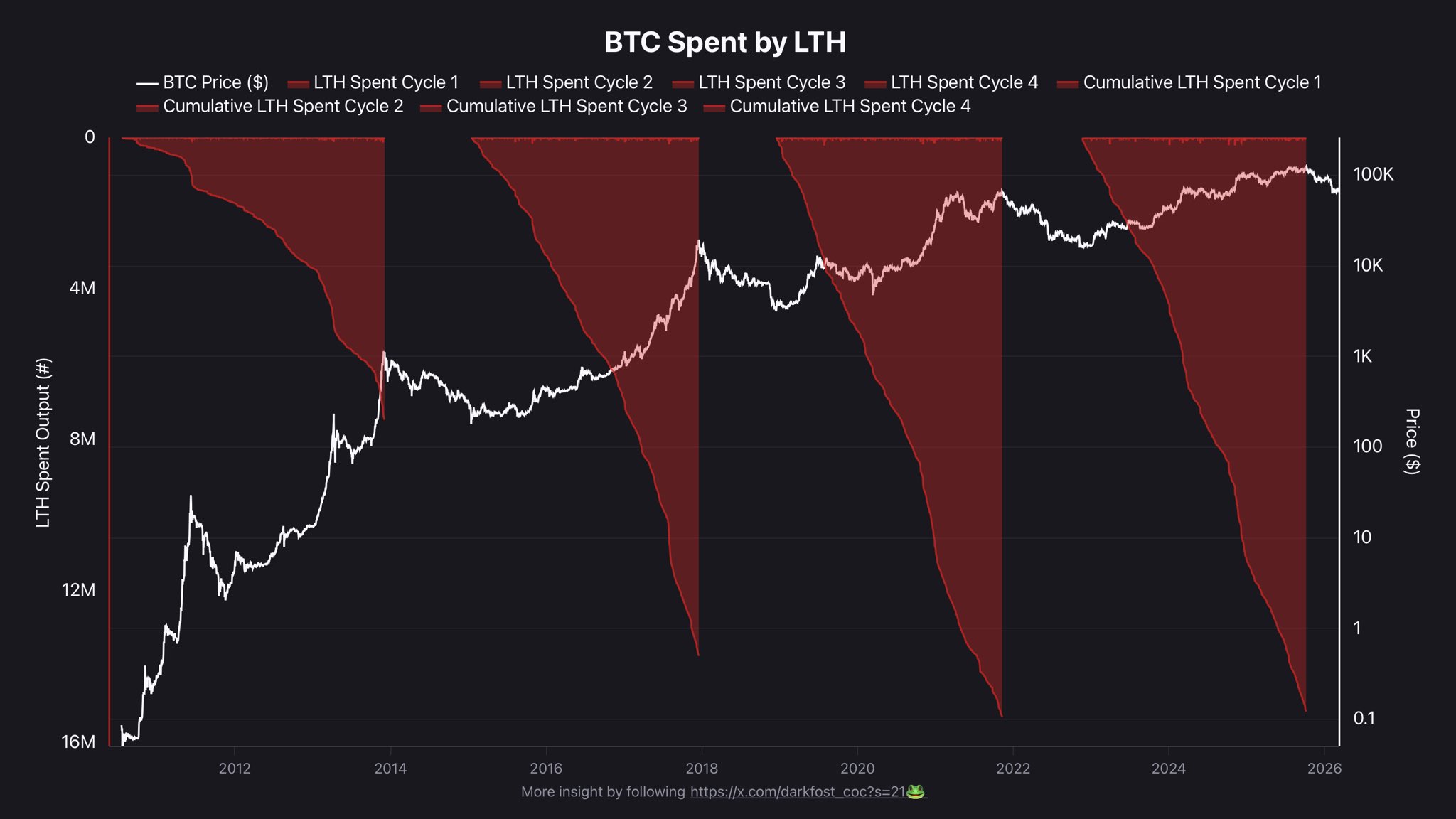
The 2025 Bitcoin cycle closed without breaking one of the market's more closely watched records. Long-Term Holders - wallets that have held Bitcoin for at least 155 days - spent approximately 15.1 million BTC over the course of this cycle.
Key Takeaways
LTHs spent 15.1M BTC in 2025 – less than the 15.3M spent in 2021, meaning this cycle did not set a new selling record
Coinbase’s internal transfer of ~800K BTC distorted raw data; actual LTH selling was likely even lower
Spot Bitcoin ETFs now hold ~1.3M BTC (6.7% of supply); Digital Asset Treasuries hold ~1.1M BTC (~5%)
Institutional holders behave differently from retail LTHs, potentially acting as a structural floor on selling pressure going forward
That figure falls short of the 15.3 million BTC spent during the 2021 bull run, which remains the high-water mark for LTH selling pressure. For context, the two cycles before that recorded around 7.3 million and 13.6 million BTC spent respectively.
That may seem surprising given the price action this cycle, which briefly pushed Bitcoin above $100,000. But the headline numbers require scrutiny before any conclusions are drawn.
The Coinbase Problem
A significant chunk of what appeared as LTH spending in raw on-chain data was, in reality, internal bookkeeping. Coinbase moved approximately 800,000 BTC — the majority of which was classified as LTH supply — in what amounted to wallet reorganization rather than market selling. Strip that out, and the actual selling pressure from genuine long-term holders looks considerably softer.
This isn’t an isolated case. As more institutional-grade entities operate on-chain, internal transfers of this scale have become more common. It’s less a bug in the data and more a structural feature of a maturing market — one that traditional on-chain metrics weren’t originally built to accommodate.
Who Counts as a Long-Term Holder Now?
The more substantive issue is that the definition of “Long-Term Holder” is quietly becoming outdated.
Historically, the LTH cohort was dominated by early adopters, miners, and conviction-driven retail investors who accumulated Bitcoin and sat on it through multiple bear markets. That population still exists. But two new categories of holder have entered the market at scale — and they behave differently.
The first is spot Bitcoin ETFs. Launched in the United States in January 2024, these products now collectively hold around 1.3 million BTC, roughly 6.7% of total supply. BlackRock’s iShares Bitcoin Trust alone accounts for over 770,000 BTC. These funds don’t sell based on price euphoria. They sell — or more precisely, redeem — when their investors exit. That’s a fundamentally different selling mechanism than the retail-driven distribution that characterized previous cycle tops.
The second is Digital Asset Treasuries. Companies like Strategy (formerly MicroStrategy) have adopted Bitcoin as a primary reserve asset and now collectively hold approximately 1.1 million BTC, close to 5% of total supply. These entities have no formal obligation to maintain reserves the way ETFs do, but their acquisition strategies are long-horizon by design. Quarterly earnings pressure doesn’t translate directly into Bitcoin liquidations.
What This Means Going Forward
Together, ETFs and treasury companies control roughly 11–12% of Bitcoin’s total supply. When both cohorts are folded into on-chain LTH data — as they eventually will be, given their holding periods — the aggregate numbers will look increasingly stable relative to prior cycles. That’s not necessarily bullish in a near-term price sense, but it does suggest that the kind of aggressive, cycle-peak distribution that drove sharp corrections in 2018 and 2022 may be harder to replicate.
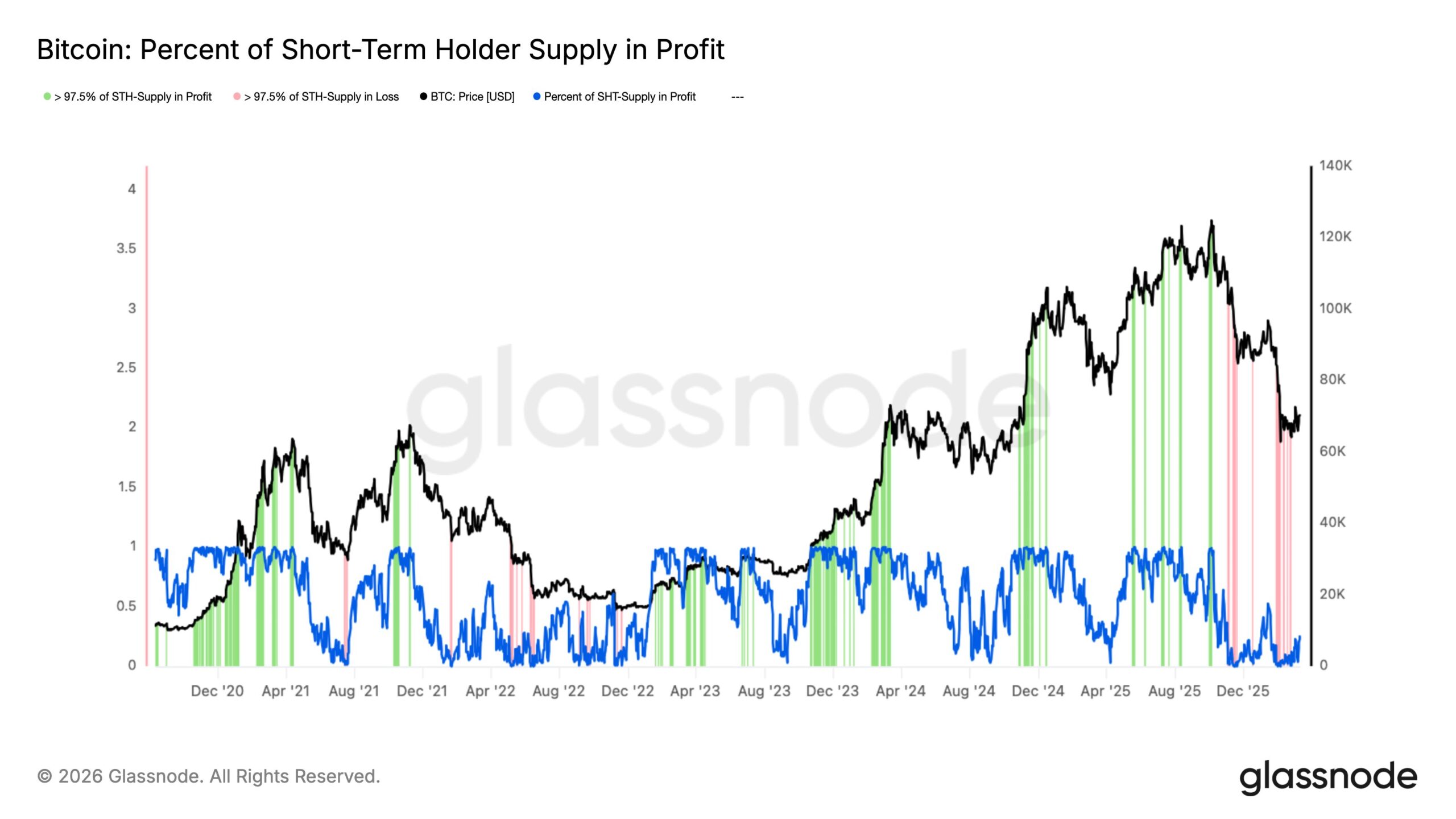
Glassnode’s recent note on Short-Term Holder supply adds another layer to the picture. STH supply in profit falling below 50% — a level now being watched closely — has historically been a precondition for sustained recovery rather than further downside. Until that metric flips back above the threshold, demand-side risk appetite tends to stay compressed.
The broader takeaway is that Bitcoin’s ownership structure is in transition. The LTH metric, long a reliable gauge of conviction and distribution pressure, is being reshaped by actors whose behavior doesn’t map cleanly onto the patterns analysts built their models around. Whether the existing frameworks catch up to that reality, or whether new metrics are needed entirely, is a question the on-chain analytics community will be wrestling with through the next cycle and likely beyond.
At the time of writing, BTC is trading around $71,000 after briefly breaking the $73,000 level yesterday.


