


US spot Bitcoin ETFs snapped a prolonged stretch of outflows and stagnation last week, recording their first five-day inflow streak of 2026.
Key Takeaways
US spot Bitcoin ETFs posted their first five-day inflow streak of 2026, pulling in ~$767M in a single week
BlackRock’s IBIT alone absorbed roughly $600M, cementing its dominance in the space
Institutional buyers treated the $65K–$70K range as a buying opportunity while retail sentiment sat in “Extreme Fear”
Ethereum and Solana ETFs lagged far behind, though staking-focused products are beginning to gain traction
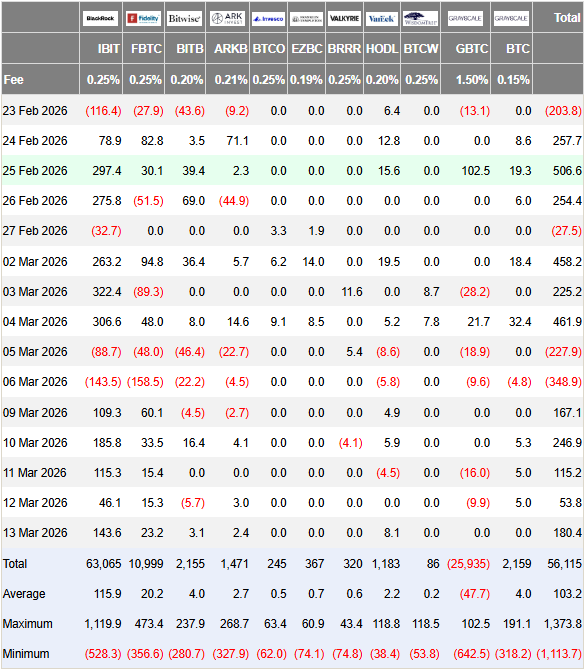
Net inflows for the week ending March 14 totaled approximately $767.3 million, according to Farside Investors data – a sharp reversal from February, which closed with net negative flows.
The daily breakdown tells the story plainly: $167.1 million on March 9, $251 million on March 10, $115.2 million on March 11, and $180.4 million on March 13. By March 11, cumulative inflows for the month had already reached $1.56 billion, effectively wiping out the previous month’s losses.
BlackRock Leads, Others Follow
No fund came close to BlackRock’s iShares Bitcoin Trust (IBIT) in terms of absorption. The fund pulled in roughly $600 million across the five-day period — about 78% of total weekly inflows — widening its lead over competitors in a market where consolidation around a handful of dominant products appears to be accelerating.
Total Bitcoin ETF assets across all funds now sit at $90.89 billion. That figure dwarfs every other crypto ETF category combined and signals just how thoroughly Bitcoin has outpaced alternative assets in capturing institutional capital.
The Trade Behind the Numbers
The inflow surge didn’t happen in a vacuum. On March 10, Bitcoin jumped 3.29% following signals of potential de-escalation in the Middle East, which also sent oil prices lower. Analysts at The Block noted that a growing cohort of institutional investors is treating Bitcoin as a geopolitical hedge — a store-of-value narrative that gains ground each time traditional risk assets come under pressure.
The macro backdrop adds another layer. Goldman Sachs has pointed to global debt exceeding $100 trillion as a structural tailwind for Bitcoin, framing it as an alternative asset that benefits directly from deteriorating sovereign balance sheets.
What makes last week’s inflows notable isn’t just the size — it’s who was buying. Retail sentiment, as measured by the Crypto Fear & Greed Index, hovered around 12–14, firmly in “Extreme Fear” territory. The buying came from institutional players who treated the $65,000–$70,000 consolidation range as a discount window, accumulating while smaller investors sat on the sidelines or exited.
Price Targets and Technical Levels
Standard Chartered revised its 2026 year-end Bitcoin price target to $100,000, though the bank flagged possible dips to $50,000 before any sustained recovery takes hold. Economist Henrik Zeberg projected a peak between $110,000 and $120,000 sometime in March 2026, tied directly to what he describes as the current “risk-on” phase of ETF-driven demand.
On the charts, Bitcoin faces resistance at $71,000 and $74,000. A clean break above the latter opens the door to the $80,000–$90,000 range. Until that level clears, the price action remains a test of whether last week’s institutional conviction translates into sustained momentum.
Altcoin ETFs: Ethereum and Solana Struggle to Keep Up
While Bitcoin’s ETF week was clean and decisive, the picture for Ethereum and Solana was murkier. Both assets saw net positive flows for the week, but the numbers and the consistency tell a different story.
Ethereum ETFs netted approximately $42 million over the period — notable, but barely a rounding error next to Bitcoin’s haul. The week started badly, with $51.3 million in outflows on March 9 alone. Recovery came mid-week, partly driven by a new product: BlackRock launched the iShares Staked Ethereum Trust (ETHB) on March 12, drawing $15.5 million on its debut day. The fund’s staking component marks a meaningful structural shift — it’s the first major move by a dominant ETF issuer toward yield-bearing crypto products.
Even so, the ETH/BTC ETF asset ratio sits at just 13%. Given Ethereum’s market cap relative to Bitcoin, that gap points to persistent under-allocation among institutional buyers.
Solana ETFs posted roughly $15 million in net inflows for the week, though the trajectory was uneven. Daily flows swung between positive and negative throughout the period. Staking-focused products — particularly Bitwise’s BSOL — held up better than non-staking alternatives, accumulating $971 million in net inflows since launch. Major institutional names including Goldman Sachs and Electric Capital account for the bulk of SOL ETF activity, keeping volume concentrated and flows somewhat predictable.
The broader pattern across Ethereum and Solana suggests that staking yield is becoming a necessary feature, not a premium add-on, for altcoin ETF products to sustain institutional interest.
Crypto Markets and the War Premium
Last week’s inflow surge unfolded against a backdrop that would have rattled most asset classes. The U.S.-Israel conflict with Iran has injected a persistent uncertainty premium into global markets, and Bitcoin — despite or perhaps because of that environment — attracted more institutional capital than it had in months.
That dynamic, if it holds, reshapes the usual risk-on/risk-off binary that has historically governed crypto flows. In prior cycles, geopolitical stress tended to push capital toward cash and US Treasuries. The fact that institutional buyers are now rotating into Bitcoin during episodes of geopolitical tension — not out of it — suggests the asset’s macro identity is shifting.
Whether last week’s streak marks the beginning of a sustained recovery or a brief interruption in a broader downturn depends heavily on how the conflict develops and whether the macro conditions that drove the March 10 price surge persist. What’s clear is that the infrastructure — ETFs, institutional custody, regulated products — is in place to channel capital at scale when sentiment turns. Last week proved that mechanism works. What remains to be seen is whether the demand behind it does too.
At the time of writing, BTC is priced around $71,000 after regaining some bullish momentum this past week.


