


Bitcoin (BTC) is trading near $72,400, consolidating cautiously as the Federal Open Market Committee (FOMC) prepares to release its critical policy decision. This monetary pivot point effectively determines the near-term cost of capital, dictating whether risk assets face a liquidity drought or a renewed expansion phase. Traders are currently bracing for a major move, with technical indicators signaling a binary resolution that risks a structural breakdown to $55,000 or a massive crypto volatility breakout targeting $170,000.
The market is currently pricing in a high probability that the Federal Reserve will maintain interest rates within the 3.50% to 3.75% target range, but the accompanying Statement of Economic Projections (SEP) remains the primary variable. With inflation data presenting a mixed picture due to recent energy sector volatility, the tone of Chairman Jerome Powell’s press conference will likely serve as the directional trigger. The binary is clear: a dovish pivot validates the current bull flag accumulation, while a hawkish hold threatens to unwind months of institutional inflow.
Fed Independence and the Liquidity Equation
The relationship between Fed interest rates and Bitcoin price action operates primarily through the liquidity channel. When the Fed maintains a restrictive stance, higher yields on risk-free Treasury assets increase the opportunity cost of holding non-yielding assets like Bitcoin. Conversely, when the Fed signals easing, the cost of capital falls, forcing investors to move further out on the risk curve in search of yield. This mechanic is critical for the current setup, as Bitcoin has recently displayed a negative correlation of -0.43 with the S&P 500, suggesting it is reacting more directly to monetary conditions than to general equity sentiment.
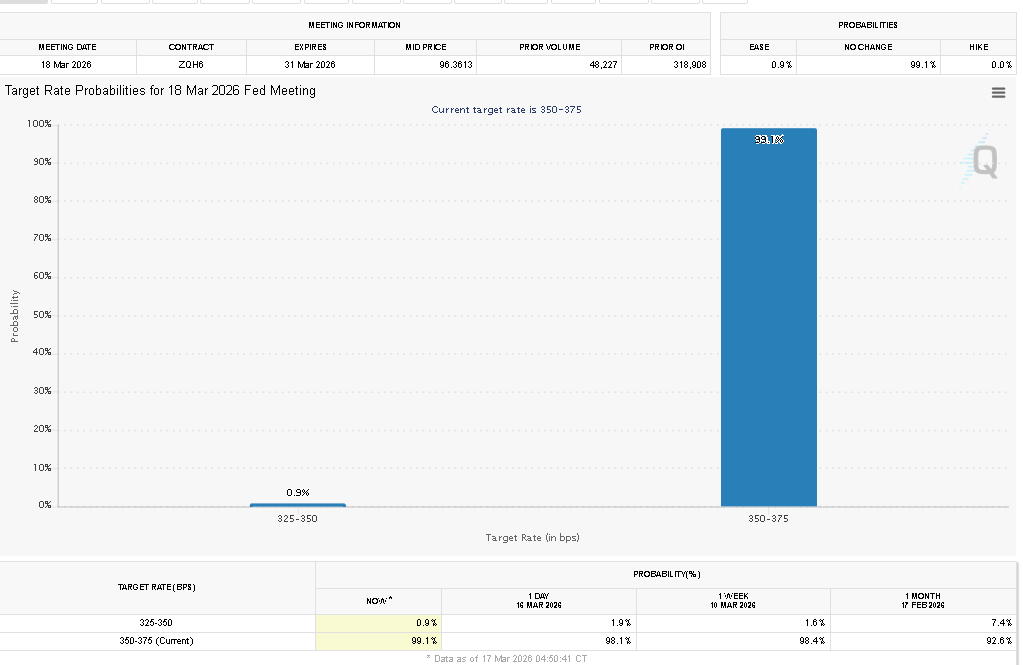
(Source –CME FedWatch)
Three distinct scenarios face the market. In a hawkish scenario, the Fed emphasises persistent service inflation and delays projected cuts, effectively tightening liquidity conditions and strengthening the US Dollar Index (DXY). In a neutral scenario, rates are held steady with balanced language, likely keeping Bitcoin range-bound. In a dovish scenario, acknowledgement of banking-sector stress or progress toward disinflation could signal the start of a liquidity-injection cycle. According to CME FedWatch data, markets are currently split on the timing of the next cut, making the dot-plot forward guidance the decisive factor for capital allocation.
This macro-transmission mechanism sets the stage for a volatile technical resolution, with volatility compression reaching historical extremes.
Bollinger Band Width Signals Volatility Expansion: The $55K–$170K Range
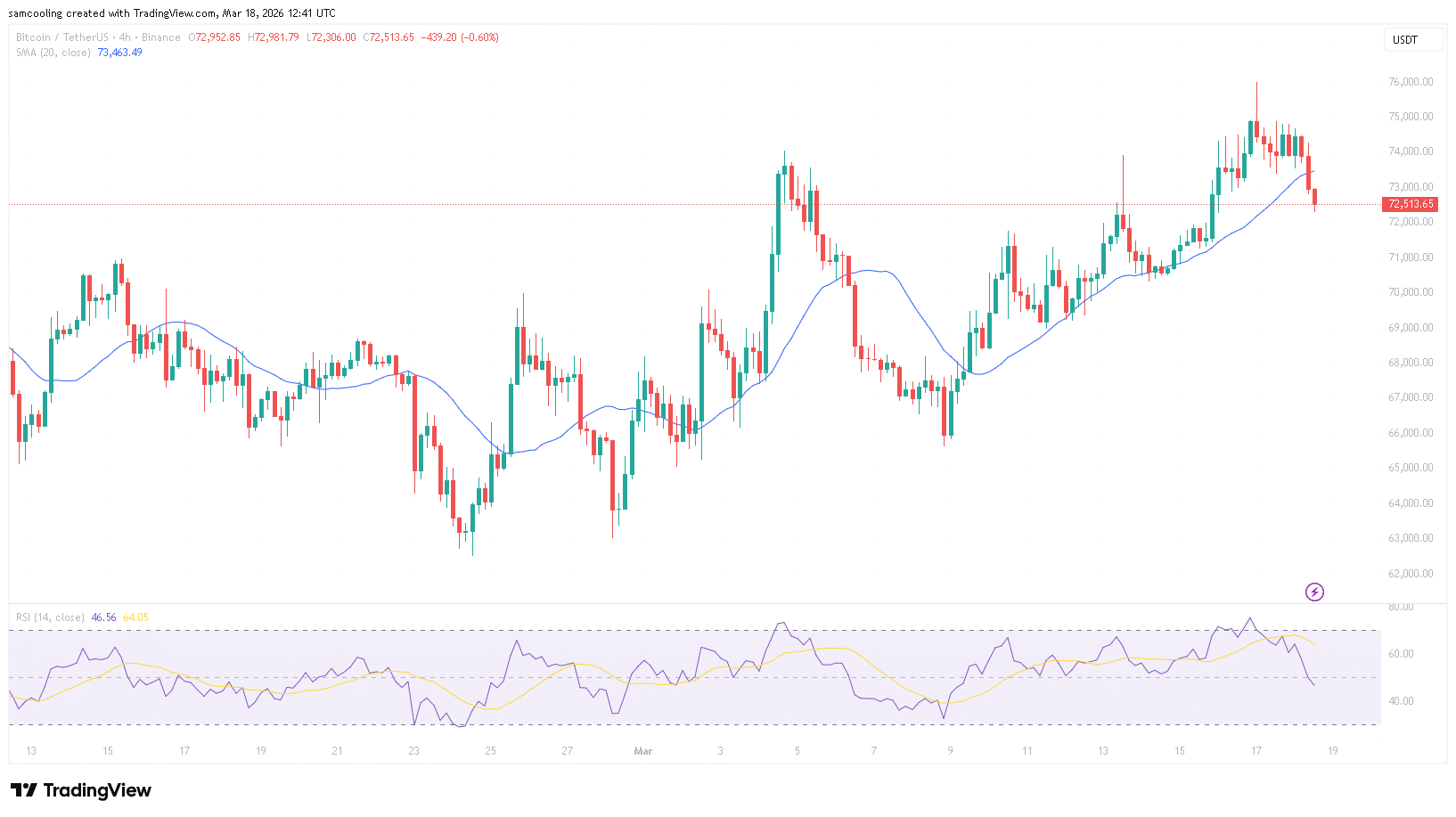
The technical structure for Bitcoin price is currently defined by a historic compression in Bollinger Band width, a phenomenon known as a “squeeze” that typically precedes significant price expansion. Analysts note that the current consolidation has coiled price action tightly around the 20-day moving average, creating a dormant volatility setup that demands a release. Based on historical data, periods of such low volatility often resolve in moves exceeding 20-30% in either direction.
(Source – BTC USD, TradingView)
Mapping this technical setup against the FOMC backdrop reveals distinct price targets. In a bearish outcome driven by hawkish policy, a failure to hold the mid-band would target the lower Bollinger Band, which aligns structurally with the $55,000 support zone. Conversely, a bullish resolution would see price “walking the bands” upward. If volatility expands to the upside, Fibonacci extension levels derived from the current consolidation pattern project a long-term Bitcoin price prediction target as high as $170,000. The immediate confirmation level for traders remains the upper band resistance near $78,000; a daily close above this level confirms the breakout thesis.
Hawkish FOMC: The Path to $55,000 and Lower Band Support
A hawkish outcome would likely manifest as the Fed holding rates steady while revising the “dot plot” to show fewer cuts in 2026 than previously anticipated. Specifically, if Chair Powell cites elevated core PCE numbers or tight labor market conditions as justification for a “higher for longer” stance, the immediate reaction would likely be a spike in the 10-year Treasury yield. This repricing would drain liquidity from risk assets, effectively forcing Bitcoin to test lower support levels.
Technically, this scenario triggers a rejection at the Bollinger Band basis. If Bitcoin loses the psychological $70,000 handle on closing volume, the path of least resistance shifts toward the lower band extremities. Analysts identify the $55,000 region as the critical structural floor—a level that represents a full retracement of the recent pre-FOMC speculative rally. Confirmation of this bearish trend would be a spike in the DXY above 104, inversely correlating with a breakdown in crypto assets. The invalidation for this bearish thesis would be a rapid reclamation of the $72,000 level immediately following the press conference.
Dovish Signal or Volatility Breakout: The Case for $170,000
The bullish case for a volatility breakout rests on the Federal Reserve signaling a dovish pivot, potentially by acknowledging risks to financial stability or softening its inflation language. Such a signal would likely compress real yields, driving capital into hard assets as a hedge against monetary debasement. Under this scenario, the inverse correlation with the dollar acts as a tailwind, effectively unlocking the liquidity needed to sustain a push toward new all-time highs.
From a technical perspective, a dovish catalyst would likely force a decisive close above the upper Bollinger Band, currently constraining price near $78,000. Phemex analysis suggests that a breakout here, accompanied by significant spot volume, opens the door to price discovery. The measured move from this multi-month consolidation, when extrapolated via Fibonacci extensions, places the cycle peak target near $170,000. Intermediate resistance lies at the psychological $100,000 level, where significant sell-side liquidity is likely clustered. For this scenario to remain valid, Bitcoin must maintain support above $74,000 throughout the initial volatility event.
FOMC Institutional Flow Implications: ETF Positioning and Volatility Pricing
Institutional positioning ahead of the decision suggests smart money is hedging against extreme variance rather than betting on a single direction. Recent data indicates that spot Bitcoin ETFs, including key products from BlackRock and Fidelity, have seen mixed flows, with a notable accumulation trend from whales, evidenced by a recent transfer of over 1,900 BTC from exchanges. However, the options market tells a more cautious story; implied volatility is elevated, indicating that traders are paying a premium to protect against outsized moves.
This positioning structure implies that a “sell-the-news” event is less likely, given the existing caution. Instead, the market is primed for a “volatility crush” if the Fed delivers a neutral verdict, or a directional squeeze if a surprise occurs. If the FOMC decision aligns with the consensus of a hold without hawkish rhetoric, the probability of a grind higher increases, as hedged positions are unwound. Conversely, a surprise rate adjustment would catch a significant portion of the market offside, fueling the volatility breakout described in the technical setups.
Until the Federal Reserve clarifies its stance via the Statement of Economic Projections, the probability of range-bound volatility remains elevated, effectively capping Bitcoin’s immediate upside near resistance levels. Traders will be scrutinizing the specific language regarding the timeline for future rate cuts; any deviation from the expected mid-year timeline will likely serve as the catalyst that resolves the current Bollinger Band squeeze into a directional trend.


