


Morgan Stanley filed its second amendment to an S-1 registration statement with the SEC on March 18, 2026 - a move that marks a decisive shift for the bank from merely distributing third-party crypto products to becoming a direct issuer in its own right.
Key Takeaways
Morgan Stanley filed its second S-1 amendment for a spot Bitcoin ETF on March 18, 2026, moving from distributor to direct issuer
The fund will use Coinbase Custody for Bitcoin storage and BNY Mellon for cash administration
The bank is simultaneously pursuing Ethereum and Solana ETFs, the latter including a staking component
Over 126 crypto ETF applications are pending with the SEC, with XRP and Solana approvals widely expected by late 2026
The updated filing covers the Morgan Stanley Bitcoin Trust, set to trade under the ticker MSBT on NYSE Arca. It is the most detailed version of the document to date, confirming key operational decisions that had previously been left open. Shares will be priced daily using the CoinDesk Bitcoin Benchmark, specifically the 4:00 PM New York settlement rate, which pulls aggregated trade data from major spot exchanges.
On custody, the bank has split responsibilities between two institutions. Coinbase Custody will handle the physical Bitcoin, stored in offline cold storage. Bank of New York Mellon takes on the role of cash custodian, administrator, and transfer agent. The fund will support both cash and in-kind Bitcoin creations and redemptions – a structure aimed squarely at institutional authorized participants.
The timing was not incidental. The filing landed on the same day as the Morgan Stanley European Financials Conference, where Co-President Dan Simkowitz publicly highlighted the bank’s push toward integrated wealth management strategies.
The financial logic behind the move is straightforward. By issuing its own ETF rather than routing clients into BlackRock’s IBIT or similar products, Morgan Stanley captures management fees rather than commissions. Analysts estimate the fund’s expense ratio will land somewhere between 0.20% and 0.30% to stay competitive. The bank’s 15,000-plus financial advisors have reportedly been cleared since early 2026 to proactively recommend Bitcoin ETFs to clients – a significant unlock given the firm manages roughly $1.8 trillion in wealth management assets.
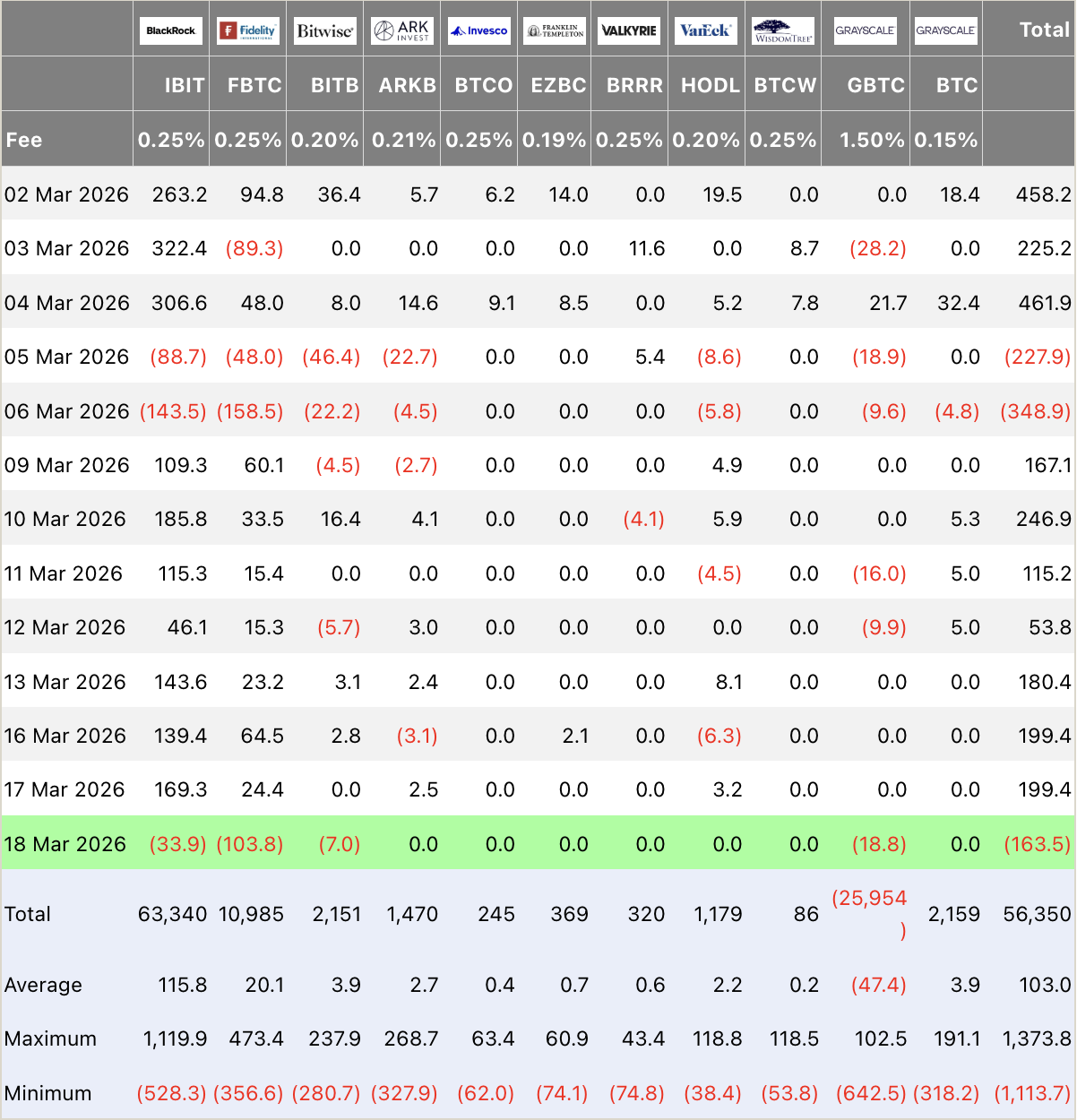
Crypto markets took another hit on March 18, with spot Bitcoin ETFs recording net outflows of roughly $129.6 million, according to data from Farside Investors – a signal that institutional appetite is cooling alongside broader price weakness. The bulk of the damage came from BlackRock’s IBIT, which shed more than $100 million in a single session. Fidelity and Bitwise products also saw withdrawals, though on a smaller scale. According to data from Farside Investors, the outflow day adds to a pattern of softening demand that has tracked closely with Bitcoin’s recent slide toward and briefly below the $70,000 mark.
Ethereum and Solana Are Next on Morgan Stanley’s List
Morgan Stanley has also submitted applications for a spot Ethereum ETF and a Solana Trust, as reported by TheBlock – both filed in early January 2026 – signaling that the bank is building toward a multi-asset digital strategy rather than a single-product experiment.
The Morgan Stanley Solana Trust, filed January 6, is designed as a passive vehicle tracking SOL token performance. Its distinguishing feature is a staking component: the fund intends to stake a portion of its holdings through third-party providers, with rewards added to net asset value and distributed to shareholders at least quarterly. The filing followed the SEC’s broader approval of listing rules for spot altcoin ETFs in late 2025.
The Ethereum Trust, filed a day later on January 7, follows a similar structure. It will hold physical Ether directly and plans to engage in staking to generate additional yield – a meaningful differentiator from earlier spot Ethereum products that launched without staking features. Daily valuations will be calculated using a benchmark derived from major trading venues.
Together, the three filings position Morgan Stanley as one of the more aggressive traditional finance entrants into the digital asset space.
Wall Street’s ETF Pipeline Is Running Deep
Morgan Stanley is not operating in a vacuum. The SEC is currently sitting on a backlog of more than 126 pending crypto ETF applications as of March 2026, with traditional financial institutions making up a growing share of the queue.
Goldman Sachs moved decisively in late 2025, acquiring Bitcoin ETF issuer Innovator for $2 billion to establish a direct market presence. The bank now holds $2.4 billion in crypto exchange-traded products, including positions in XRP and Solana funds. Fidelity, already established with its Wise Origin Bitcoin Fund, amended its spot Ethereum application in March 2026 to add staking provisions. Merrill Lynch cleared its wealth management advisors to actively recommend spot Bitcoin ETFs to clients as of January 2026. JPMorgan, while more cautious on issuance, has analysts projecting 2026 as the year pension funds and endowments drive upward of $130 billion in annual inflows into regulated crypto products.
On the altcoin side, several approvals are expected before year-end. Eight XRP ETF applications are currently pending – analysts estimate that approval alone could trigger between $5 billion and $7 billion in immediate capital movement. Solana ETFs are already trading: Bitwise’s staking-enabled BSOL debuted on NYSE Arca earlier this year with $56 million in first-day volume. Cardano is under review as part of what some in the industry are calling the 2026 “blue-chip” altcoin expansion. Litecoin cleared the process in early 2026 following a commodity classification ruling. Grayscale and Trump Media & Technology Group have also floated a multi-asset “Crypto Blue Chip ETF” proposal seeking exposure to BTC, ETH, SOL, and XRP in a single wrapper.
What This Means Going Forward
Morgan Stanley’s second amendment is procedural on the surface, but the direction it signals is anything but routine. A major wirehouse bank moving from crypto-curious to crypto-issuer represents a structural shift in how regulated financial institutions are approaching digital assets – not as a fringe allocation but as a product category worth owning end-to-end.
The months ahead will test whether the SEC can process its backlog at the pace the market is anticipating. If XRP and additional altcoin approvals materialize on the expected timeline, 2026 is shaping up as the year institutional crypto infrastructure catches up to institutional crypto interest.
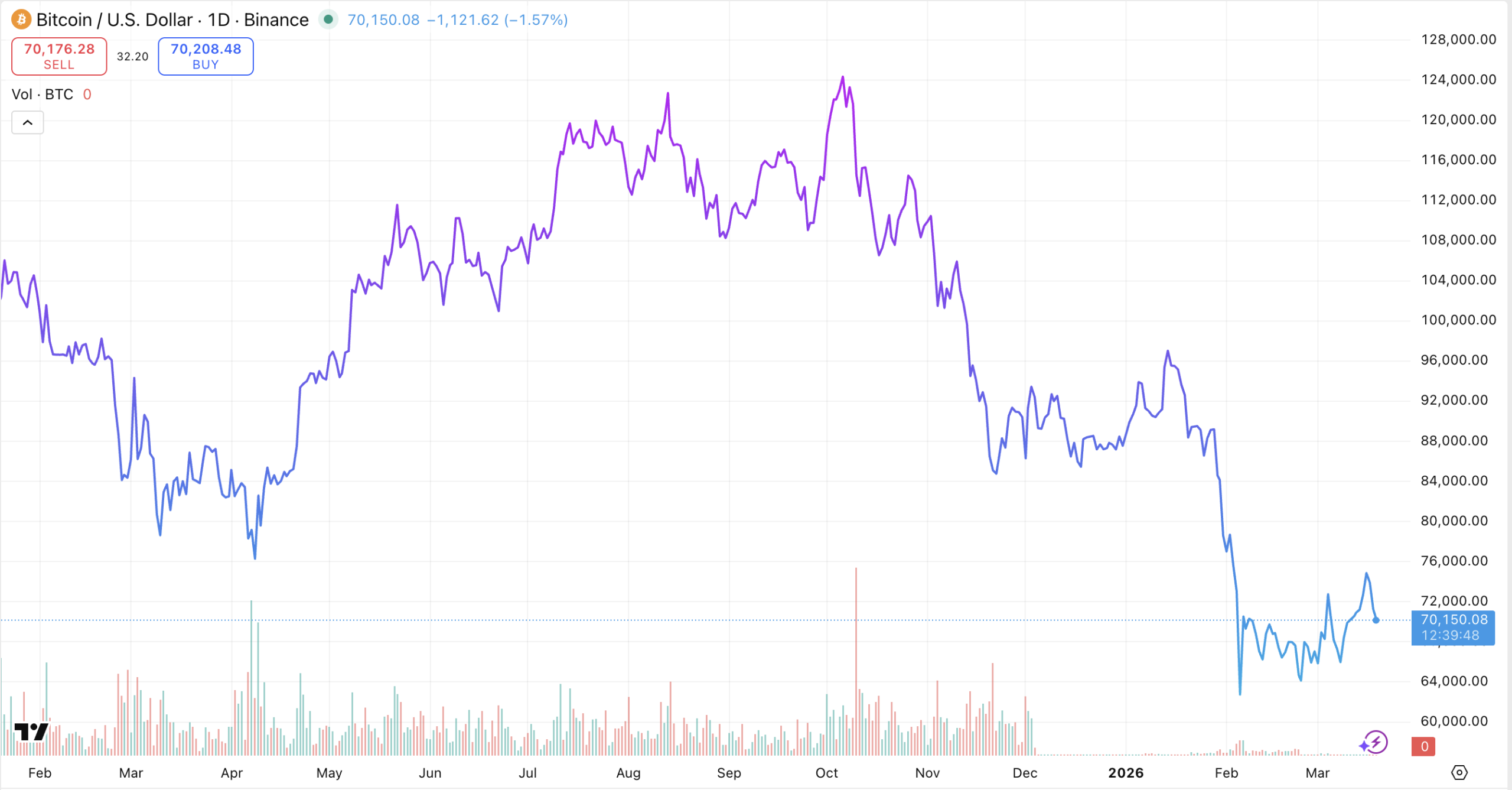
Bitcoin is currently trading just above $70,000, having briefly slipped below that level in the past 24 hours before recovering. The dip represented a roughly 5% decline, though the asset has since clawed back to hold the threshold – a level many traders consider psychologically significant.


