


Something is quietly breaking in Bitcoin's mining sector, and most retail investors aren't watching closely enough.
Key Takeaways
Bitcoin miner revenue collapsed to ~$30M/day in mid-March, down from $60M+ at peak
Hash rate is weakening after a post-halving high near 120K TH/s – a classic capitulation signal
Over 57% of network hash rate comes from unknown/unidentified pools, raising concentration concerns
BTC is trading around $69,944 – down 1.59% on the week – as mining stress adds sell pressure
Analyst Joao Wedson flagged it bluntly: “Are Bitcoin miners on vacation?” The question is rhetorical. What’s actually happening is more serious – a slow-motion capitulation that’s been building since early 2025 and is now showing up clearly in on-chain data.
Back in January, Wedson had already warned that mining hadn’t capitulated yet. Shortly after, Bitcoin dropped from roughly $96K to near $60K. Hash rate recovered briefly – then started weakening again. The pattern is familiar to anyone who’s tracked mining cycles: when margins compress, the weakest operations go dark first.
Are Bitcoin miners on vacation?
Back in January, I pointed out that Bitcoin mining had not yet capitulated.
Shortly after, price dropped from ~$96K to near $60K.
Hash Rate recovered slightly, but is now weakening again.In other words, the mining sector is losing momentum, and… https://t.co/DYE0DqR22k pic.twitter.com/udVcxYb4So
— Joao Wedson (@joao_wedson) March 20, 2026
What the On-Chain Data Actually Shows
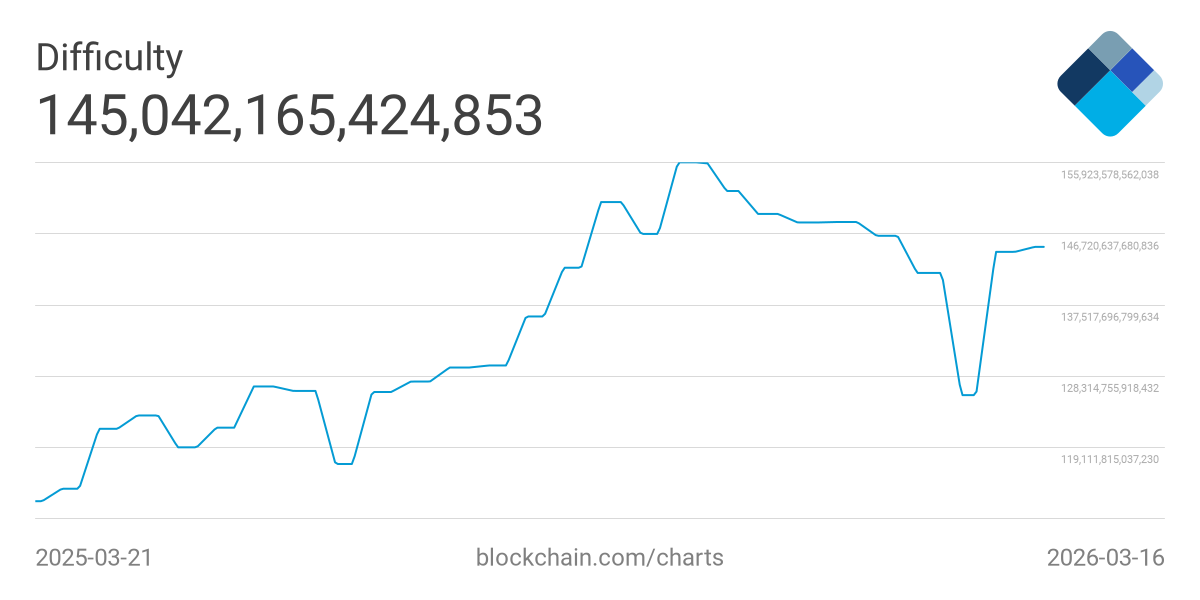
The Blockchain.com data confirms what Wedson is describing. Total network hash rate climbed aggressively through mid-2025, peaking near 120,000 TH/s around October before beginning a choppy decline. By early 2026, it had shed meaningful ground. Network difficulty – which adjusts to reflect real computational power – tells the same story, sitting at approximately 145 trillion as of March 16, while Bitcoin’s market price hovered just under $70K on the same date.
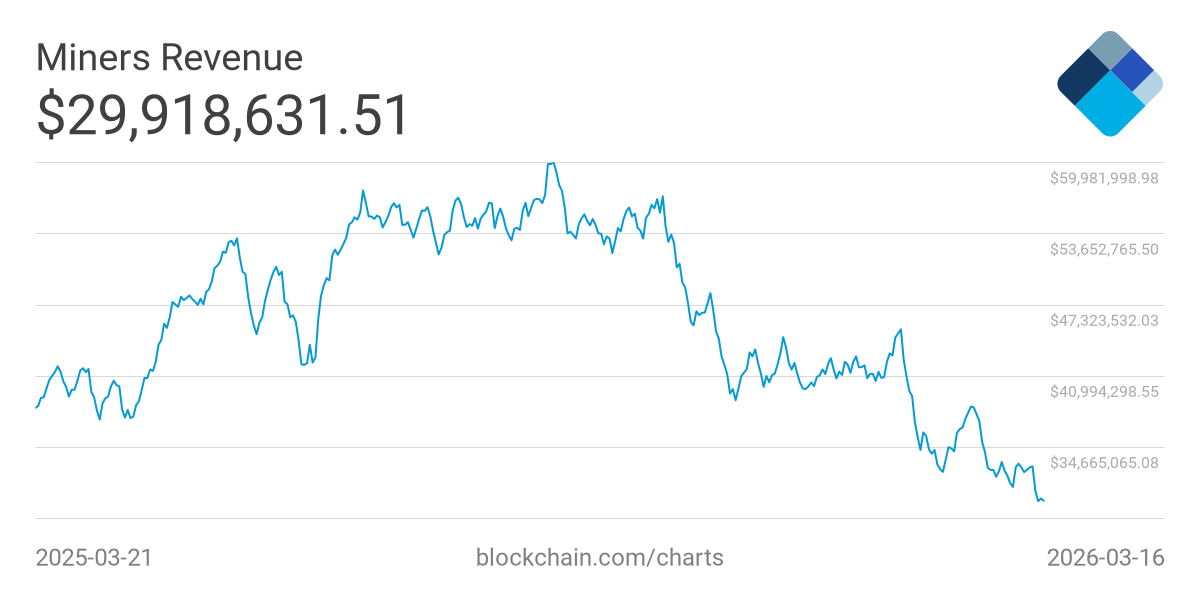
Miner revenue is where the pain becomes undeniable. At the bull market peak, miners collectively pulled in over $60 million per day. By March 16, that figure had dropped to roughly $29.9 million – less than half.
This isn’t a minor fluctuation. It’s the kind of revenue compression that forces operational decisions: cut power consumption, sell BTC reserves, or shut down rigs entirely.
Two Paths Out – Neither Is Easy
Wedson outlines two realistic paths forward for the sector. The first is hardware innovation – new ASIC architectures that deliver better efficiency. The problem, as he notes, is that most major mining companies made their heavy capital investments between 2023 and 2024. Another full upgrade cycle in the short term is financially impractical for most players.
The second path is consolidation through attrition. Smaller miners with tighter margins get squeezed out, hash rate contracts further, and larger operations absorb what’s left. This is how mining cycles have historically resolved – not cleanly, and not quickly.
The hashrate distribution chart adds another layer worth noting. Over the 6-month window, roughly 57% of blocks were mined by pools listed simply as “Unknown.” AntPool accounts for around 18%, F2Pool and ViaBTC trail behind. That level of anonymized mining concentration is a structural issue that rarely gets discussed outside technical circles, but it matters for network transparency and censorship-resistance assumptions.
Sell Pressure Is Already Here
The broader market implication, which Wedson raises directly, is that mining capitulation tends to increase BTC selling pressure. Miners who are underwater on operational costs don’t hold – they liquidate. That dynamic is already in play. Bitcoin is sitting at $69,944 at the time of writing, down 0.75% in 24 hours and 1.59% over the past week, with a market cap just under $1.4 trillion.
None of this means a crash is imminent. As Wedson points out, miners are among the toughest participants in this ecosystem – conditioned to survive 70-80% drawdowns over multi-year bear cycles. But the signals coming out of the mining sector right now are stress signals, and they deserve more attention than they’re getting from analysts focused purely on price action.
The mining industry has always been a leading indicator, not a lagging one. Those who ignored it throughout 2025 have already paid for that oversight.
Despite this the current situation in the crypto market does not look optimistic. Although Bitcoin’s price has been relatively stable, the macro conditions currently do not favor risk assets. Without fresh investments, the miners will continue to have a difficult time. Many analysts believe that 2026 we will see a major crypto rebound, but for now, with the geopolitical tensions and rising inflation concerns, the future seems too unpredictable.


