


Fresh data highlights widening gap across digital asset flows as investors rotate within crypto exposure.
Key Takeaways
Bitcoin ETFs recorded a net inflow of $167 million on March 23, led by BlackRock and Fidelity.
Ethereum ETFs posted continued net outflows, extending a multi-week pattern of weak demand.
Solana ETF flows remained muted, while XRP products saw no meaningful activity.
Diverging flows signal selective institutional positioning rather than broad crypto accumulation.
Bitcoin Draws Fresh Capital As Flows Rebound
According to data from Farside Investors spot exchange-traded funds saw net inflows of about $167 million on March 23, according to compiled data from major issuers, indicating a strengthening of institutional demand for Bitcoin at the beginning of the week.
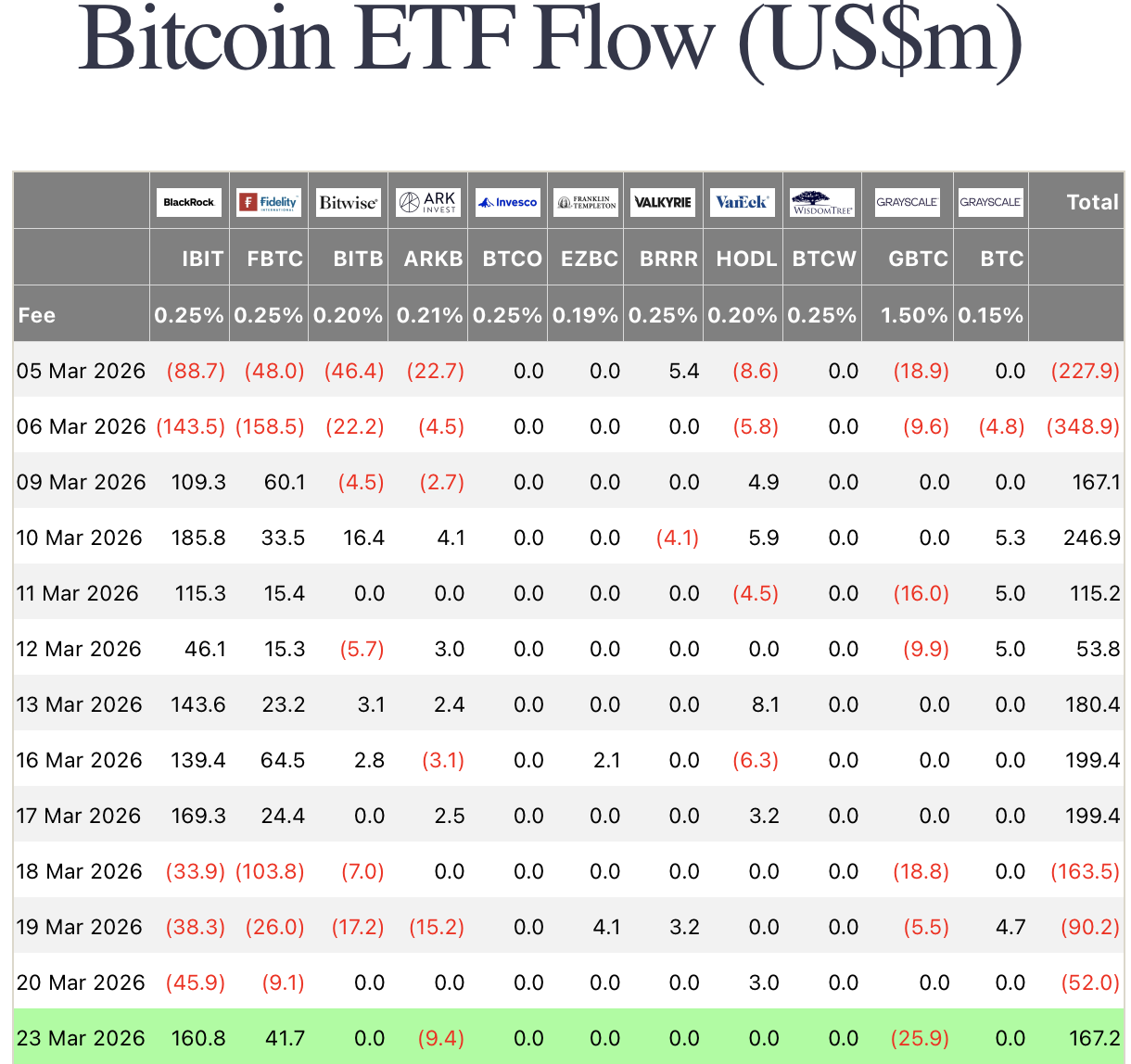
BlackRock’s IBIT, which received $160.8 million, and Fidelity’s FBTC, which received $41.7 million, received the majority of the inflows. Outflows from Grayscale’s GBTC, which lost $25.9 million and continued its ongoing trend of capital leakage, somewhat offset these gains.
In contrast to the previous week, when a number of sessions saw net outflows, the data indicates a return to investor confidence in Bitcoin as the main institutional allocation among digital assets.
Other issuers, including Bitwise, ARK Invest and Invesco, recorded relatively muted activity, underscoring the concentration of flows among a small number of dominant products.
Bitcoin’s price rebound near the $71,000 level after Trump posted on his social media for productive talks with Iran seems to be good news for the institutional investors resulting on the positive net flows in the BTC ETFs. More positivity comes from the steady accumulation from Strategy, marking 104 consecutive buys and lifting the total holdings above 762,000 BTC.
Despite the market optimism, Peter Schiff – a well known Bitcoin critic, forecasts again that BTC will crash. He expects that once the leading cryptocurrency breaks bellow $50,000, the meltdown will continue to $10,000. In that case he states, that Michael Saylor’s Strategy will go bust.
? PETER SCHIFF SAYS BITCOIN $BTC WILL CRASH TO $10,000 VERY SOON
"STRATEGY WILL BE FORCED TO LIQUDIATE ALL OF THEIR $BTC AND CRASH"
"MICHAEL SAYLOR WILL GO OUT OF BUSINESS" pic.twitter.com/uA4wZMBIMY
— BlockNews (@blocknewsdotcom) March 23, 2026
Ethereum ETF Outflows Extend Despite Broader Market Stability
Data shows net outflows of approximately $16.2 million on March 23, extending a pattern of inconsistent and often negative flows throughout March. Losses were driven primarily by BlackRock’s ETHA and Fidelity’s FETH, both of which recorded outflows on the day.
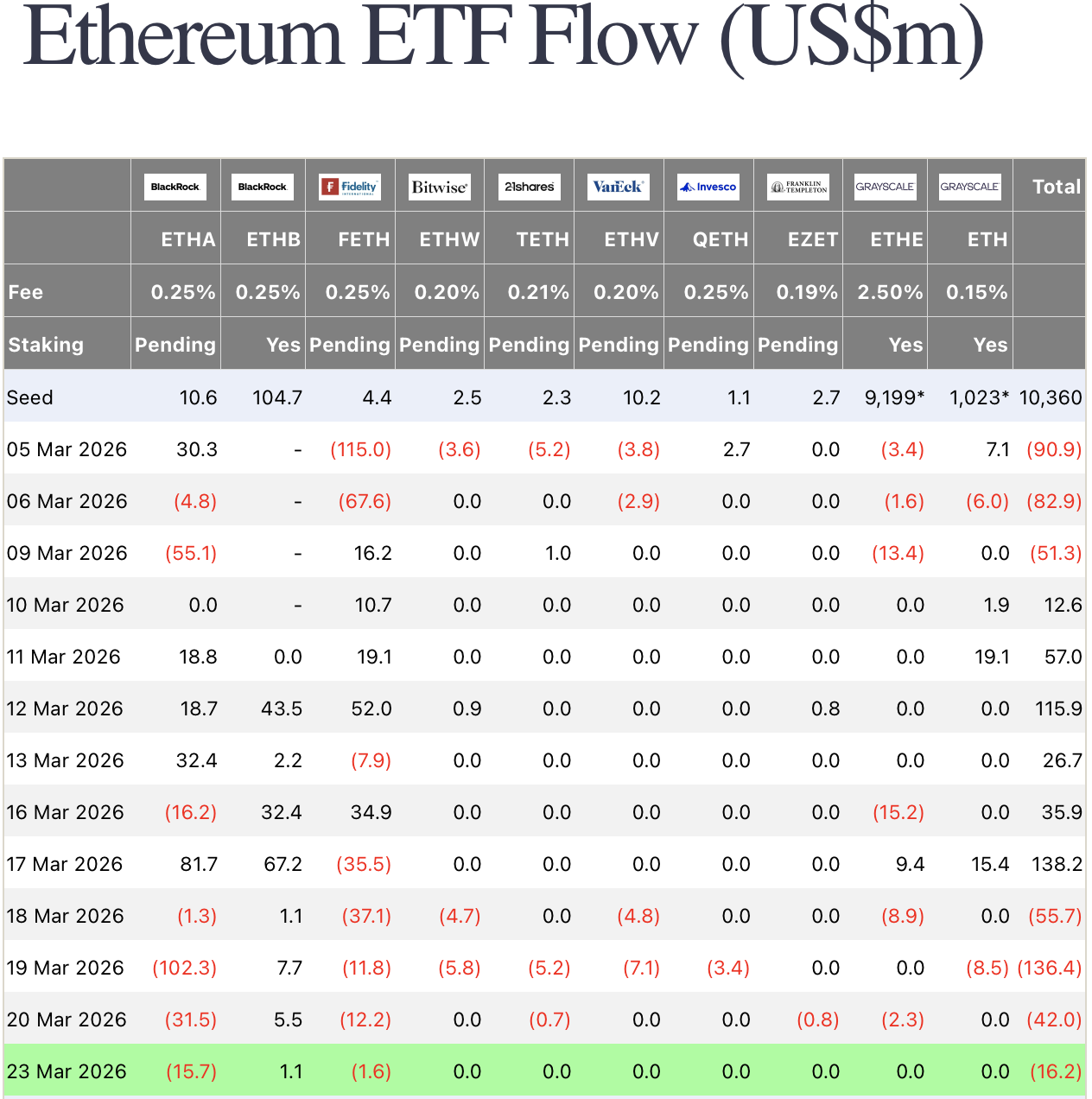
The divergence between the flows of Ethereum and Bitcoin indicates a change in investor preferences, with money moving toward assets that are thought to be more liquid or established in uncertain times.
It also shows a structural variation in placement. Although most people consider Bitcoin to be a macro asset and store of value, Ethereum’s investment case is still more directly related to network activity, staking yields, and the wider use of decentralized applications.
Ethereum ETFs have substantial seeded capital despite the recent decline, indicating that institutional exposure is unaffected even as incremental demand wanes.
Altcoin ETF Activity is still muted
On March 23, there were no net inflows for Solana-based products after multiple sessions of low and erratic activity.
Although there were brief periods of positive flows earlier in the month, the momentum has since diminished, suggesting that investors are being cautious.
Similarly, according to data from Coinglass there were no net inflows for XRP-linked products, and the day’s activity was essentially flat across major issuers.
It appears that institutional investors are not generally increasing their exposure across the digital asset spectrum based on the lack of movement across altcoin ETFs. Rather, capital allocation seems to be very selective, giving preference to assets with greater liquidity and more transparent market narratives.
Institutional Strategy is Defined by Selective Rotation
The divergence in ETF flows points to a more nuanced phase of institutional participation in crypto markets.
Investors are increasingly switching between assets based on perceived risk, liquidity, and macro positioning rather than expanding their exposure uniformly.
Bitcoin’s position as the anchor asset for institutional portfolios is strengthened by its steady inflows. Ethereum seems to be going through a phase of consolidation in terms of new capital allocation, even though it is still essential to the ecosystem.
As for altcoins, there is little proof of consistent demand through ETF structures, so they continue to be on the periphery of institutional strategies.
This selective approach reflects a maturing market, where capital is deployed with greater precision rather than broad-based enthusiasm.
The Path Ahead
The state of the market and changing perceptions of each asset class will determine whether the current divergence continues.
Bitcoin might continue to be the most well-known and liquid digital asset if macro uncertainty persists. On the other hand, staking-driven returns or an increase in network activity might rekindle interest in Ethereum.
As of right now, the data points to a distinct hierarchy in institutional preferences that is influencing the movement of capital throughout the landscape of digital assets.
It is clear that ETF flows for now are no longer coordinated. Rather, they are exposing a market that is becoming more and more distinct, where the choice of assets is just as important as total exposure.


