

Robinhood Markets (HOOD) has authorized a massive $1.5 billion share buyback program, yet the stock tumbled to a 2026 low of $69.08 on Tuesday. The trading platform, often viewed as a proxy for retail risk appetite, shed 4.7% in a single trading session amid intensifying geopolitical headwinds.
While the board’s approval of the buyback—intended to roll out over three years—signals internal confidence, the immediate market response has been decidedly bearish.
According to the SEC filing, the program includes $1.1 billion in new capacity. “Robinhood is a generational company with a massive long-term opportunity,” stated CFO Shiv Verma, emphasizing the goal of returning value to shareholders.
However, the stock remains approximately 54% below its October highs, suggesting that investors are currently prioritizing macro risks over corporate buyback incentives. This divergence signals a potential capitulation phase for tech-aligned equities.
Can Robinhood HOOD Hold the $68 Support Level with Buyback?
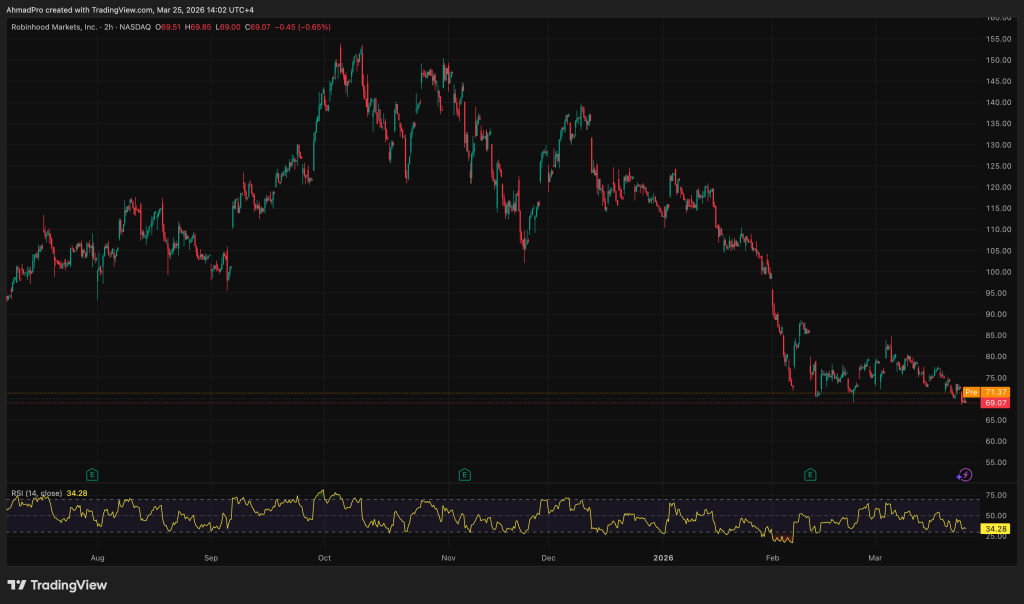
The technical structure for Robinhood has deteriorated rapidly over the last week. After failing to sustain highs near $77.35 in mid-March, the stock has surrendered approximately 7.8% of its value. T
uesday’s close at $69.08 was accompanied by heavy volume of 28.2 million shares, indicating significant selling pressure rather than a simple retail pullback. Institutional distribution appears evident as the price slices through previous consolidation zones.
(Source: TradingView)
Technical data from market trackers highlights $68.58 as the critical support line. A daily close below this level could open the door to further downside, potentially testing lower liquidity zones. Conversely, bulls need to reclaim $71.84 to stabilize the chart.
With the price hovering in this precarious $68.58-$72.97 range, the $1.5 billion buyback news has notably failed to trigger the short-squeeze many traders anticipated. Analysts note that with a P/E ratio still fluctuating between 35 and 49, valuation concerns persist despite the price drop.
Crypto Correlations and Market Strategy
The disparity between Robinhood’s corporate optimism and its falling stock price serves as a stark reminder of current market fragility. When a major fintech player struggles amid a broad downturn despite announcing significant capital returns, it often points to deeper systemic caution.
Corporate finance strategies are currently battling against a risk-off macro tide that is punishing high-growth tech stocks.
This decoupling effect leads veteran traders to look beyond equity proxies. While stocks like HOOD face headwinds, the underlying crypto assets they facilitate often move independently.
Investors seeking to hedge against this tech-sector weakness are increasingly researching the best cryptocurrencies to buy amid stock crashes.
??CLARITY ACT: ROBINHOOD CEO SAYS PRIORITY IS VALUE AND SAFETY
Robinhood CEO Vlad Tenev (@Vladtenev) is urging Congress to pass the CLARITY Act, declaring that Value and safety are key to determining stablecoin yields.
Tenev calls for regulatory clarity that lets stablecoins… pic.twitter.com/yEmi2c4u35
— BSCN (@BSCNews) March 21, 2026
Owning the asset directly, rather than the exchange equity, remains a favored strategy during periods of geopolitical instability. For those watching the charts, the focus remains strictly on HOOD’s ability to hold $68—a failure there could signal a broader exit from retail-favored equities.


