


The wall between traditional finance and blockchain is coming down - and Franklin Templeton, managing $1.7 trillion in assets, just announced a major move, while tokenized stock AUM hits $951 million.
Key Takeaways
Franklin Templeton and Ondo Finance are bringing five ETFs on-chain – launching outside the U.S. first, pending SEC clarity.
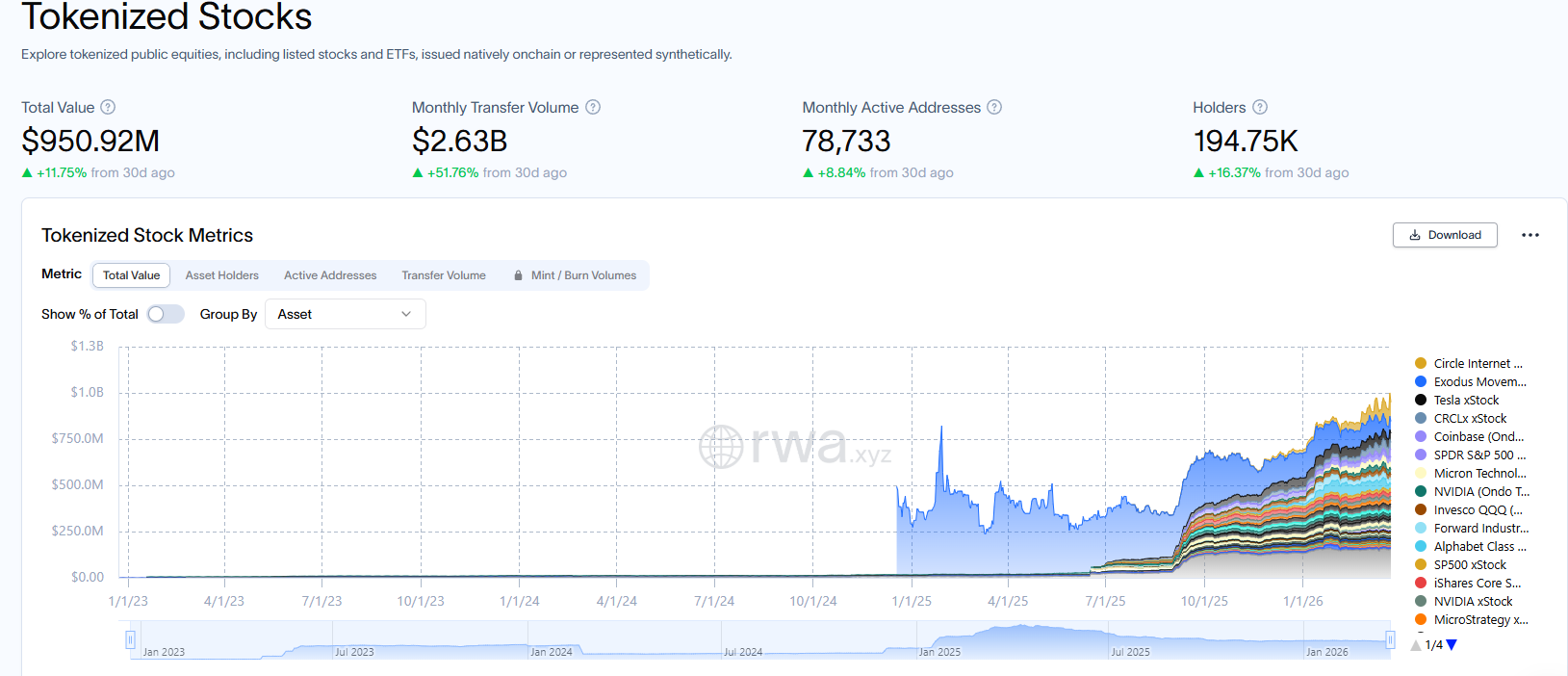
Tokenized stocks hit ~$951M total value, up 11.75% in 30 days, with monthly transfer volume surging past $2.6B.
The broader tokenized Treasury market has grown from under $1B in early 2024 to over $11B by March 2026.
Ondo’s ecosystem now spans 250+ assets, with integrations across MetaMask, Binance, Bitget, and 30 EEA countries.
Franklin Templeton, the $1.7 trillion asset manager, has partnered with Ondo Finance to put five of its ETFs on public blockchains. The funds span U.S. equities, large-cap multifactor exposure, responsibly sourced gold, high-yield corporate debt, and income equity. Holders won’t own the underlying shares directly – instead, Ondo structures the exposure through a Special Purpose Vehicle that acquires the ETF shares and issues blockchain tokens representing rights to the return stream. Every token is backed 1:1 by securities held at U.S.-registered broker-dealers. Dividends reinvest automatically.
We’re excited to announce that Ondo has partnered with Franklin Templeton (@FTDA_US), one of the world’s largest asset managers with $1.7T AUM.
Together, we’re bringing exposure to Franklin Templeton-managed investment products onchain through Ondo Global Markets. pic.twitter.com/vY2AqbiMm7
— Ondo Finance (@OndoFinance) March 25, 2026
The practical upshot is that these products can be traded 24/7, directly from a crypto wallet, without going through a traditional brokerage account. That’s the pitch to a crypto-native audience that doesn’t want to touch legacy financial infrastructure – and Franklin Templeton’s head of innovation, Sandy Kaul, has been upfront that this is partly a test to see how much demand actually exists for that use case.
The initial rollout targets Europe, Asia-Pacific, the Middle East, and Latin America. A U.S. launch isn’t imminent. The sticking point is regulatory: Franklin Templeton’s funds are registered under the Investment Company Act of 1940, while Ondo typically operates under Regulation D exemptions. That mismatch creates real friction around how these products can be marketed to retail investors domestically. The SEC closed a multi-year investigation into Ondo without charges in late 2025, but the broader question of how third-party DeFi platforms can legally distribute registered funds on-chain remains unresolved.
The Infrastructure Build-Out
What separates this cycle from earlier tokenization experiments is the collateral use case. These tokens aren’t just for holding – they’re being plugged into DeFi lending markets. Euler Finance has already gone live with lending against Ondo’s tokenized assets, letting users borrow stablecoins using these securities as collateral. Aave’s Horizon, the protocol’s institutional-facing layer, is being positioned as a framework for regulated counterparties to interact with tokenized assets without the compliance exposure of permissionless pools. On Solana, Ondo’s assets are available through Jupiter for trading and DeFi integration, with Chainlink providing the institutional-grade price oracles that make safe liquidation management possible.
That last piece matters more than it might appear. Pricing oracle quality has historically been a weak point for DeFi protocols accepting real-world assets as collateral. Chainlink’s involvement is a direct answer to that concern.
The Broader Race
Franklin Templeton isn’t alone here – it’s not even the first mover. BlackRock’s BUIDL fund, launched in March 2024, is sitting at roughly $2.85 billion in assets across Ethereum, Solana, and Avalanche. JPMorgan launched its own on-chain money market fund late last year, seeded at $100 million for qualified institutional investors. Fidelity’s tokenized Treasury product crossed $250 million. WisdomTree ended 2025 with $770 million across 15 tokenized funds.
The tokenized Treasury market alone went from under $1 billion in early 2024 to over $11 billion by March 2026. McKinsey and BCG analysts have been projecting a trillion-dollar market cap as the infrastructure connecting traditional fixed income and commodities to blockchain rails matures. Institutional adoption is the variable that makes that credible – and at this point, the institutional adoption is happening.
JPMorgan’s Kinexys platform – rebranded from Onyx – now processes up to $2 billion daily in tokenized assets. State Street and Galaxy are set to launch a tokenized liquidity fund on Solana, with Ondo pledging $200 million as seed capital. Binance and Crypto.com have both started accepting BlackRock’s BUIDL as off-exchange collateral for derivatives trading, which is a different order of magnitude of integration than simply listing a token.
The tokenization market is growing at a rapid pace. According to data from RWA.xyz, total value locked in tokenized stocks just crossed $950 million, monthly transfer volume is sitting at $2.63 billion – up over 51% from a month ago – and the number of active addresses has climbed past 78,000. Whatever narrative said this space was niche is getting harder to hold.
Ondo’s Distribution Push
On Ondo’s side specifically, the pace of expansion has been notable. The platform has added more than 60 tokenized stocks and ETFs in recent months, pushing total listings past 250 assets. Bitget launched spot trading for Ondo’s tokenized stocks.
Binance integrated Ondo’s offerings through its Alpha program – effectively reviving tokenized stock access on the world’s largest exchange. MetaMask enabled eligible non-U.S. users to access Ondo assets directly from a mobile wallet. Blockchain.com secured regulatory passporting for Ondo to operate across 30 European Economic Area countries.
As of March 2026, Ondo manages approximately $2.7 billion in tokenized assets. That’s not a niche platform running a proof of concept anymore.
The infrastructure is being built. The institutional capital is moving. The regulatory gaps – particularly in the U.S. – are the remaining friction. But the direction of travel is clear enough that arguing about whether tokenized real-world assets are viable seems like last year’s debate.


