


Britain has moved to shut down one of the least regulated entry points for foreign money into its political system.
Key Takeaways
UK bans crypto donations to political parties.
The ban comes after Russia, China and Iran interference.
Reform UK is the primary party affected.
£100,000 annual cap on expat donations introduced.
US PREDICT Act targets congressional prediction market trading.
The decision lands at a moment when the threat is no longer theoretical, it has already produced a criminal conviction. The same day, across the Atlantic, the US Congress introduced its own bill targeting a different but structurally related problem at the intersection of political power and financial markets.
What the UK Ban Does
Prime Minister Keir Starmer announced an immediate moratorium on cryptocurrency donations to UK political parties during Prime Minister’s Questions on March 25. The ban applies to donations of any size, including those below the usual £500 reporting threshold that previously meant small crypto transfers went entirely unrecorded.
It is not a permanent ban. Philip Rycroft, the former senior civil servant who led the independent review that prompted the decision, was explicit in his report that the moratorium should be seen as an interlude rather than a prelude to an outright prohibition. According to Rycroft report, the intention is to pause crypto donations while regulators develop oversight frameworks robust enough to verify the origin of digital funds with the same rigour applied to conventional bank transfers.
The government is amending the Representation of the People Bill currently passing through Parliament to codify the change. Once passed, parties will have 30 days to return any crypto received since March 25 or face criminal penalties. Alongside the crypto ban, the government introduced a £100,000 annual cap on political donations from British citizens living abroad, replacing a system that previously allowed unlimited expat donations.
The Review That Made It Happen
The ban follows the publication of the Rycroft Review, commissioned in December 2025 after Reform UK’s former Wales leader Nathan Gill was convicted of accepting Russian bribes to make pro-Moscow statements while serving as a Member of the European Parliament. The conviction made the threat of foreign financial interference in British politics concrete rather than hypothetical.
Rycroft’s findings are direct. Foreign interference in British politics is “real and persistent.” Russia, China, and Iran are actively attempting to cause harm to UK democracy. The threat has become “arguably more acute” in recent years. Cryptocurrency, in this context, is not primarily a financial concern. It is a transparency concern. Digital assets can obscure the origin of funds in ways that bank transfers cannot. A donation arriving in Bitcoin from an anonymous wallet carries no account details, no jurisdiction, and no paper trail.
The Joint Committee on the National Security Strategy had already labeled crypto donations an “unacceptably high risk” in a warning issued the week before the ban, calling for exactly the moratorium Starmer subsequently announced.
Committee Chair Matt Western warned that the idea of politicians being bought by foreign money is “corrosive” to the entire political system.
The Political Fallout
The ban is not politically neutral and nobody in Westminster is pretending otherwise. Reform UK is the only major British party to have actively courted Bitcoin donations. Nigel Farage has previously called for a national Bitcoin reserve and described the currency as a “freedom currency.”
Reform received approximately £12 million in the past year from Christopher Harborne, a British businessman based in Thailand. That donation came under scrutiny after Farage publicly promoted Tether, the cryptocurrency company in which Harborne holds a significant stake, shortly after receiving the funds. The overseas donation cap compounds the financial pressure directly – Harborne’s £12 million donation would fall well outside the new £100,000 annual limit.
Starmer did not deliver the announcement neutrally. During Prime Minister’s Questions he said: “There is only one party leader who has shown he will say anything, no matter how divisive, if he is paid to do so.” Reform UK lawmakers walked out of the House of Commons chamber as he spoke. Deputy leader Richard Tice said the government was trying to “stop the incredible progress of Reform.”
Housing and Communities Secretary Steve Reed described the crypto ban as a “patriotic duty” and said it was “vital” to stop “malign and hostile actors” from stoking division. Liberal Democrat cabinet spokeswoman Lisa Smart called on Farage to return all crypto donations received from anonymous overseas sources, saying Reform “taking untraceable, secretive crypto donations to fund their Trump-style politics here in the UK should never have been allowed.”
Rycroft, when asked whether Reform UK felt targeted by his recommendations, said: “I wasn’t here to look out for the interests of any political party. I was here to look out for the interest of our democratic processes.”
The US Moves the Same Day
In the same week that Starmer announced the UK ban, Congressman Adrian Smith and Congresswoman Nikki Budzinski introduced the PREDICT Act in the US House of Representatives. The bipartisan bill could ban members of Congress, the president, the vice president, their spouses, dependent children, senior congressional staff, and political appointees from trading on prediction markets where outcomes are tied to political events, policy decisions, or government actions.
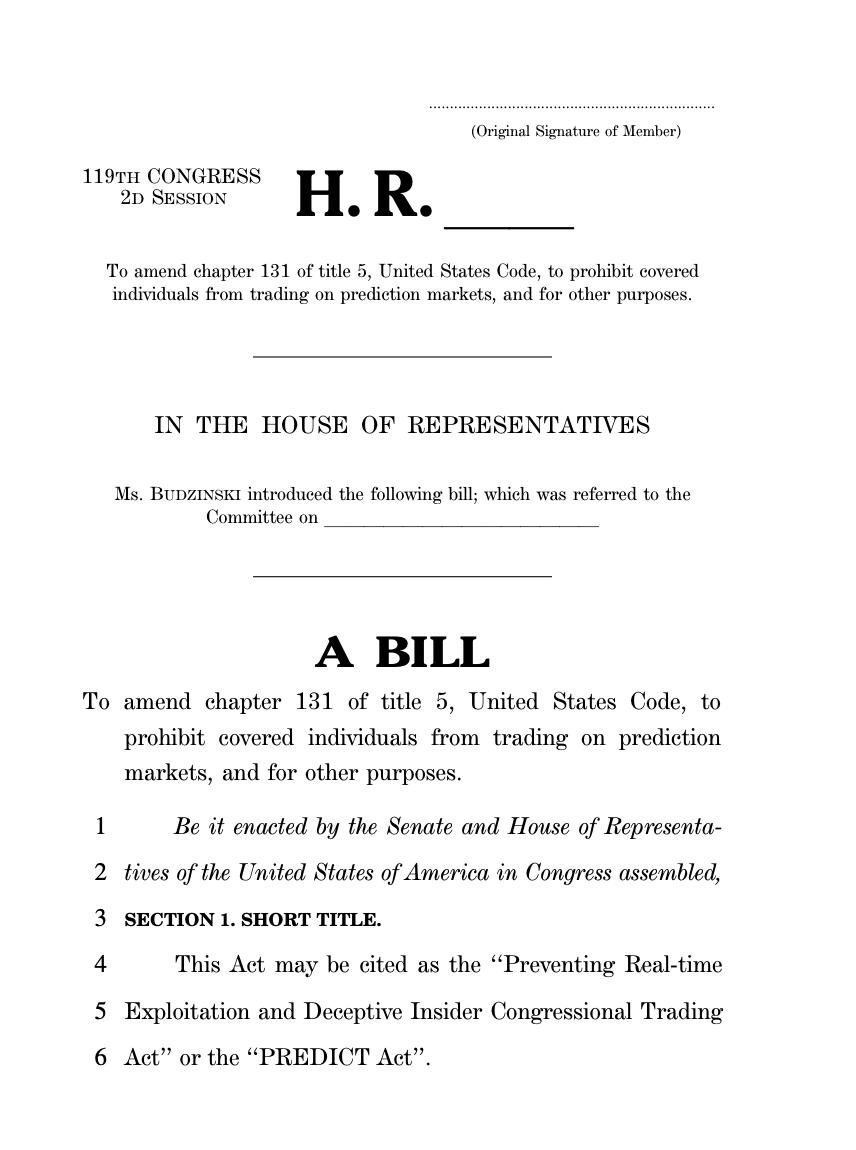
According to report by WashingtonExaminer, the concern is insider advantage. Politicians who know how legislation is moving, how votes will fall, or what executive decisions are being made before they become public hold information that translates directly into profitable positions on platforms like Kalshi and Polymarket. Violations would result in a civil penalty equal to 10 percent of the transaction value plus full disgorgement of any profits earned.
The bill arrives in a politically sensitive context. Donald Trump Jr. is an adviser to both Kalshi and Polymarket. Trump Media and Technology Group announced plans last year to launch its own prediction market service called Truth Predict. Budzinski said: “The American people are tired of politicians using their influence for personal gain, and the rise of prediction markets has made those concerns even more relevant.”
The UK and US bills address different mechanisms, which targets anonymous foreign money entering politics through crypto, the other targets politicians profiting from insider knowledge through prediction markets. But the underlying concern is the same. Digital financial instruments have created entry points and profit opportunities around democratic processes that existing regulations were not written to address. Both bills are attempts to close those gaps before they define how the next election cycle gets funded and traded.


