


Ethereum is trading at $2,079 while its network is holding at 3.64 million weekly active addresses - an all-time high level. Those two facts sit in direct contradiction.
Key Takeaways
Ethereum active addresses holding at all-time high levels of 3.64 million weekly.
Price broke below $2,080 with RSI at 28.22, deep in oversold territory.
150,000 ETH left exchanges in February but price dropped.
Whale transactions spiked 1,500% on March 24 then collapsed back to 239 by March 26.
$2.1 billion ETH options expire tomorrow with max pain above current price at $2,100.
What the Price Is Doing
The one-hour chart tells a specific story over the past eight days. ETH declined from $2,280 on March 19, dropped sharply on March 22 to $2,040, then recovered on March 23 to $2,200 on the highest volume visible in the chart window. That recovery failed to hold. Price has been drifting lower since March 24 and today broke below $2,080 on another volume spike.
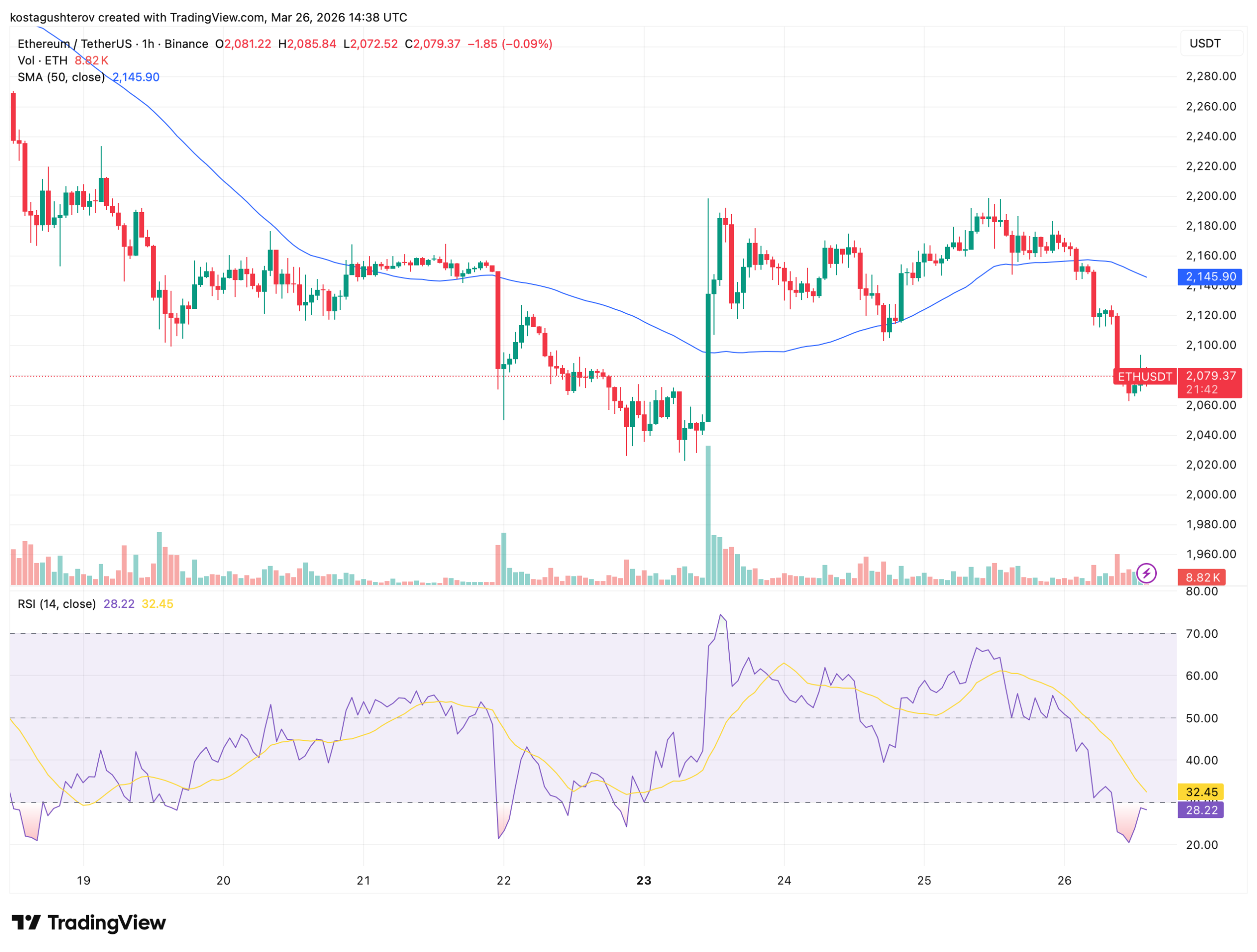
The RSI sits at 28.22, well below its smoothed average of 32.45 and deep in oversold territory. The 50-hour moving average is at $2,145.90, more than $65 above current price and still pointing downward. What happened on March 23 was not the start of a recovery. It was a single event.
The Network That Does Not Match the Price
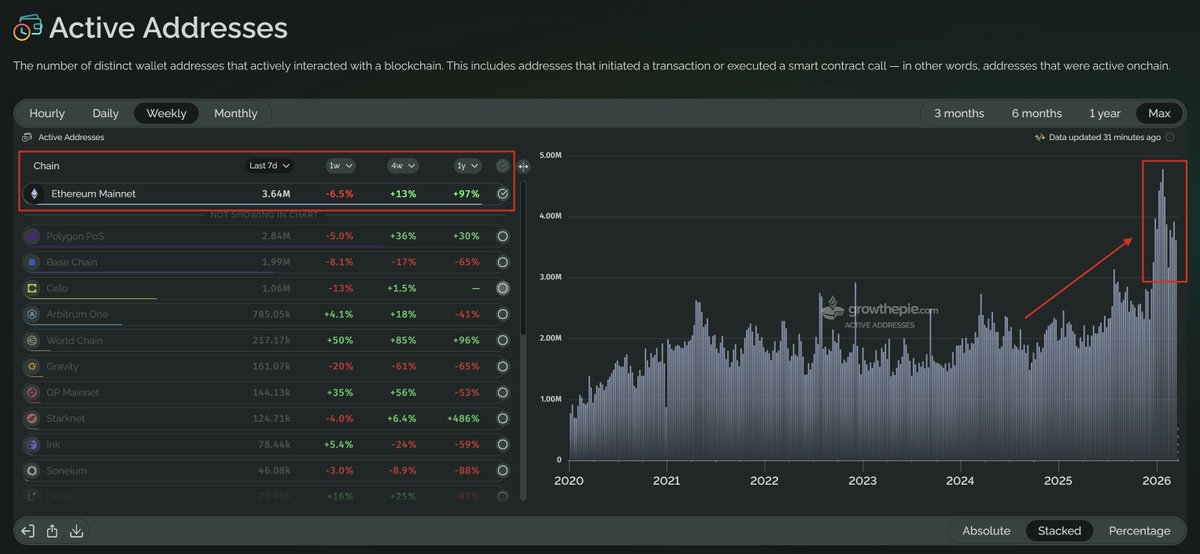
While the price was declining, Ethereum Mainnet weekly active addresses held at 3.64 million, an all-time high level, up 97% year-over-year and 13% over the past four weeks, according to data shared by Growthpie. Polygon PoS sits behind at 2.84 million. Base at 1.99 million. Arbitrum at 785,000.
More people are actively using ETH right now than at any point in its history. That is not a narrative. It is a network utilization metric. The question is why sustained record usage is not translating into price appreciation.
Why the Outflows Are Not Working
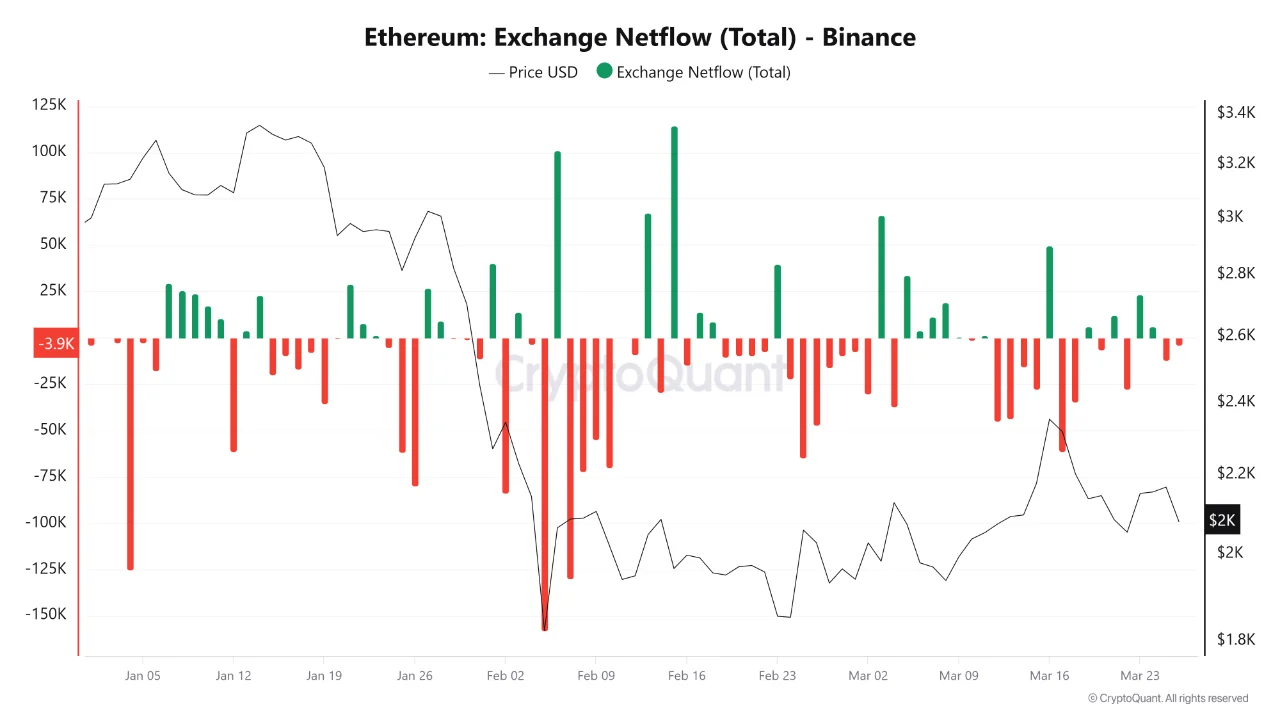
CryptoQuant data on Ethereum’s exchange netflow on Binance reveals the answer. In early February, approximately 150,000 ETH left exchanges in a single period, one of the largest outflow events in the chart window. Exchange outflows of that magnitude are normally a bullish signal. Supply leaving exchanges reduces selling pressure. Price should respond.
It did not.
Price dropped sharply during the same period. ETH is being withdrawn from exchanges, reducing the available float. But no new capital is entering to absorb what supply remains. There is holding. There is no accumulation. The market structure is clear, investors are cautious, preferring cash, and there is simply no capital to drive a sustained move. Unless ETH breaks above $2,500 with strong volume, rallies are likely to remain reactive. The overall direction continues sideways with a downward bias.
Whales Moved Once. Then Stopped.
Crypto analyst Ali Martinez, citing Santiment data, noted that whale transactions on the Ethereum network spiked from 123 on March 21 to 2,055 on March 24, a 1,500% increase in three days. By March 26 they had dropped back to 239.
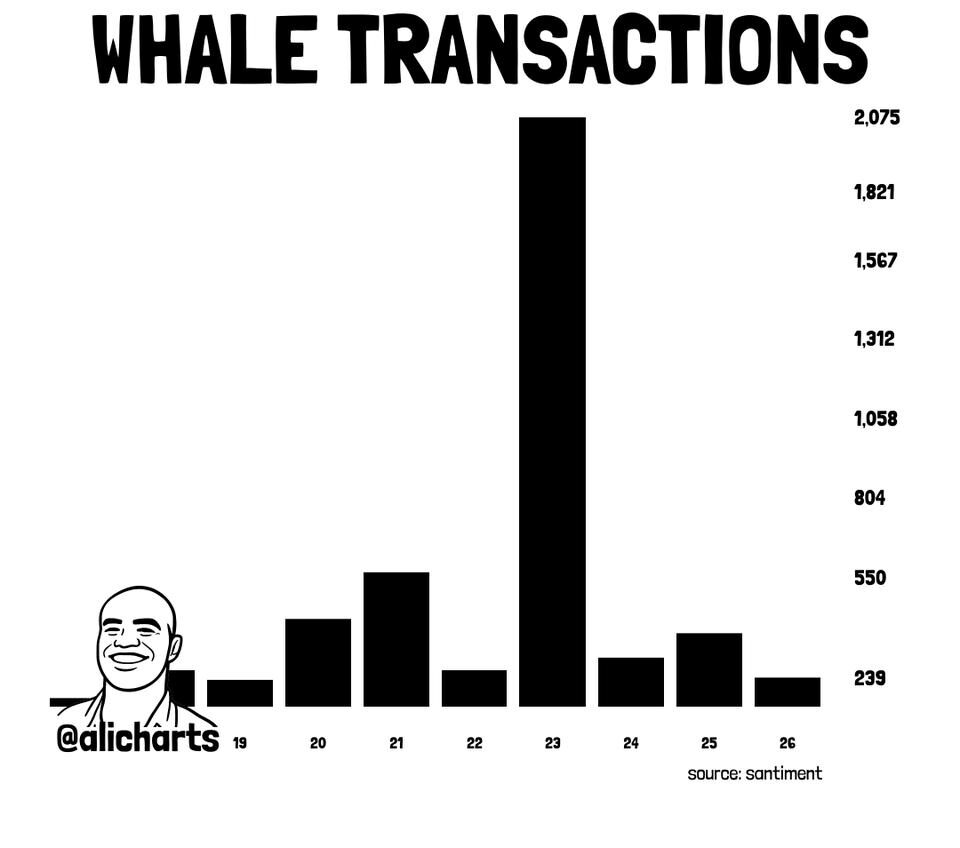
That spike coincided exactly with the March 23 price recovery on the chart. Large capital moved, price responded, and then the activity disappeared. The whale spike was not the beginning of a new accumulation phase. It was a single event that faded.
The Institutional Layer Is Still Building
Here is where the picture gets more complicated. While whales retreated and spot demand remains absent, institutional products are moving in the opposite direction.
The Hashdex Nasdaq CME Crypto Index ETF expanded to seven assets, adding Cardano and Chainlink to its existing Bitcoin, Ethereum, XRP, Solana, and Stellar holdings, per its first annual SEC 10-K filing reported by GlobeNewswire. Ethereum remains a core holding.
NEW: The Hashdex Nasdaq CME Crypto Index ETF $NCIQ has expanded to seven assets, adding $ADA and $LINK to its existing $BTC, $ETH, $XRP, $SOL and $XLM holdings, per its first annual SEC 10-K filing. pic.twitter.com/lQmQYZaSgS
— CoinDesk (@CoinDesk) March 26, 2026
The ETF expansion, backed by BlackRocks Staked Ethereum product, is one signal. The tokenized equity market building on top of Ethereum is another. Token Terminal data shows Ethereum hosts the largest tokenized equity market of any blockchain. Coinbase’s tokenized stock COINon leads at $31 million. SPYon sits at $30.6 million. IVVon at $21.5 million. The tokenized stock market on Ethereum is growing despite the price weakness.
The network is being used at record levels. Institutional products are expanding their exposure. Capital is just not expressing either of those things through spot price demand yet. But none of that institutional activity changes what happens tomorrow morning
Tokenized stocks on @ethereum.
The largest tokenized equity on Ethereum is @coinbase.
Interesting. pic.twitter.com/pM0Nz9SjpD
— Token Terminal ? (@tokenterminal) March 25, 2026
The Options Expiry Tomorrow
The ETH max pain chart on Coinglass shows the largest options expiry cluster landing on March 27 which is tomorrow. The notional value for that expiry sits at approximately $2.1 billion, the tallest bar in the chart window. The max pain level is above $2,100, above where ETH is currently trading.
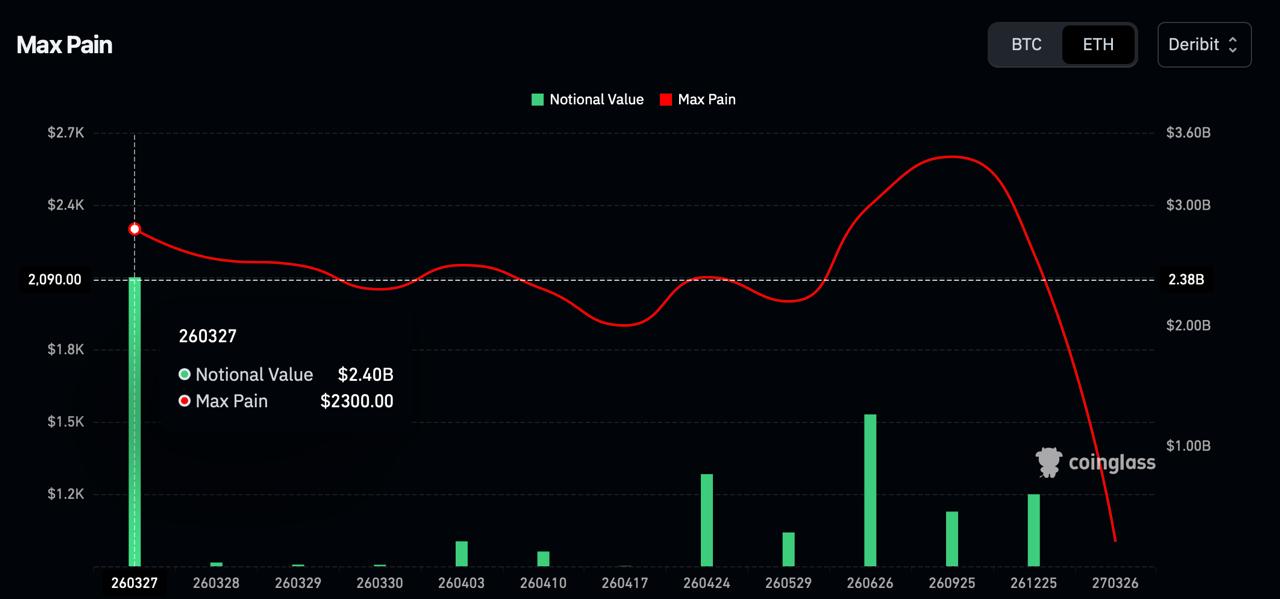
As price sits below max pain heading into expiry, dealer hedging adds mechanical selling pressure to near-term dynamics independently of any directional view.
Friday adds another layer of pressure to a market already struggling to find buyers.
Holders Without Buyers
Ethereum is in a specific and unusual condition. Network usage holding at all-time highs. Institutional products expanding. Tokenized assets growing. A price that is oversold, below its moving average, and drifting lower.
The exchange flow data provides the most honest explanation for all of it. Selling pressure has reduced. Demand has not arrived to fill the gap. The holders are there. The buyers are not.
The divergence between network activity and price is real and it is not resolving on its own. The $2,500 level is where the data points to a genuine trend change becoming possible. Everything below it, including where ETH is trading right now, is a market waiting for a reason to move rather than one that has found it.


