

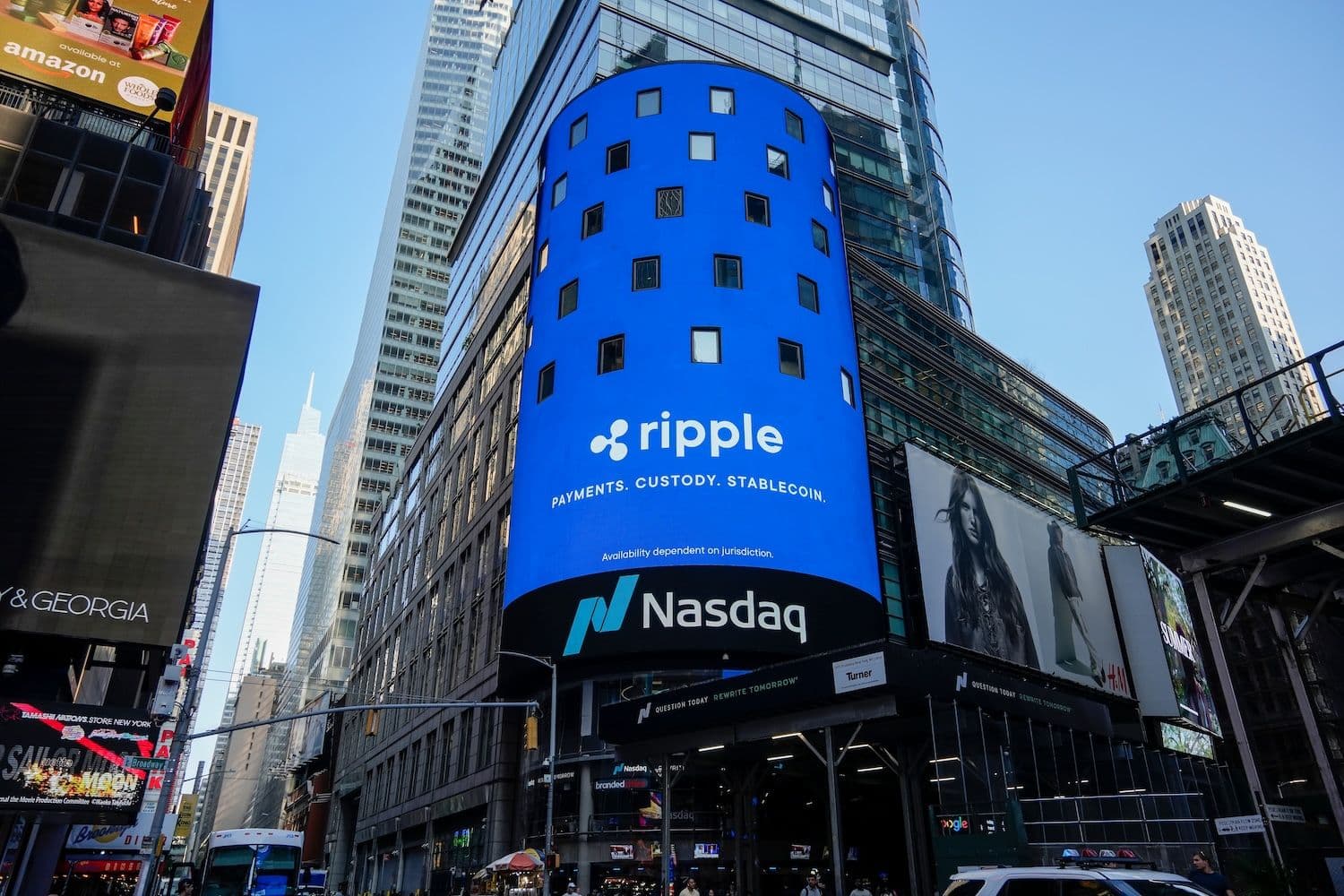
At a Crypto Valley Association panel in Zurich this month, Ripple (XRP) executives laid out a vision for replacing the global correspondent banking system with blockchain-powered rails — a pitch backed by $4 billion in acquisitions, a $40 billion private valuation, partnerships with more than 300 financial institutions, and the long-awaited end of the company's SEC lawsuit.
TL;DR
- Ripple spent roughly $2.45 billion on three major acquisitions in 2025 — Hidden Road, GTreasury, and Rail — while raising $500 million at a $40 billion valuation from Fortress and Citadel Securities.
- The SEC lawsuit that hung over the company for four years ended in Aug. 2025, opening the door for spot XRP ETFs, a national trust bank charter, and partnerships with Mastercard, BNY Mellon, and SBI Holdings.
- Critics argue XRP remains largely disconnected from Ripple's corporate success, pointing to less than $200,000 per month in on-chain transaction fees supporting an $80 billion-plus market cap.
From ODL to Ripple Payments: What the Network Actually Does
Ripple rebranded its On-Demand Liquidity service to Ripple Payments in Sept. 2023. VP Emi Yoshikawa said the change was about shedding crypto jargon in favor of language mainstream financial institutions could understand. The rebrand signaled something deeper than marketing.
Ripple was consolidating its fragmented product suite into a composable platform with four core capabilities. Those capabilities are Collect (accept fiat and stablecoin inflows), Hold (virtual accounts and wallets), Exchange (24/7 fiat-to-digital asset conversion), and Payout (real-time mass disbursements).
The network now spans more than 300 financial institutions across 55-plus countries with 90-plus payout markets.
Those markets cover roughly 90% of the daily global FX market. Settlement happens in three to five seconds at an average cost of roughly $0.0002 per transaction — compared to $15-50 and one to five business days through traditional correspondent banking rails.
The XRP Ledger processes approximately 1,500 transactions per second. It is compliant with ISO 20022, the messaging standard that SWIFT itself completed migrating to in Nov. 2025.
The mechanics of XRP's bridge function are straightforward.
When a U.S. business needs to pay a supplier in Thailand, the sender's dollars convert to XRP on a local exchange, transfer across the XRP Ledger in seconds, then convert to Thai baht on the receiving end. XRP is held for only a few seconds during the process. That eliminates the need for pre-funded nostro and vostro accounts — the foreign currency reserves that correspondent banks park globally at enormous cost.
Also Read: A US Senator Is Questioning the SEC — And The Justin Sun Case Is At The Center

Ripple's $2.45B Acquisition Spree Is Reshaping the Company
The most dramatic transformation happened not on-chain but through M&A. Ripple spent approximately $2.45 billion on three major acquisitions in 2025 alone. CEO Brad Garlinghouse described the strategy as building infrastructure for institutions looking to access crypto and blockchain.
The crown jewel was Hidden Road, acquired for $1.25 billion in Apr. 2025 and rebranded as Ripple Prime by October.
Hidden Road was one of the fastest-growing non-bank prime brokers in the world, clearing $3 trillion annually for 300-plus institutional clients across FX, derivatives, and digital assets.
The deal made Ripple the first crypto company to own a global, multi-asset prime brokerage.
Its business has tripled since the acquisition, according to the company. RLUSD, Ripple's stablecoin, now serves as collateral across Ripple Prime products, while post-trade activity migrates to the XRP Ledger.
In Oct. 2025, Ripple announced the $1 billion acquisition of GTreasury, a 40-year-old treasury management system processing approximately $12.5 trillion in annual payment volume for Fortune 500 clients. This deal opens the $120 trillion-plus corporate treasury market and embeds XRP-based infrastructure into operational systems where multinational treasurers manage cross-border payments.
A month earlier, Ripple acquired Toronto-based Rail for $200 million. That deal added stablecoin-powered B2B payment processing that handles over 10% of the $36 billion global B2B stablecoin payment market.
Here is what the acquisition portfolio looks like:
- Hidden Road ($1.25 billion): prime brokerage, $3 trillion in annual clearing volume, rebranded as Ripple Prime
- GTreasury ($1 billion): corporate treasury management, $12.5 trillion in annual payment volume, Fortune 500 client base
- Rail ($200 million): stablecoin B2B payments, 10%-plus share of global B2B stablecoin volume
Also Read: Solana's Correction To $50 May Fuel Next Big Rally
RLUSD, the $500M Raise, and the Stablecoin Bet
The RLUSD stablecoin launched in Dec. 2024 under a New York DFS charter with BNY Mellon as primary reserve custodian. It has grown to approximately $1.4 billion in market cap — making it the 10th-largest stablecoin globally.
RLUSD addresses a fundamental critique.
Banks have long been reluctant to use volatile XRP for settlement.
By offering a stable dollar-pegged asset alongside XRP's liquidity function, Ripple pursues what it calls a two-asset approach — XRP for speed and liquidity, RLUSD for stability and compliance.
In Nov. 2025, Ripple raised $500 million at a $40 billion valuation from Citadel Securities, Fortress Investment Group, Pantera Capital, Galaxy Digital, Brevan Howard, and Marshall Wace. Garlinghouse called it a clear bet on what the future of crypto will look like.
Also Read: Bitcoin Spot Volume Falls 8% As Traders Step Back
Inside the Zurich Panel Where Ripple Laid Out Its Vision
At the Web3 Banking Symposium hosted by the Crypto Valley Association in Zurich in Mar. 2026, Ripple's Director of Commercial Tania Griffith offered a window into how the company pitches itself to European banking executives.
The panel also featured YouHodler CEO and CVA Board Member Ilya Volkov, alongside speakers from N3XT and Unblock.ch. The discussion focused on international payments, stablecoin settlement, and blockchain's integration into traditional banking.
Griffith told the audience that banks and financial institutions are increasingly comfortable using crypto and blockchain for payments.
She described stablecoins as a proven and scalable use case for institutional clients. She cited faster settlement, lower costs, 24/7 operations, and enhanced security as the primary drivers.
Crucially, she framed Ripple's approach as complementary to traditional financial rails, not an alternative. That message was calibrated for an audience of Swiss bankers accustomed to regulatory precision. She walked through XRP's function as a bridge currency, using the example of enabling instant settlement between less common currency pairs that traditional systems struggle to serve.
Griffith highlighted Ripple's first licensed payment solution launched in Nov. 2023.
She also discussed RLUSD's role in streamlining cross-border treasury payments and linked institutional progress to the EU's MiCA regulation, which she said had provided the clearer framework European institutions needed.
Volkov captured the broader trajectory at the panel: the industry started as technology and tokens but is now a fully regulated financial business.
Also Read: XRP Weekly RSI Mirrors 2022 Bear Market Oversold Zone
Banks Are Signing Up, but the XRP Adoption Gap Persists
Ripple's partner roster reads like a directory of global finance.
Key relationships include SBI Holdings (Japan's largest financial conglomerate and Ripple's deepest partner), Santander (One Pay FX), Standard Chartered, PNC Financial, Bank of America (confirmed pilots), and Zand Bank (UAE's first digital bank, onboarded May 2025).
The Mastercard pilot announced at Ripple's Swell 2025 conference represents a notable milestone.
It uses RLUSD on the XRP Ledger to settle fiat credit card transactions for the Gemini Credit Card through FDIC-insured WebBank.
That makes it one of the first instances of a regulated stablecoin settling traditional card payments on a public blockchain.
Adoption metrics tell a growth story:
- Ripple Payments customers doubled quarter-on-quarter in 2025
- ODL processed $15 billion in cross-border payments in 2024, a 32% year-over-year increase
- Asia-Pacific accounts for roughly 56% of ODL volume across 70-plus corridor pairs
- Pan-African fintech Onafriq built remittance corridors connecting 27 African countries to the UK, Australia, and the Gulf via 1,300-plus mobile wallet connections on RippleNet
But here lies the critical nuance that separates Ripple's corporate narrative from XRP's market reality.
Many of Ripple's 300-plus institutional partners use the messaging and settlement infrastructure without touching XRP. Even Ripple CTO David Schwartz has acknowledged that many clients prefer off-chain settlement.
The Motley Fool flagged the disconnect most sharply: XRP's $116 billion market cap at its late-2025 peak was built on approximately $1 million in annual transaction fees — yielding an effective price-to-sales ratio north of 60,000. That gap between corporate traction and token utility remains the most important unresolved question for XRP investors.
Also Read: This Rare Signal Suggests Altcoins Could Explode Before Bitcoin Moves
The SEC Case Closed, and Institutional Doors Opened
The resolution of the SEC's lawsuit against Ripple — filed on Jay Clayton's final day as SEC Chair in Dec. 2020 — removed the single largest overhang on both the company and the token. Judge Analisa Torres' July 2023 ruling established a landmark precedent: XRP is not a security when sold programmatically on public exchanges, though institutional sales did constitute unregistered securities transactions.
The SEC dropped its appeal in Mar. 2025 under the Trump administration.
The case officially closed in Aug. 2025 after both parties dismissed their appeals. Garlinghouse estimated Ripple spent more than $150 million on its legal defense. Chief Legal Officer Stuart Alderoty framed the broader impact, saying the SEC had dropped every case against every crypto company in the United States.
The business impact was immediate. Within months of the case closing, the SEC approved spot XRP ETFs from Canary Capital, Franklin Templeton, Bitwise, Grayscale, and 21Shares. Canary's XRPC debuted on Nov. 13, 2025 with $59 million in first-day trading volume — the highest of any ETF launched that year.
Collectively, spot XRP ETFs have attracted over $1.25 billion in cumulative inflows, locking approximately 810 million tokens in institutional custody. The OCC granted Ripple conditional approval for a national trust bank charter in Dec. 2025, positioning it to custody digital assets and potentially access the Federal Reserve system directly.
Also Read: Bitget Upgrades Agent Hub With 5 New AI Skills
What Proponents and Critics Get Right — and Wrong
The bull case for Ripple's approach comes most forcefully from its own executives. President Monica Long declared in early 2026 that the floodgates would open this year, citing Bank of America's reaffirmed commitment and the SEC's rescission of SAB 121 as pivotal moments.
Garlinghouse has projected that Ripple could capture 14% of SWIFT's annualized $155 trillion transaction volume.
Standard Chartered's Geoffrey Kendrick, the most prominent institutional analyst covering XRP, initially forecast $8 by 2026 and $28 by 2030. He subsequently cut his 2026 target 65% to $2.80 — the largest reduction among all his crypto forecasts — while maintaining the long-term $28 target, conditional on XRP becoming core global financial infrastructure.
The skeptics raise substantive points. Ryan Selkis, founder of research firm Messari, has called XRP an outdated asset belonging to a pre-stablecoin era. He argues its value proposition has been eroded by regulated stablecoins like USDC (USDC).
Anonymous venture capitalists told Unchained Crypto that Ripple is not worth anything outside of its XRP holdings and that investors in the $500 million round were likely buying discounted XRP rather than business value. SWIFT's Chief Innovation Officer Tom Zschach has argued banks will not outsource settlement finality to XRP, emphasizing that liquidity is one thing but legal enforceability is another.
The most powerful critique may be structural. The XRP Ledger generates less than $200,000 per month in transaction fees — a fraction of what its $80 billion-plus market capitalization implies about usage. RippleNet can grow while on-chain XRP activity remains modest, creating a disconnect between corporate success and token value.
Also Read: Bitcoin To Reach $500K, Ethereum To $40K By 2030, Says Standard Chartered
The Competitive Landscape Is Converging Fast
Ripple does not operate in a vacuum. SWIFT connects 11,000-plus institutions across 200-plus countries and processes more than $5 trillion daily — dwarfing Ripple's network by orders of magnitude. SWIFT GPI has pushed 50% of payments to complete within 30 minutes, with the fastest SWIFT Go transaction clocking 21 seconds.
The completion of SWIFT's ISO 20022 migration in Nov. 2025 positions the incumbent for blockchain interoperability. Partnerships with Chainlink, HSBC, and Ant International on tokenized asset processing show SWIFT is not standing still.
The stablecoin market presents perhaps the most formidable competition. Total stablecoin transaction volume hit $33 trillion in 2025 — a 72% year-over-year increase — with USDC alone processing $18.3 trillion. Stablecoins offer zero volatility risk, operate across multiple blockchains, and require no company-specific infrastructure. Stripe, Visa, Mastercard, and PayPal are all integrating stablecoin settlement.
Against this backdrop, Ripple's RLUSD serves as both defensive armor and competitive weapon. It acknowledges that XRP's volatility has been a barrier while positioning Ripple within the stablecoin ecosystem it once competed against.
Stellar (XLM), founded by Ripple co-founder Jed McCaleb, targets a complementary niche — financial inclusion, remittances, and humanitarian aid — with a market cap of roughly $7.9 billion versus XRP's $80 billion-plus. While Stellar serves a meaningfully different market, its existence underscores that Ripple's technology is not unique.
Meanwhile, fintechs like Wise processed $118 billion in cross-border transfers in 2024 using a non-blockchain local-account model. JPMorgan's Kinexys platform processes blockchain-settled payments within its own ecosystem. The future likely involves coexistence rather than winner-take-all — with Ripple competing for institutional settlement and emerging-market corridors while SWIFT retains dominance in established banking relationships.
Also Read: Crypto Funds Bleed $414M In First Outflows Over Five Weeks: CoinShares
Where Things Stand: Price, ETFs, and What Comes Next
XRP trades at approximately $1.33-$1.39 as of late Mar. 2026, down roughly 63% from its all-time high of $3.65 reached in July 2025. The token's market cap sits near $82-85 billion, ranking it among the top five cryptocurrencies.
The post-peak decline has been persistent. After surging 580% between Nov. 2024 and Jan. 2025 on the SEC resolution and pro-crypto political environment, XRP spent the second half of 2025 bleeding value. A broader crypto market selloff in Feb. 2026 — Bitcoin (BTC) dropped 25% — pushed XRP below $1.20 before a modest recovery.
Spot XRP ETFs, despite attracting $1.25 billion-plus in cumulative inflows, have seen weekly inflows collapse from $200 million to roughly $2 million amid the downturn. Standard Chartered's revised targets frame a wide range of possible outcomes:
- 2026: $2.80 (cut 65% from original $8 target)
- 2027: $7
- 2028: $12.60
- 2030: $28
Ripple's corporate trajectory and XRP's price trajectory tell different stories. The company holds 75-plus regulatory licenses. It has a national trust bank charter, $4 billion-plus deployed in acquisitions, and relationships with hundreds of financial institutions. Its RLUSD stablecoin is gaining traction. The Mastercard pilot could prove transformative. Yet XRP's price remains stubbornly tethered to speculative crypto cycles rather than Ripple's operational metrics.
Also Read: Prediction Markets Gain 118% More Users In Record March, Hit All-Time High
Conclusion
Ripple has built something tangible. The company's pivot from blockchain messaging startup to a full-stack financial infrastructure provider — with prime brokerage, treasury management, stablecoin issuance, and regulatory licenses that rival traditional banks — ranks among the most ambitious corporate transformations in crypto history.
The $100 billion-plus in cumulative payment volume, the Mastercard partnership, and the Citadel/Fortress-backed $40 billion valuation represent real institutional credibility.
The unresolved question is whether XRP the token captures that value. The disconnect between Ripple's corporate success and XRP's on-chain activity — less than $200,000 per month in network fees supporting an $80 billion-plus market cap — remains the core tension.
RLUSD may eventually help by making the broader Ripple ecosystem more attractive to banks who can use stablecoins for settlement while XRP provides background liquidity.
But the competition from generic stablecoins, SWIFT's modernization, and fintech alternatives means Ripple's window to establish XRP as indispensable infrastructure is narrowing. The company has built the rails. Whether the trains carry XRP or something else is the $80 billion question.
Read Next: Saylor Quiet On Bitcoin After 13-Week Buying Spree


