


Two Republican senators have introduced a bill that aims to bring Bitcoin mining back to American soil, reducing dependence on Chinese-made hardware and formalizing the nation's cryptocurrency infrastructure as a strategic national asset.
Key Takeaways
Senators Lummis and Cassidy introduced the Mined in America Act on March 30, 2026, to bring Bitcoin mining hardware production back to the U.S.
Chinese companies currently supply roughly 97% of global mining machines – a dependency Washington now considers a national security risk.
The bill would formally codify a Strategic Bitcoin Reserve under the Treasury Department, using seized assets – no new taxpayer spending.
If passed, proponents project a $30.6 billion GDP boost and 54,000+ jobs by 2028.
On March 30, 2026, Senators Cynthia Lummis and Bill Cassidy filed the “Mined in America Act”, a bill that would push to bring Bitcoin mining hardware manufacturing back onto U.S. soil, formalize a Strategic Bitcoin Reserve in federal law, and chip away at what critics describe as a dangerous dependency on Chinese-made equipment.
The concern driving the legislation is straightforward: approximately 97% of the specialized machines used to mine Bitcoin globally are manufactured by companies with ties to China. For a network that now commands serious financial and infrastructural weight, that hardware concentration represents a lever that foreign governments could, in theory, pull.
According to the official press release from Cassidy, the bill does not ban foreign equipment outright. Instead, it creates a voluntary “Mined in America” certification administered by the Commerce Department. Miners who earn that certification gain preferential access to existing federal energy programs – no new government spending required. The National Institute of Standards and Technology would be directed to assist domestic manufacturers in building competitive alternatives to the Chinese-made ASICs that currently dominate the market.
The State of Mining in 2026
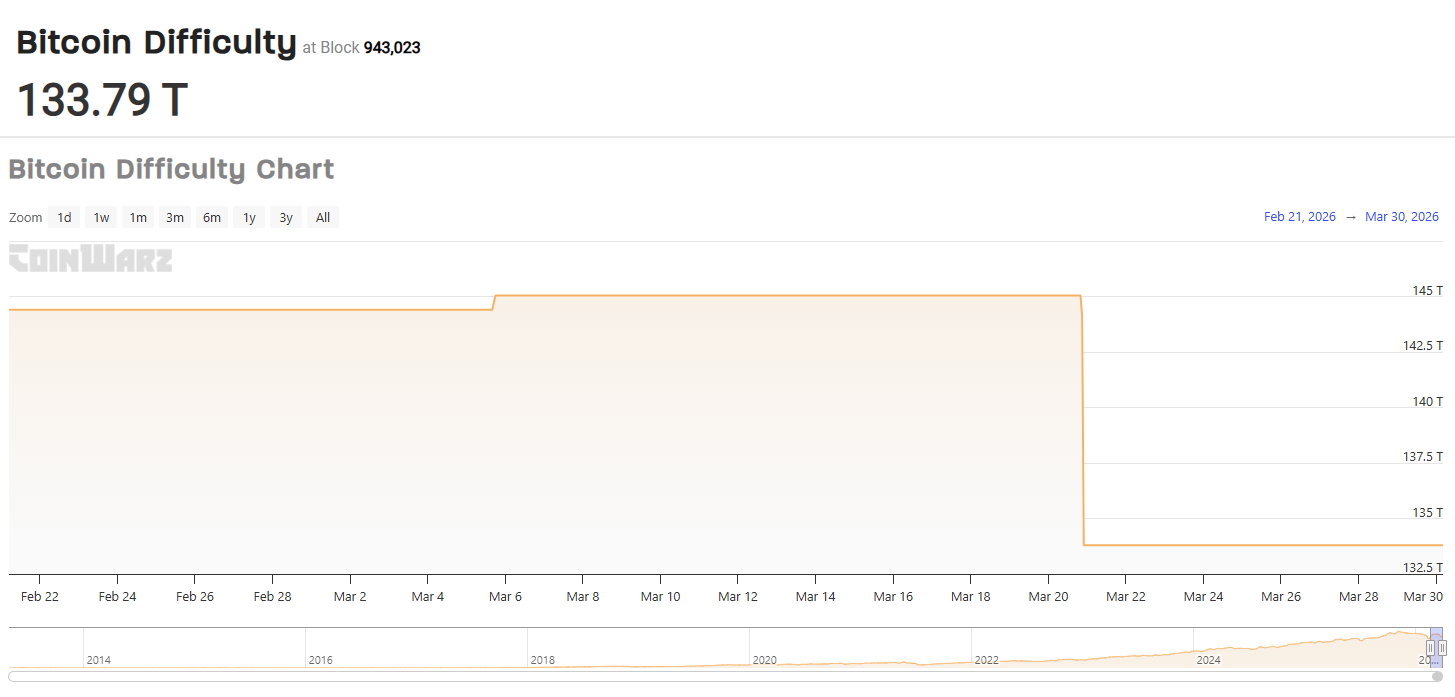
The bill arrives at a pressured moment for the industry. As per data from CoinWarz, network difficulty has dropped sharply to 133.9 trillion, down from 145.04 trillion on March 20 – a significant pullback that has brought production costs down to approximately $77,530 per BTC. Mining a single coin requires an estimated 710,000-720,000 kWh – still equivalent to powering a U.S. household for roughly 35–38 days. Additionally, the current hashrate has dropped significantly amid the ongoing war in Iran and the major shift that companies are undergoing, transitioning to the AI sector.
The Antminer S23 series from Bitmain, released in early 2026, has set a new efficiency benchmark as the first mass-produced hardware to break below 10 joules per terahash, delivering 73% more hashrate than its predecessor with barely any additional power draw. It is a hardware leap that does nothing, however, to change who manufactures these machines or where.
About 52% of global mining now runs on low-carbon sources, with hydropower leading at 23.4%. Carbon intensity per mined Bitcoin has edged down to 358 kg CO2e. Still, the network consumes an estimated 120–180 TWh annually – scale that has Washington’s attention for reasons beyond the environment.
The Reserve and What It Means for Markets
The bill’s most consequential provision is its codification of a Strategic Bitcoin Reserve under the Treasury Department. The U.S. already holds roughly 200,000 BTC from criminal asset seizures. The Act would lock that position into permanent law and establish a budget-neutral acquisition pathway: proceeds from seized altcoins fund additional Bitcoin purchases, and certified domestic miners can sell BTC directly to the Reserve at a slight discount in exchange for a tax-free transaction.
For markets, that mechanism matters. Formalizing the reserve removes a layer of political risk – a future administration could no longer quietly liquidate the government’s position without overturning an act of Congress. It also introduces sustained, institutionalized buy pressure that operates independently of market cycles. Proponents project a 90% domestic hashrate share by 2028 could add $30.6 billion to GDP and create over 54,000 jobs. The U.S. currently controls around 38% of global hashrate.
The Political Construction
Lummis and Cassidy have framed this deliberately as an energy, manufacturing, and defense bill – not a crypto bill. That framing gives climate-focused legislators something to engage with: Bitcoin miners can absorb excess renewable energy that would otherwise go to waste. California alone curtailed roughly 3,400 GWh in 2025. Miners can also cut power within seconds during grid emergencies, a flexibility demonstrated during Winter Storm Elliott in Texas.
The national security argument is harder to dismiss. If the hardware running 38% of the world’s most valuable proof-of-work network is manufactured and potentially compromised abroad, the strategic exposure is real. The bill’s sponsors are betting that framing resonates across the aisle – with defense hawks and climate hawks alike – without requiring a single new appropriation.
Whether it passes is a separate question. Critics have raised concerns over wealth concentration and federal scope. But regardless of legislative outcome, the bill signals something markets should register: Bitcoin has moved fully into the vocabulary of U.S. strategic planning.


