

Building a crypto exchange from scratch used to take months of development, six-figure infrastructure budgets, and a dedicated compliance team. That math has changed in 2026. Using one of the best crypto whitelabel solutions lets businesses launch a fully branded trading platform in weeks, with built-in liquidity, KYC/AML tooling, and regulatory support baked into the stack.
The market has caught on. The global cryptocurrency exchange platform market was valued at roughly $45.9 billion in 2023 and is projected to reach $264.3 billion by 2030. Many of the top crypto exchanges already run on third-party infrastructure, and a large share of new regional launches across the EU, Middle East, and Asia-Pacific are following suit.
We reviewed six popular crypto whitelabel solutions available in 2026 and compared them across deployment speed, pricing structure, regulatory readiness, liquidity depth, and technical capability. Here are our findings.
The Best Crypto Exchange Whitelabel Solutions Ranked
The table below provides a quick comparison of each whitelabel crypto exchange software provider across the factors that matter most. Detailed reviews follow in the next section.
| Provider | Best For | Deployment | Pricing Model | Launch Time | Liquidity |
| ChangeNOW | Fast, low-cost launch | Cloud / API / Widget | Revenue share (from 0.4%) | 1–4 weeks | Aggregated (Binance, OKX, Uniswap, KuCoin) |
| AlphaPoint | Institutional / enterprise | Cloud / On-premise | Custom (sales contact) | 4–8 weeks | Institutional liquidity tooling |
| HollaEx | Developer-first / startups | Cloud / On-premise / Open-source | $35,000/yr + 15% rev share to $69,000/yr with 0% rev share | 1 day–1 week | Integrated (major pairs) |
| ChainUp | Enterprise / multi-product | SaaS Cloud / On-premise | Custom (sales contact) | 4–8 weeks | Proprietary Bitwind SOR |
| OpenDAX | Full code ownership | Cloud / On-premise / Turnkey | Perpetual license ($50,000+) | 4–12 weeks | Tier 1 integrations |
| PayBito | US-focused / budget entry | Cloud / Turnkey | $149–$12,000/mo subscription | 1–10 days | Integrated liquidity |
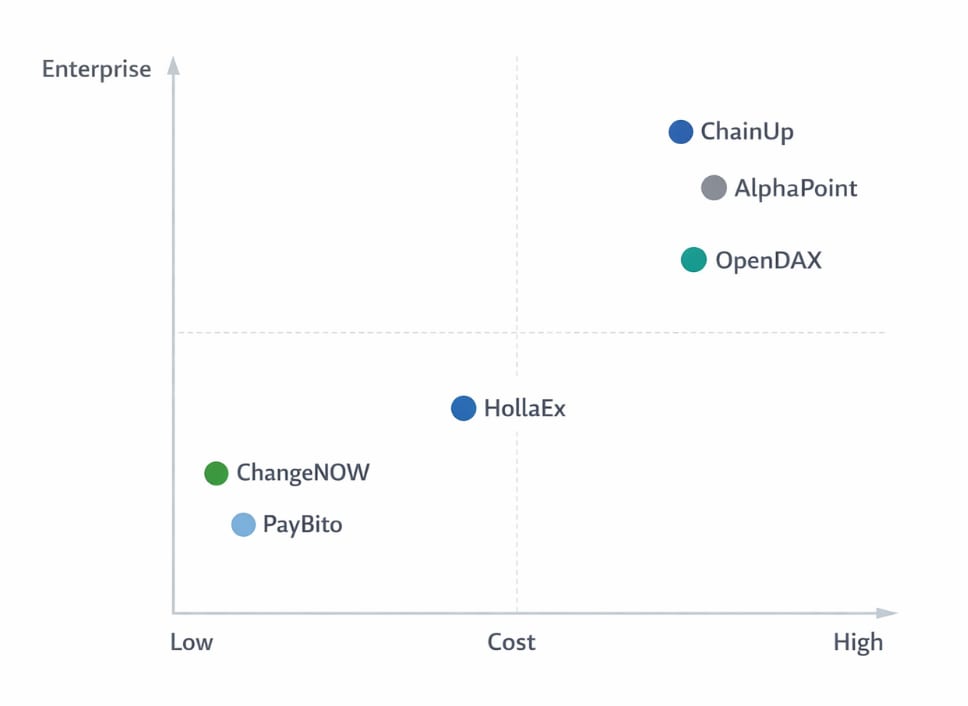
Whitelabel providers mapped by cost and complexity
An Introduction to Crypto Whitelabel Solutions
A whitelabel crypto exchange solution is pre-built trading software that a business can license, rebrand, and deploy under its own name. Instead of hiring a development team to build an order matching engine, wallet infrastructure, and compliance stack from the ground up, the operator buys or leases a ready-made platform and customizes the front end.
The range of whitelabel cryptocurrency exchange solutions on the market covers everything from lightweight swap widgets to full enterprise trading suites. This concept isn’t new – traditional finance has used whitelabel brokerage software for years.
But in crypto, the model has become especially important because exchange infrastructure is uniquely complex. A functional exchange requires a matching engine, hot- and cold-wallet management, KYC/AML verification, fiat on- and off-ramps, and liquidity from day one.
Building all of that in-house can cost $500,000 or more and take six months to a year. Whitelabel providers compress that timeline to a matter of weeks. The operator focuses on branding, user acquisition, and local compliance, while the provider handles the technical backbone.
It’s worth noting that an estimated 40–60% of new regional exchange launches are using third-party or whitelabel infrastructure, driven by shared liquidity pools and pre-built regulatory modules that would be prohibitively expensive to replicate independently.
Why Choose Crypto Whitelabel Software?
Opting for a pre-built solution offers several advantages over in-house development, particularly in terms of time and capital efficiency:
Speed to Market
The most obvious advantage is launch speed. Custom-built exchanges typically require 6-12 months of development before they can handle real trades. A whitelabel crypto exchange can go live in as little as 1-4 weeks, depending on the provider and the level of UI customization. For businesses looking to capture market share during a bull cycle or ahead of a regulatory window (like MiCA compliance deadlines), that difference is massive.
Lower Upfront Costs
Building from scratch means hiring blockchain developers, security auditors, and DevOps teams. A realistic first-year budget for a custom exchange easily exceeds $500,000 when you factor in hosting, licensing, and compliance. Whitelabel solutions are much cheaper, with revenue-share models like ChangeNOW requiring zero upfront payment.
Built-In Liquidity
An empty order book kills a new exchange faster than anything else. Most whitelabel providers solve this by aggregating liquidity, routing orders to Tier 1 exchanges and major DEXs, so that even a brand-new platform can offer tight spreads on hundreds of pairs from day one. Providers typically aggregate from venues that handle Binance listings and other high-volume pairs.
Compliance Infrastructure
Regulatory requirements are tightening globally. MiCA is the core EU framework for crypto-asset providers, and frameworks in the UAE (VARA), Singapore (MAS), and the UK (FCA) each carry their own licensing burdens. Whitelabel providers that offer integrated KYC/AML tools, Travel Rule compliance, and transaction monitoring (KYT) save operators legal groundwork.
Top Whitelabel Cryptocurrency Providers Reviewed
Below, we review each of the six whitelabel crypto exchange software providers in detail, covering their strengths, pricing, and limitations.
ChangeNOW
ChangeNOW operates as a non-custodial exchange aggregator that offers whitelabel crypto exchange software through two integration paths: an Exchange API for operators who want full UI control, and an Exchange Widget for no-code or low-code deployment. The platform supports over 1,500 cryptocurrencies across 110+ blockchains and aggregates liquidity from exchanges including Binance, OKX, Uniswap, and KuCoin.
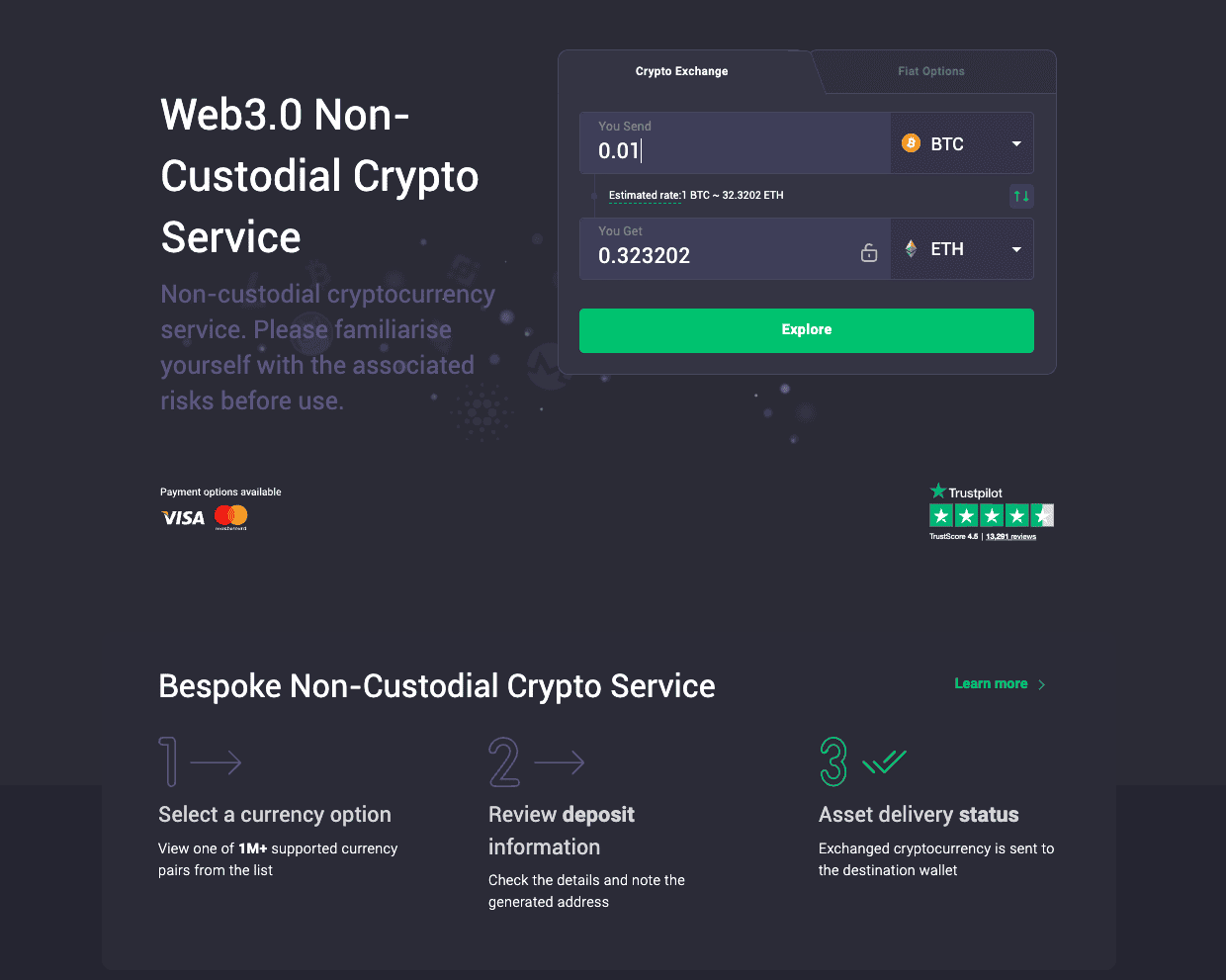
ChangeNOW differentiates itself by combining fast deployment with a low-cost entry model. Widget-based integrations can deploy within a week, and the revenue-share model (starting at 0.4% per transaction) eliminates the large upfront licensing fees associated with enterprise-grade alternatives. The xPortal case study, published in February 2026, demonstrated that a full API integration was completed within one week.
Because ChangeNOW is non-custodial, user funds stay in their own wallets throughout the swap process. That non-custodial structure significantly reduces platform risk and simplifies compliance in jurisdictions with strict custodial requirements. Users can also connect any of the best crypto wallets to interact with a ChangeNOW-powered interface.
The platform holds an Excellent rating of 4.5 out of 5 on Trustpilot, based on more than 13,000 reviews, with particularly strong feedback on speed and transparency. The main limitation is that it functions as a swap aggregator rather than a full order-book exchange, so operators looking for advanced spot or futures trading features would need a different architecture.
Pros
No upfront licensing cost; revenue-share model starts from 0.4%
Extremely fast deployment (1 week for widget, 1–4 weeks for API)
Non-custodial architecture reduces platform risk
Deep liquidity aggregated from multiple CEXs and DEXs
Cons
Swap/aggregator model, not a full order-book exchange
Does not support advanced trading features (futures, margin)
AlphaPoint
AlphaPoint targets the institutional end of the market. The platform serves over 150 customers in 35+ countries, with its most notable deployment being El Salvador’s Chivo wallet. Its matching engine can process
Setup speed is impressive – HollaEx claims operators can go live within a day using the cloud setup, making it one of the fastest options for MVP-style launches. The platform supports major blockchains and stablecoins, with Enterprise Unlimited offering unlimited coin and market additions.
The developer-first approach is the draw here. APIs are well-documented, the GitHub community is active, and operators can connect custom domains, payment gateways, and banking partners. The trade-off is that HollaEx’s matching engine specs aren’t publicly benchmarked at the same level as those of AlphaPoint or ChainUp.
Pros
Open-source option available (HollaEx Kit on GitHub)
Affordable entry
Rapid deployment (same-day possible)
Cons
No public benchmarks for matching engine performance
Smaller provider with less institutional presence
ChainUp
ChainUp operates at the enterprise end of the spectrum, claiming to have launched 500+ exchanges and serving 1,000+ enterprise clients across 30 countries. The platform offers CEX, DEX, and hybrid exchange (HEX) models, plus a modular product suite that includes perpetual futures, staking, and an NFT marketplace.
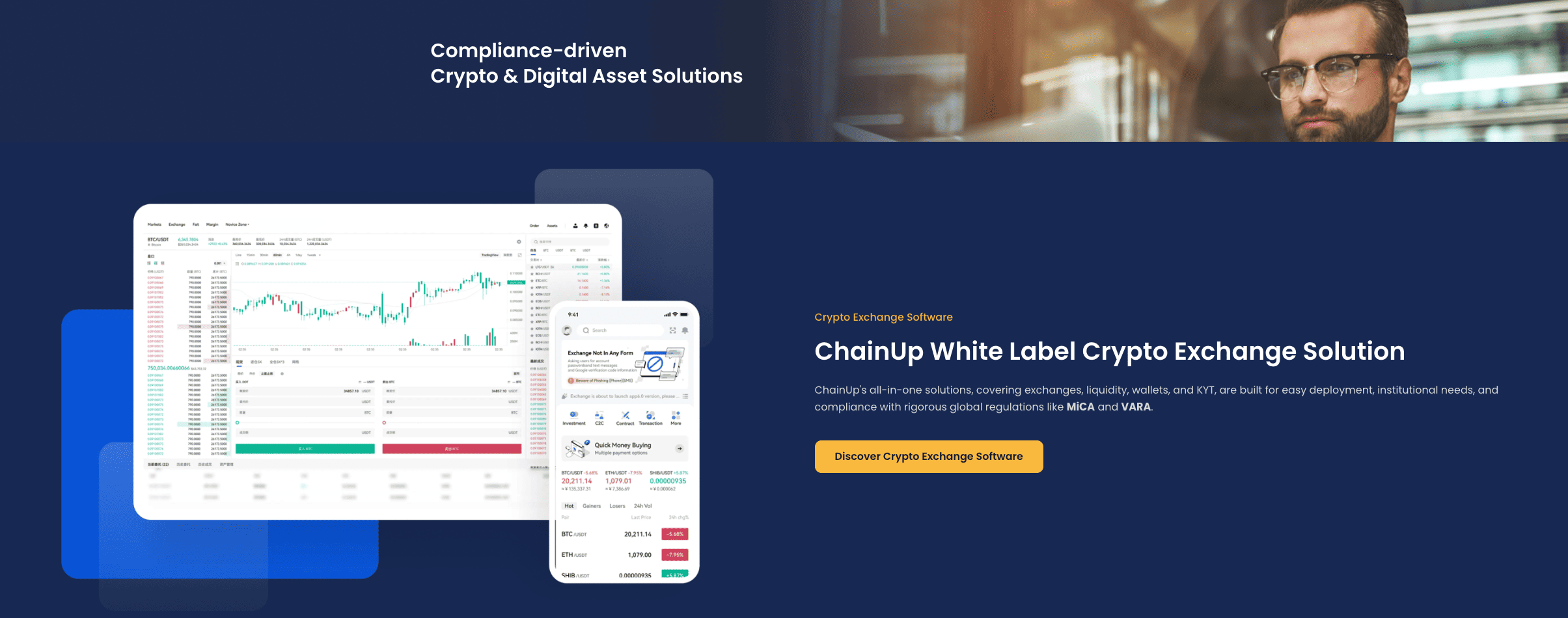
On the technical side, ChainUp’s spot matching engine handles 50,000 TPS per pair, while its proprietary Bitwind liquidity network uses smart order routing to aggregate depth from top global exchanges. The platform is also built with MiCA and VARA compliance in mind, integrating Trustformer for Know Your Transaction (KYT) monitoring and implementing mandatory quarterly KYC refreshes.
Pricing is private and estimated at $ 5,000–$50,000+, depending on the deployment model and feature set. That puts ChainUp firmly in the enterprise bracket, and likely out of reach for smaller operators or early-stage projects.
Pros
Modular architecture (spot, futures, staking, NFTs)
Strong compliance infrastructure (MiCA/VARA ready)
Proprietary Bitwind liquidity with smart order routing
Cons
Private pricing with high estimated entry costs
Enterprise focus may be overkill for smaller operations
OpenDAX (by OpenWare)
OpenDAX differentiates itself by offering a perpetual software license with full access to the source code. That means clients own the code outright and can modify the backend without restrictions, which is a big advantage for operators who want long-term independence from their provider. The OpenFinex matching engine can process over 500,000 orders per second, and the platform supports more than 1,000 cryptocurrencies.
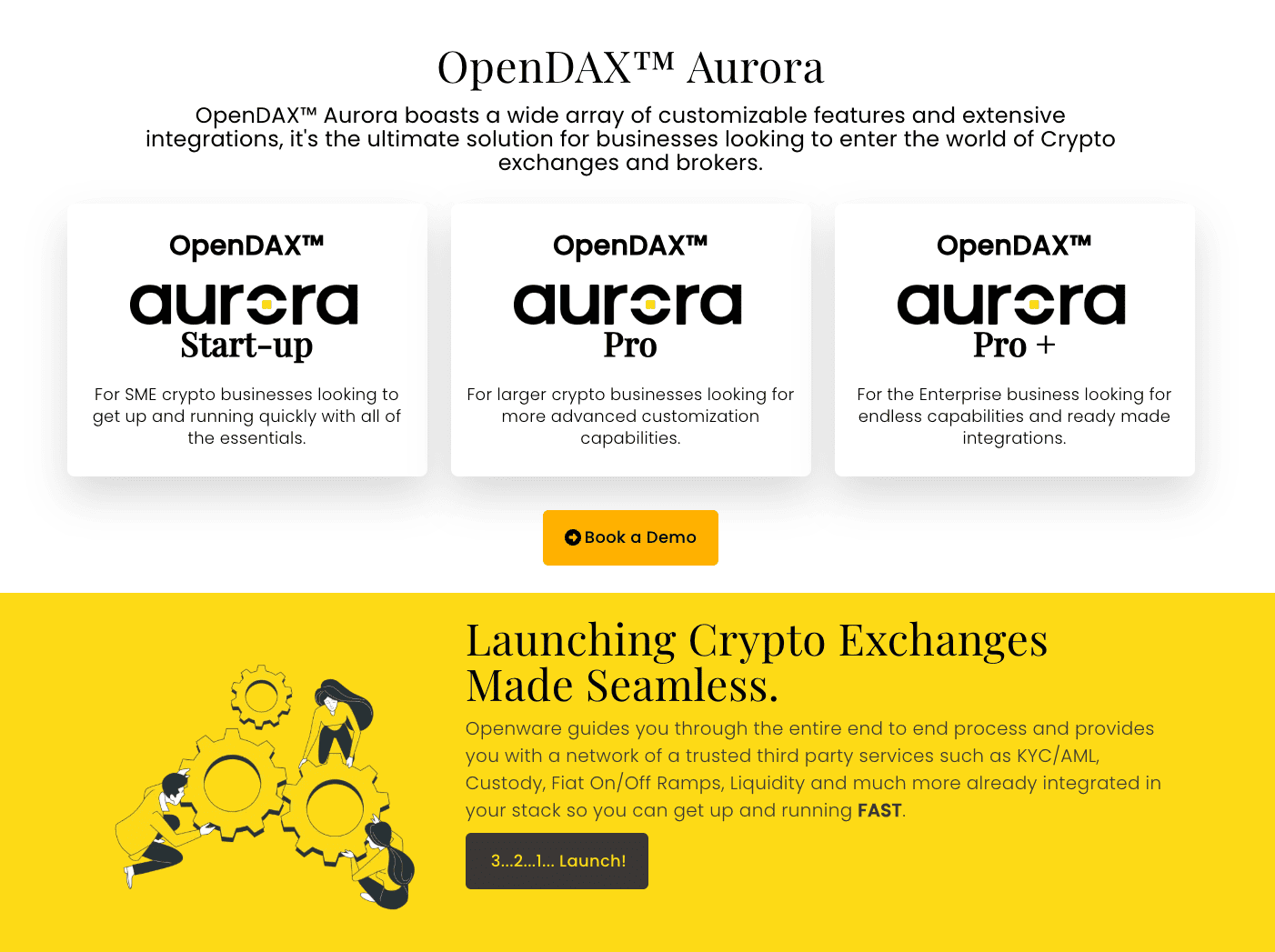
Deployment options include cloud, on-premise (bare metal), and turnkey. The minimum project size starts around $50,000, with most engagements under $100,000. Hourly customization rates run $50–$200. Notable clients include JDAX, Yellow, EMIREX, and Polkadex.
Owning the source code is particularly valuable for operators in jurisdictions with strict data localization rules, or for businesses planning to scale across multiple markets. The downside is a longer setup timeline (4–12 weeks for custom builds) and a higher upfront investment than SaaS alternatives.
Pros
Perpetual license with full source code ownership
High-performance OpenFinex matching engine
Maximum long-term flexibility and independence
Cons
High upfront cost ($50,000+ minimum)
Longer deployment timeline for custom builds
PayBito
PayBito (also marketed as PayBitoPro) targets operators looking for a budget-friendly entry point into the whitelabel exchange space. Subscription pricing starts at $149 per month for the Basic tier and scales to $12,000 per month for the Plus tier.
Developer Experience
If you have an in-house development team, check the quality of the provider’s API documentation, the availability of SDKs, and GitHub activity. Source code access (provided by OpenDAX and HollaEx’s open-source kit) offers maximum flexibility but requires technical expertise to leverage effectively.
Launching Your Crypto Exchange With Whitelabel Software
Marketing materials from whitelabel providers often promise a launch in days. The reality is more nuanced. A realistic timeline from contract signing to full public launch is 4–12 weeks, depending on the provider and the level of customization involved.
During weeks one and two, expect server provisioning, branding customization, and initial UI setup. Weeks three and four typically cover fiat payment gateway integration and liquidity routing. Weeks five through eight handle legal compliance, KYC/AML integration, and load testing.
A soft launch can happen around week six, with full public rollout by week eight to twelve. Operators in jurisdictions with strict licensing (especially the EU under MiCA) should budget additional time for regulatory filings.
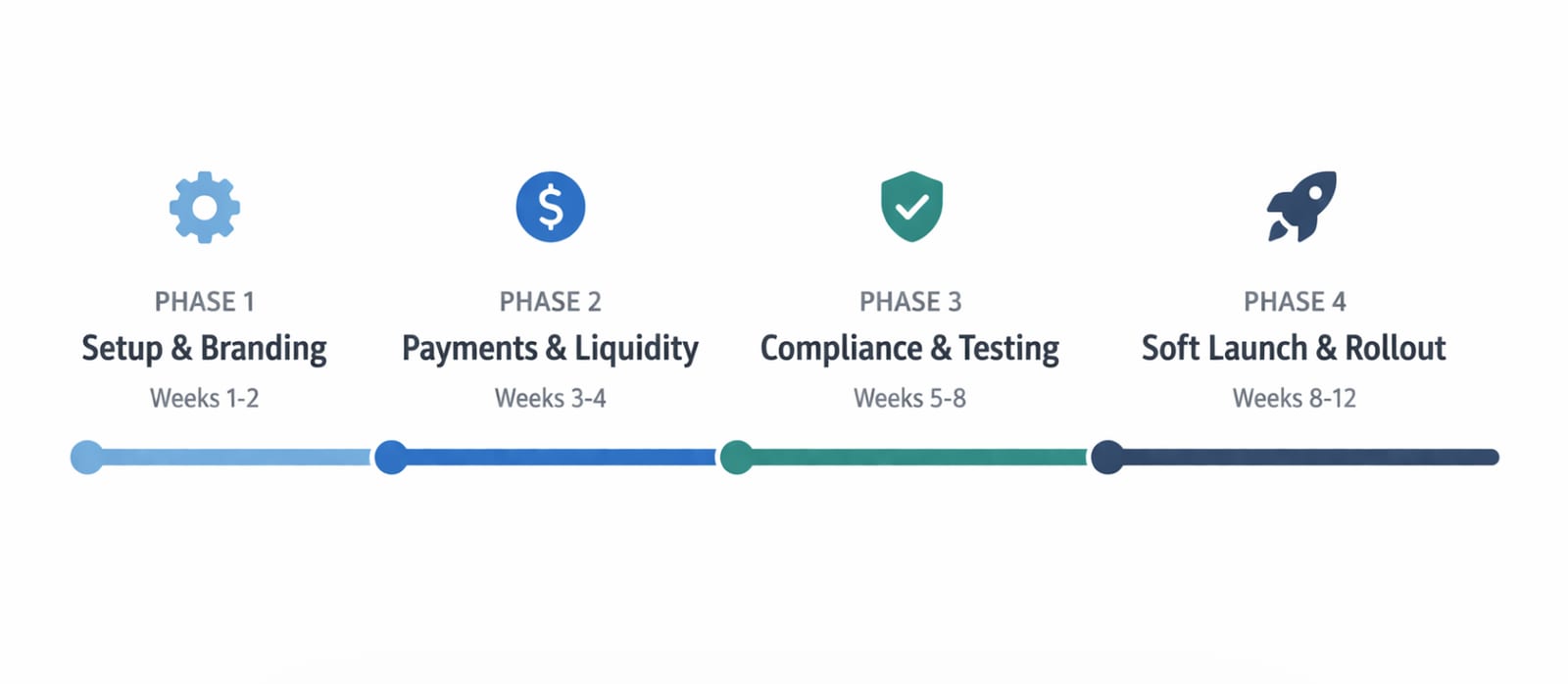
Realistic launch timeline from contract to public rollout
Our Conclusion: Which Is the Best Option in 2026?
The right whitelabel crypto exchange solution depends on what you’re building and how fast you need to get there. After reviewing the best crypto whitelabel solutions on the market, our top pick for most operators is ChangeNOW.
The zero-upfront-cost revenue share eliminates the financial barrier that stops many projects before they start. The liquidity aggregation across major CEXs and DEXs solves the cold-start problem that kills new exchanges. And the non-custodial architecture means less regulatory overhead in jurisdictions with strict custody requirements.
That said, enterprise operators with institutional clients and a need for advanced trading products should look at AlphaPoint or ChainUp. And developers who want full code ownership and long-term platform independence should consider OpenDAX.
Methodology: How We Reviewed Whitelabel Crypto Solutions
We evaluated each whitelabel crypto exchange software provider across six criteria: deployment speed, pricing transparency, liquidity infrastructure, compliance tooling (KYC/AML, Travel Rule, regulatory alignment), technical capability (matching engine, API quality, security certifications), and track record (named clients, reviews). These criteria informed our ranking of the best crypto whitelabel solutions in this guide.
Research drew on official product documentation, published case studies, third-party review platforms (Trustpilot, Clutch, G2), regulatory filings, and industry reports. Where providers did not publicly disclose pricing, we noted estimates based on industry benchmarks.
Disclaimer: Crypto markets are volatile and unpredictable. This guide is for informational purposes only and does not constitute investment or business advice. Always conduct your own research and consult with legal and financial professionals before launching a crypto exchange.
Frequently Asked Questions
What is a whitelabel crypto exchange?
A whitelabel crypto exchange is a pre-built trading platform that a business can license, rebrand with its own logo and design, and launch under its own name. The provider handles the technical infrastructure (matching engine, wallets, liquidity), while the operator focuses on branding, compliance, and user acquisition.
How much does it cost to launch a whitelabel crypto exchange?
The total cost to launch a whitelabel crypto exchange typically ranges from $50,000 to $200,000 for the first year, including licensing, legal setup, liquidity, hosting, and compliance tooling. Software licensing alone ranges from $6,000 per year (HollaEx cloud) to $100,000+ (OpenDAX perpetual license).
How long does it take to launch a whitelabel crypto exchange?
Marketing claims often say days, but a realistic timeline from contract to fully public, compliant launch is 4–12 weeks. Widget-based integrations (like ChangeNOW’s) can be deployed in under a week, while enterprise-grade custom builds with on-premise hosting take longer.
Do I need a license to operate a whitelabel crypto exchange?
In most jurisdictions, yes. The EU requires CASP authorization under MiCA. The US requires federal MSB registration plus state-level money transmitter licenses. Singapore, the UAE, and the UK each have their own frameworks.
What is the difference between a whitelabel exchange and building from scratch?
A whitelabel exchange uses pre-built software that you rebrand, cutting development time from months to weeks and reducing costs significantly. Building from scratch gives full control but requires a large team and higher capital.
Can I add my own tokens to a whitelabel exchange?
Most providers support custom token listings, though the process varies. Some platforms (like HollaEx Enterprise Unlimited) allow unlimited coin additions. Others may require additional configuration or fees for assets beyond the default list.
References
Cryptocurrency Exchange Platform Market Size Report, 2030 (Grand View Research)
White Label Crypto Exchange Costs: Complete Breakdown (B2Broker)
Markets in Crypto-Assets Regulation (MiCA) (ESMA)
ChangeNOW Reviews (Trustpilot)
ChainUp – Institutional Crypto Infrastructure (ChainUp)


