


Cardano is declining for the fifth consecutive session while whales accumulate at the fastest pace in weeks ,and the network just launched its most significant infrastructure in years.
Key Takeaways
ADA down 3.6% on the day and more than 8% on the week.
4H channel breakdown targets $0.22.
Whales accumulated 220M ADA in one week, from 13.44B to 13.84B.
Midnight ZK privacy mainnet launched March 30 with £250M bank partnership.
SEC and CFTC jointly classified ADA as digital commodity on March 17.
ADA is trading at $0.2407 on March 31, down 3.6% on the day and more than 8% on the week. On the one-hour TradingView chart, the decline has been structured rather than panicked: a series of lower highs and lower lows from $0.2700 at the start of the week, with each recovery attempt failing before the previous one’s high.
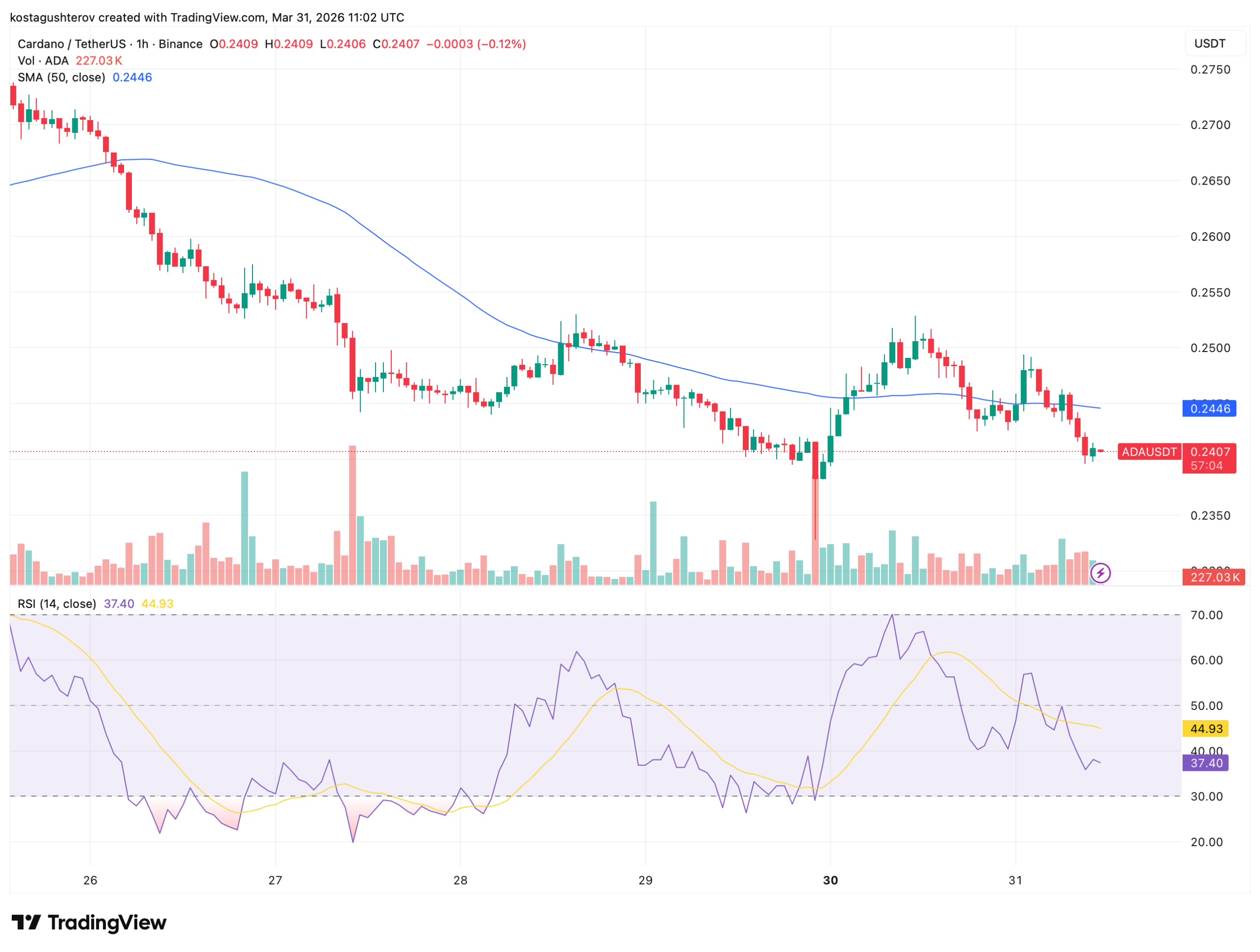
The 50-period simple moving average sits at $0.2446, above current price and still sloping downward. The RSI reads 37.40 against a smoothed signal at 44.93, running more than seven points below its average and approaching oversold territory without yet reaching it. Volume has been low throughout the decline. The selling lacks the conviction that typically marks a capitulation bottom, which means the $0.245 support break on the 4H chart carries more weight than the hourly volume suggests.
The Channel Breakdown
Analyst Ali Martinez identified a channel breakdown on the ADA 4H chart, noting that the break below $0.245 opens the path toward $0.22. When a support level breaks it typically becomes resistance on any bounce attempt, meaning $0.245 now caps recovery attempts rather than holds them. The levels above at $0.273 and $0.304 represent the resistance zones that would need to be reclaimed for the breakdown to be invalidated.
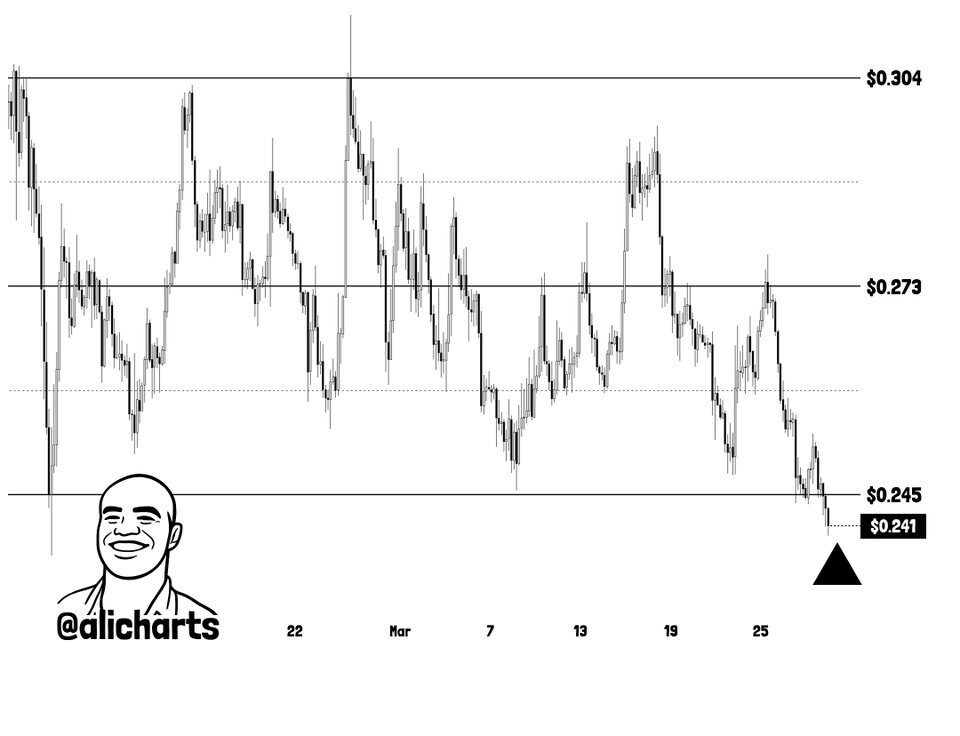
ADA at $0.2407 sits between the broken support and the $0.22 target. Every session that fails to reclaim $0.245 adds weight to the downside scenario.
While the chart is pointing lower, the on-chain data is pointing in the opposite direction.
What Whales Are Doing
According to Santiment data shared by analyst Martinez, whales accumulated 220 million ADA over the past week, with total holdings rising from approximately 13.44 billion ADA on March 24 to 13.84 billion ADA on March 30. The accumulation was steady throughout the channel breakdown, with each day from March 26 onward showing higher total whale balances than the day before.
Whales have accumulated 220 million Cardano $ADA over the past week. pic.twitter.com/ILouoizIyb
— Ali Charts (@alicharts) March 30, 2026
Large holders adding positions into a breakdown while RSI approaches oversold presents two possible readings. Either the accumulated demand drives a recovery before $0.22 is reached, or the channel breakdown completes the flush first and the whale positioning proves to be early rather than timely. What the data establishes is that large holders have already decided which side of this trade they want to be on.
The fundamental case behind that decision changed materially in March.
What Changed This Month
On March 30, Cardano founder Charles Hoskinson officially launched the Midnight mainnet, a zero-knowledge privacy partner chain enabling confidential smart contracts. Monument Bank has already partnered with Midnight to tokenize £250 million in retail deposits. A banking institution tokenizing real deposits on a ZK privacy chain is a production deployment, not a roadmap announcement.
The Midnight mainnet launched two weeks after the SEC and CFTC jointly classified ADA as a digital commodity on March 17, resolving the regulatory ambiguity that had kept institutional capital cautious. Commodity classification means regulated entities can engage with ADA without the legal uncertainty that previously complicated that engagement.
With the regulatory barrier removed and the institutional use case live, the infrastructure layer received its own direct upgrade. USDCx launched on Cardano mainnet, a native stablecoin backed 1:1 by Circle’s USDC reserves via the Cross-Chain Transfer Protocol. Native stablecoin liquidity had been an infrastructure gap limiting DeFi activity on Cardano. USDCx closes it with an asset carrying the credibility of the second-largest stablecoin in existence.
At the retail level, ADA is now accepted at 137 SPAR shops across Switzerland and has been added to Walmart’s OnePay fintech app, placing ADA in daily transaction infrastructure rather than crypto-native use cases alone.
How the Developments Affect the Longer-Term Price Picture
And yet none of the March developments have moved the price. Macro pressure and a broad altcoin decline are the dominant forces in the market right now, and regulatory classifications and mainnet launches do not offset geopolitical stress or Federal Reserve rate expectations in the near term.
What they do change is the structural picture for ADA when those conditions shift. The commodity classification removes the institutional barrier. The Midnight mainnet provides the institutional use case. USDCx provides the liquidity infrastructure. Together they describe a network building conditions for a different kind of demand than the speculative flows that drove previous ADA cycles.
Two more catalysts are on a near-term timeline. The Van Rossem hard fork arrives in Q2 2026, with Node 10.7.0 already in pre-release, targeting Plutus smart contract performance improvements. Ouroboros Leios, the scalability upgrade targeting 1,000 transactions per second, is 67% complete as of March 2026. Both upgrades arrive in the same quarter the channel breakdown is pointing toward its $0.22 target.
The 4H chart is pointing toward $0.22. The development timeline is pointing toward Q2 upgrades that will make the network structurally different from what it is today. Whales accumulated 220 million ADA in a single week into that setup. Whether the flush comes before the recovery or the recovery comes before the flush is the only question the data has not yet answered.


