

Two research teams published reports within weeks of each other in early 2026 that collectively reframed the quantum computing conversation for the entire cryptocurrency industry.
Key Takeaways
Google’s March 2026 quantum paper cited Algorand 32 times as the benchmark for real-world post-quantum cryptography on a live blockchain.
Algorand secured SWIFT ISO 20022 integration and Visa Principal membership within the same week.
ALGO surged over 44% following the Google publication, reaching $0.12, while broader crypto markets sat deep in extreme fear territory.
The question shifted from whether post-quantum cryptography would eventually be necessary to which networks had already built the infrastructure to survive the transition. Algorand found itself at the center of that answer.
The Research That Triggered It
ARK Invest fired the opening shot on March 12, 2026, in a white paper co-authored with Unchained that quantified Bitcoin’s quantum exposure at institutional scale for the first time. The firm identified approximately 6.9 million BTC – roughly 34.6% of circulating supply – as theoretically vulnerable because their public keys are already visible on-chain. Within that figure sits around 1.7 million BTC from the Satoshi era, locked in P2PK format and impossible to migrate without private keys that may no longer exist. ARK’s overall framing remained measured, placing the most probable Q-Day in the mid-2030s.
Google’s paper, published March 31, made that framing look optimistic almost immediately. The Google Quantum AI team demonstrated that breaking Bitcoin’s elliptic curve cryptography may require fewer than 500,000 physical qubits – a 20-fold reduction from prior estimates of 10 million or more. Their calculations suggested a sufficiently advanced quantum computer could derive a Bitcoin private key in approximately nine minutes, inside the ten-minute block confirmation window and putting every live transaction theoretically at risk of mempool interception.
Why Google Kept Returning to Algorand
The paper cited Algorand 32 times – not incidentally, but because the authors repeatedly used it as the reference case for what real-world post-quantum deployment actually looks like when it exists beyond a proposal document.
The live implementations Google highlighted include Falcon Digital Signatures, a NIST-standardized lattice-based scheme currently active in Algorand’s smart transaction layer, and State Proofs – post-quantum secure certificates generated every 256 rounds that attest to the ledger’s historical integrity in a way that survives attack on classical elliptic curve schemes. Google also specifically flagged Algorand’s native rekeying function, which allows private key rotation without changing a public address, as a design feature that meaningfully reduces migration friction compared to architectures requiring users to manually move funds under time pressure.
UC Berkeley and Google researchers described Algorand’s current posture as a “tangible hedge” that “facilitates future migration” – language that stands in clear contrast to the upgrade roadmaps Bitcoin and Ethereum are still in the process of drafting.
Bitcoin and Ethereum: Still Drafting
For Bitcoin, the 2021 Taproot upgrade inadvertently widened the problem by exposing public keys by default in its key-path spending mode. BIP-360, a quantum-resistant address proposal merged in February 2026, and a Coinbase-led developer coalition announced by Brian Armstrong on April 3 represent the current response – though experts note BIP-360 remains a partial fix without full post-quantum signatures. A complete voluntary migration could realistically take seven or more years.
Ethereum’s path is more coordinated, targeting full post-quantum status by 2029 through a shift from BLS signatures to hash-based alternatives and a transition from KZG blob commitments to STARK technology. Vitalik Buterin has placed the probability of a meaningful quantum breakthrough before 2030 at around 20% – a figure worth revisiting given Google’s qubit reduction results. The fundamental challenge remains upgrading thousands of individual smart contracts on top of whatever the new base layer becomes.
Algorand’s Parallel Infrastructure Build
The quantum paper did not arrive in isolation. On April 4, 2026, SWIFT completed integration testing of its ISO 20022 global financial messaging standard with Algorand, positioning the network as a potential settlement layer for regulated institutional finance. A day earlier, Quantoz – a payments firm operating on Algorand – became a Visa Principal Member, enabling real-time on-chain settlement of Visa debit transactions using Algorand’s instant finality. The Algorand Foundation and Algorand Technologies consolidated into a single Delaware-based entity in March 2026, with a new board drawing from former executives at MoneyGram, Abra, and FinCEN.
On the protocol side, the AVM v10 upgrade brought average block finality down to 2.8 seconds from 3.4, the network completed its transition to a fully peer-to-peer gossip protocol, and AlgoKit 4.0 introduced SDKs for Rust, Swift, and Kotlin. Algorand reportedly commands approximately 70% of the real-world asset tokenization market with over $425 million in tokenized assets on-chain, and has achieved full compatibility with the x402 protocol for autonomous AI agent payments.
Price Action
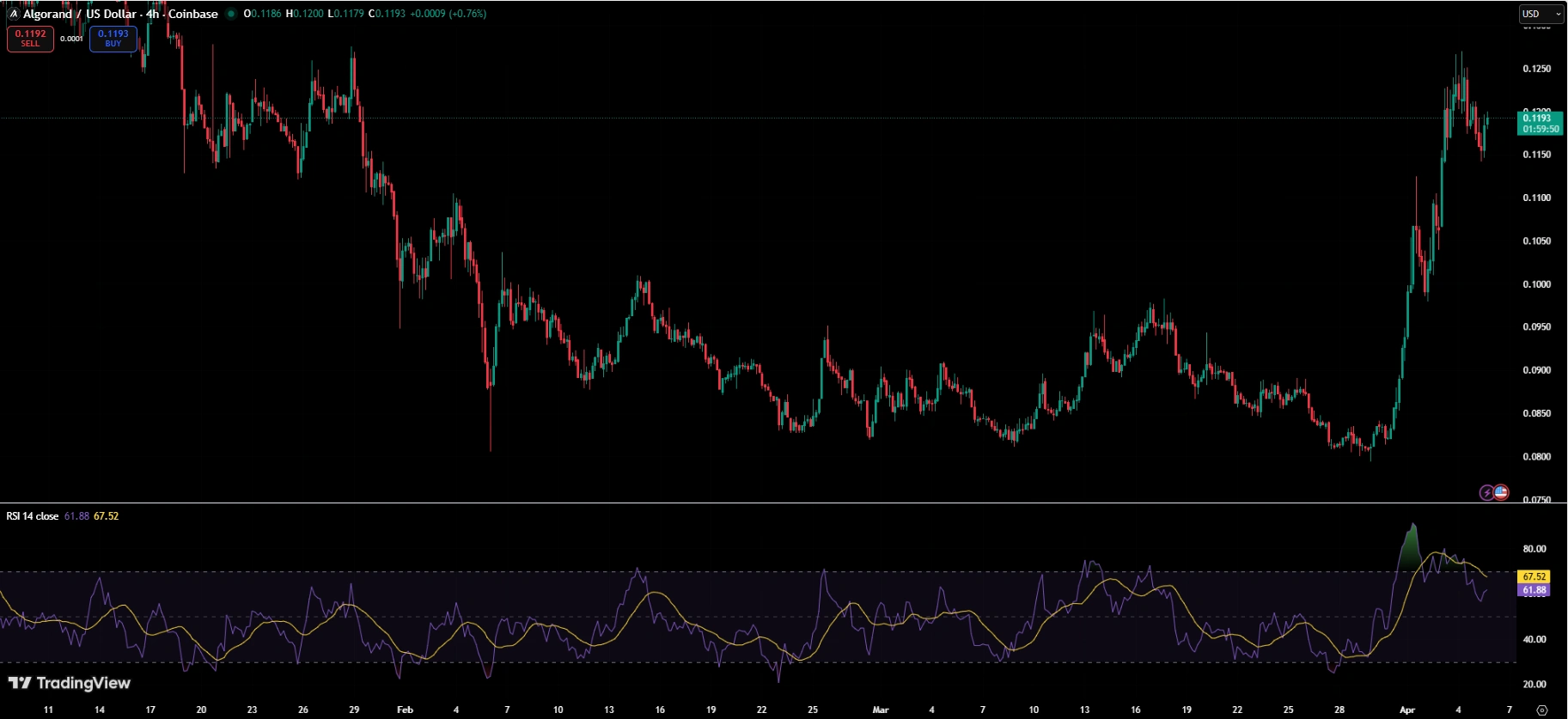
The 4-hour ALGO chart reflects a sharp, conviction-driven rally that has partially consolidated without breaking down structurally. From lows near $0.08, the token surged to approximately $0.125 before pulling back to the current $0.1193. The RSI peaked above 80 at the high and has since settled to the 61-67 range, with the moving average still lagging below – a configuration that typically suggests residual momentum rather than exhaustion. Daily volume surged nearly fivefold to roughly $167 million during the move, indicating genuine repositioning rather than thin liquidity amplification.
Bitcoin at $67,344 with a 4-hour RSI near 52 and Ethereum around $2,062 with an RSI below 50 both reflect neutral consolidation – neither pricing in the quantum risk with urgency nor dismissing the research. Google has set 2029 as its internal deadline for migrating its own systems to post-quantum cryptography. Whether institutional custodians begin treating quantum resistance as a standard due diligence requirement in the next 12 to 24 months is the variable that will determine whether ALGO’s current premium reflects genuine structural advantage or simply the market’s first, loudest reaction to a threat it is still learning to price.


