


Ethereum trading near levels last seen in early 2021 - around $2,000 - and that fact alone tells you more about the asset's recent history than any chart pattern.
Key Takeaways
Charles Schwab opened a waitlist for direct ETH spot trading, targeting 46 million client accounts managing ~$12 trillion in assets
Bitmine Immersion Technologies now holds 4.73 million ETH (~3.92% of circulating supply), with $177M in annualized staking revenue
The Ethereum Foundation staked ~70,000 ETH to generate yield and reduce market sell pressure
ETH has dropped 57% from its August 2025 peak, trading near $2,058, with RSI and MACD both pointing to neutral-to-bearish momentum
Yet over the past two weeks, a cluster of institutional moves has come together that makes the current price look less like stagnation and more like a compressed spring.
Schwab Opens the Door for 46 Million Retail Investors
The headline came on April 3rd, when Charles Schwab confirmed it is opening a waitlist for a new product called Schwab Crypto – a dedicated account that will let clients buy and sell Bitcoin and Ethereum directly, not through ETFs or derivatives. The firm, which manages $12.22 trillion in client assets across 38.9 million active brokerage accounts, plans a limited Q2 rollout, testing internally with employees before opening to a select group of clients, then broader availability. CEO Rick Wurster has framed this as a response to demand – the company has observed a 400% increase in crypto-related web activity among its users – and the logic is straightforward: tens of millions of Americans who already manage stocks and bonds through Schwab may not want to open a separate crypto exchange account to access the same assets. Charles Schwab will not accept cryptocurrency deposits from external wallets at launch as reported by TheBlock, so this is explicitly a gateway product, not a custody solution for existing holders.
Schwab is not alone in this pivot. Morgan Stanley is preparing to offer spot Bitcoin, Ether, and Solana trading through E*Trade via a partner model with Zerohash, and has filed for its own national trust bank charter. The traditional finance industry is clearly no longer content with proxy exposure through ETFs.
Bitmine Doubles Down with the Largest Corporate ETH Treasury on Earth
On the corporate treasury side, Bitmine Immersion Technologies (NYSE: BMNR) has positioned itself as the most aggressive institutional accumulator of Ethereum in existence. On March 30th, the company completed its largest weekly purchase of 2026 -71,179 ETH for approximately $143 million – bringing total holdings to 4,732,082 ETH, or about 3.92% of the circulating supply. Roughly two-thirds of that position, around 3.14 million ETH, is actively staked through its proprietary MAVAN (Made in America Validator Network) platform, which launched on March 25th. Current annualized staking revenue sits at approximately $177 million, with the company projecting that figure could reach $266 million once the full treasury is deployed. This is not a passive buy-and-hold play – it is an infrastructure-level bet on Ethereum becoming the backbone of yield-generating institutional capital.
The Ethereum Foundation Stops Selling, Starts Staking
The Ethereum Foundation itself shifted tactics in the same direction. Rather than holding ETH and periodically selling to fund operations – a practice that has historically put downward pressure on the market – the Foundation staked roughly 70,000 ETH at a target yield of around $4–5.4 million annually. The change is structurally meaningful: it converts what was a recurring source of sell pressure into a net-neutral or even net-positive position for the open market.
The Price Chart Tells a Different Story
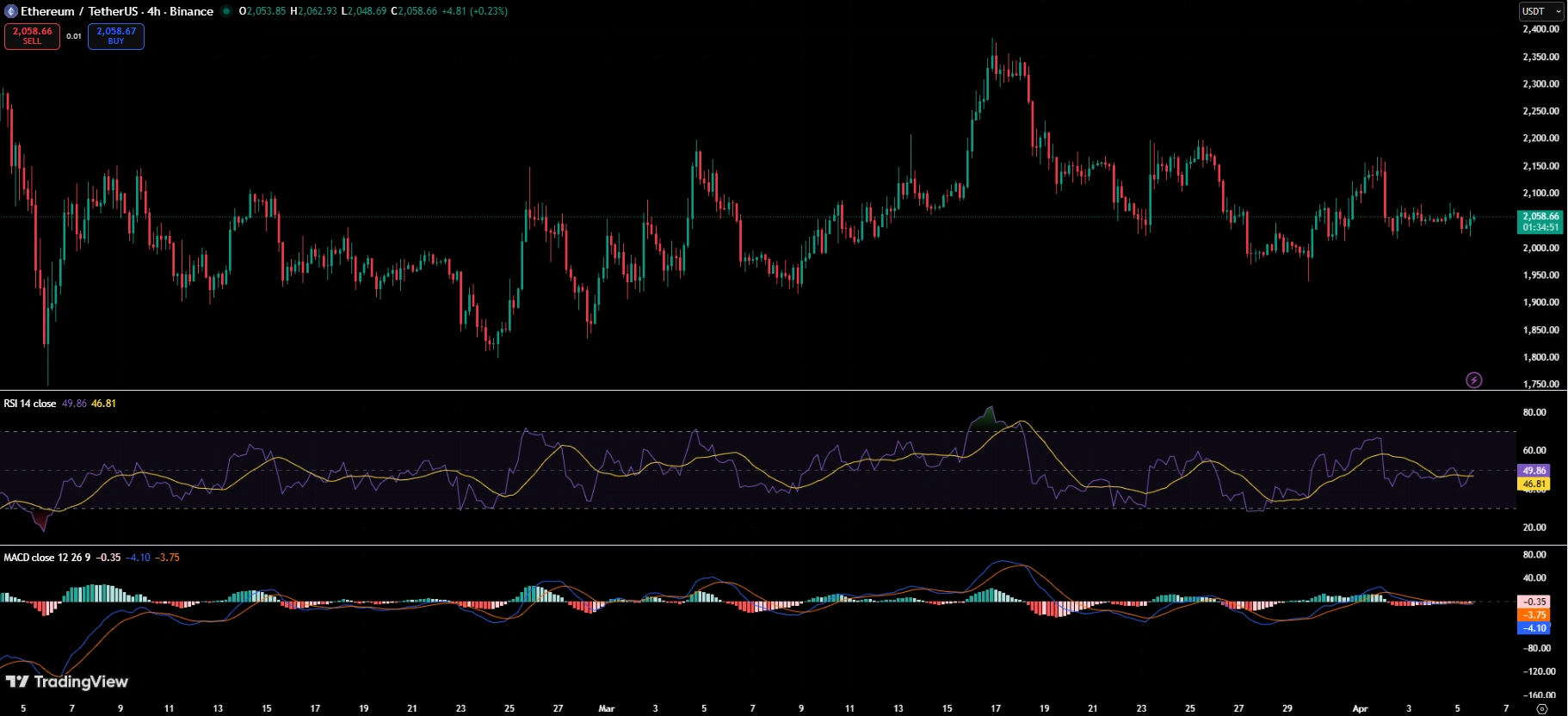
Despite all this, the chart tells a more complicated story. As of April 5th, ETH is trading at $2,058, with an RSI of approximately 49.86 on the 4-hour timeframe and a MACD reading of -4.10 – both indicators sitting in uncomfortable neutral-to-bearish territory.
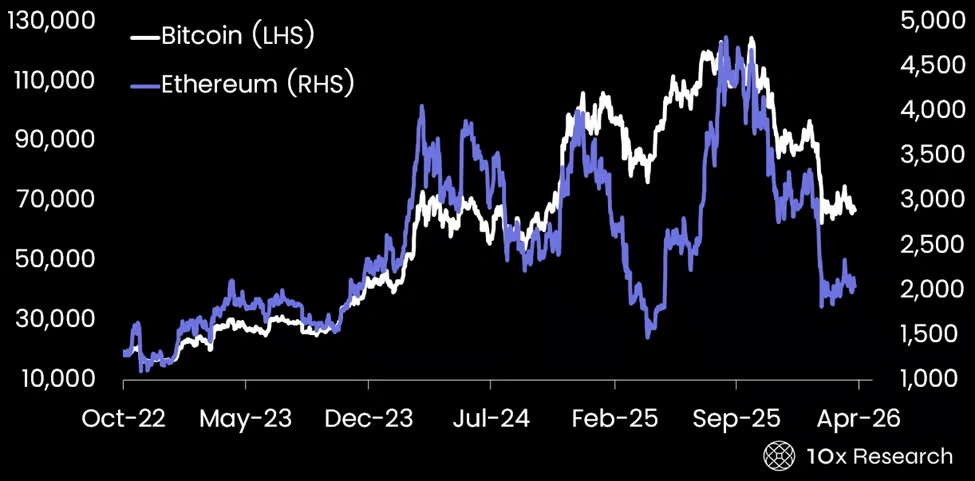
Research firm 10x Research noted in a recent post that Ethereum has effectively been “dead money” at the $2,000 level, and that the network has underperformed Bitcoin by roughly 15 percentage points since August 2025’s peak.
Early April saw ETH drop below $2,000, triggering $111 million in long liquidations and $391.8 million in ETF outflows, though whale accumulation near those lows added 466,500 ETH, including a $150 million single-wallet buy.
On-chain data from Glassnode puts ETH held on exchanges at 10.969% of total supply – a record low for the network – which typically signals long-term holder conviction and reduced near-term sell pressure. The stablecoin angle is also worth noting: USDT issuance on Ethereum recently outpaced issuance on Tron, reigniting the argument that Ethereum’s real value proposition isn’t speculative price action but settlement layer dominance for the stablecoin economy.
What the 2026 Roadmap Actually Changes
Looking further ahead, Ethereum’s 2026 technical roadmap includes two significant upgrades. The Glamsterdam hard fork, scheduled for mid-year, targets throughput of up to 10,000 transactions per second through parallel execution, along with the implementation of EIP-7732 (Enshrined Proposer-Builder Separation), which would reduce dependence on external block relays and improve decentralization at the protocol level.
Following that, the Hegota upgrade in late 2026 introduces Verkle Trees – a foundational step toward statelessness that would lower the hardware requirements for running a full node. The already-activated Fusaka upgrade, which expanded blob capacity from 6 to 48 per block, has already meaningfully reduced costs for Layer 2 networks built on top of Ethereum.
Revival or Structural Decline – The Question Remains Open
The 10x Research framing -is this a revival or the continuation of structural decline – is probably the most honest way to state the uncertainty. The accumulation is real, the infrastructure improvements are real, and the institutional access is expanding. What is not yet clear is whether any of it is enough to shift the demand picture in a market where Ethereum ETF outflows have run for five consecutive months while Bitcoin ETFs collected $1.32 billion in net inflows during March alone. The asset is cheap relative to its own history. Whether that’s an opportunity or a trap depends almost entirely on what happens on-chain over the next two quarters.


