

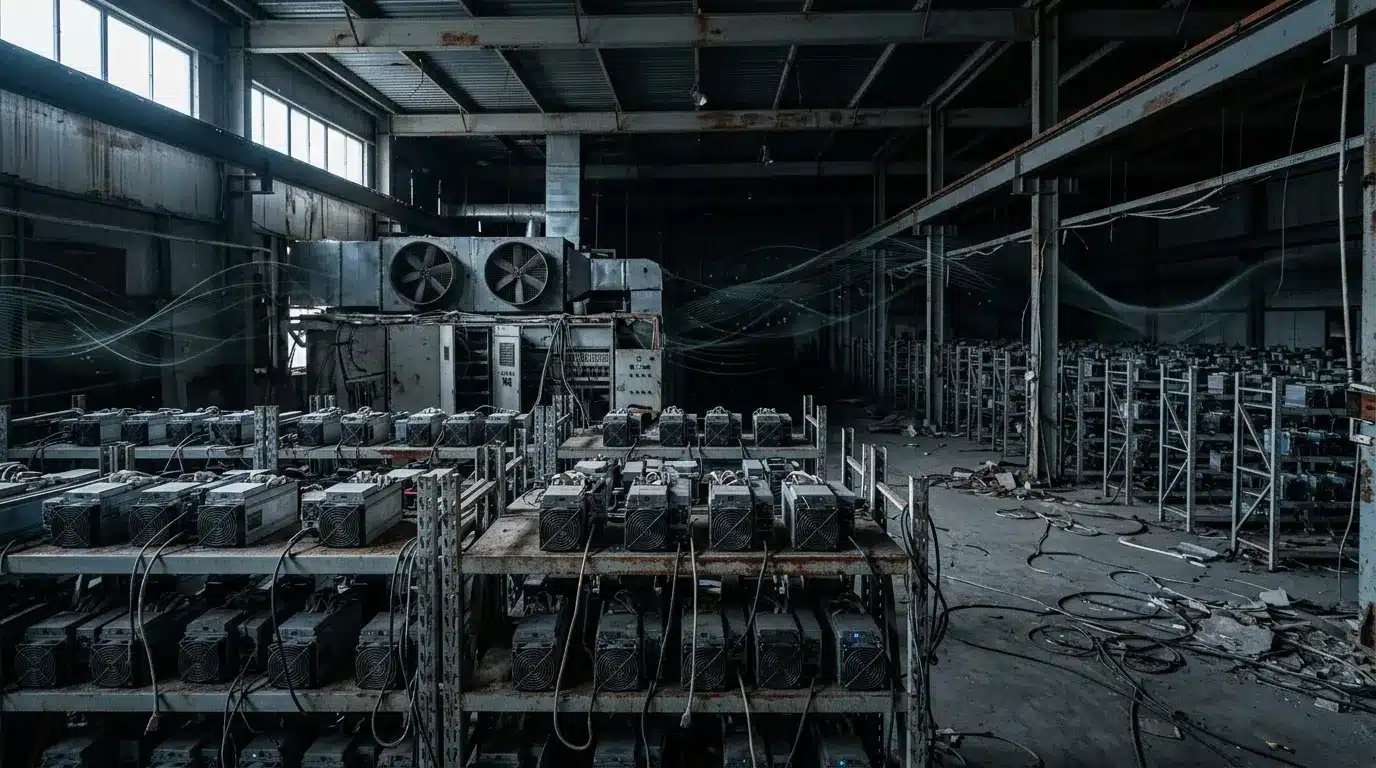
Iran Bitcoin hashrate fell approximately 77% over the past quarter – from roughly 9 exahashes per second to 2 EH/s, as U.S. and Israeli military strikes disrupted power infrastructure and forced an estimated 427,000 active mining machines offline, according to a Hashrate Index report published Monday by Ian Philpot, marketing director at Luxor Technology.
The loss represents approximately 7 EH/s quarter-over-quarter and marks the most severe regional hashrate contraction since China’s 2021 mining ban.
The immediate implication is geographic redistribution rather than network degradation. Global hashrate has held near 1,000 EH/s throughout the disruption, a figure that underscores the decentralized architecture Bitcoin’s proof-of-work security model was designed to preserve.
Regional disruptions redistribute hashrate rather than destroy it.” The 7 EH/s lost from Iran represents less than 0.7% of the network’s pre-conflict capacity, which contextualizes why global figures absorbed the shock without measurable security degradation. A two-week ceasefire between the U.S. and Iran was reached Tuesday, though the durability of that arrangement – and any infrastructure restoration timeline – remains unclear.
Bitcoin’s difficulty algorithm adjusts every 2,016 blocks – roughly every two weeks – to maintain a ten-minute average block time regardless of how much hashrate enters or exits the network. Iran’s 7 EH/s loss is meaningful at a regional level but statistically modest against a 1,000 EH/s global baseline; the difficulty adjustment would absorb that volume in a single recalibration cycle without material impact to block interval or transaction finality.
The more consequential difficulty signal is elsewhere: the 30-day simple moving average of global hashrate declined from 1,066 EH/s in Q1 to approximately 1,004 EH/s in Q2, a 5.8% quarter-over-quarter drop that Philpot attributed primarily to Bitcoin’s price collapse rather than geopolitical disruption.
Bitcoin has fallen more than 45% from its all-time high of $126,000 set in October, according to CoinGecko data, pushing hash prices to record lows and forcing an estimated 252 EH/s of older, less efficient ASICs offline globally. The parallel to the post-2021 China mining ban is instructive but imperfect: China’s 2021 exit removed 50–70% of global hashrate in weeks, triggering multiple consecutive negative difficulty adjustments before capacity migrated to the U.S. and Kazakhstan.
Iran’s loss is an order of magnitude smaller and has produced no comparable adjustment cascade. We suspect the Q2 difficulty softness is predominantly a profitability story – miners voluntarily curtailing marginal machines – rather than a conflict story. The Iran disruption is a regional footnote within a globally price-driven contraction.


