

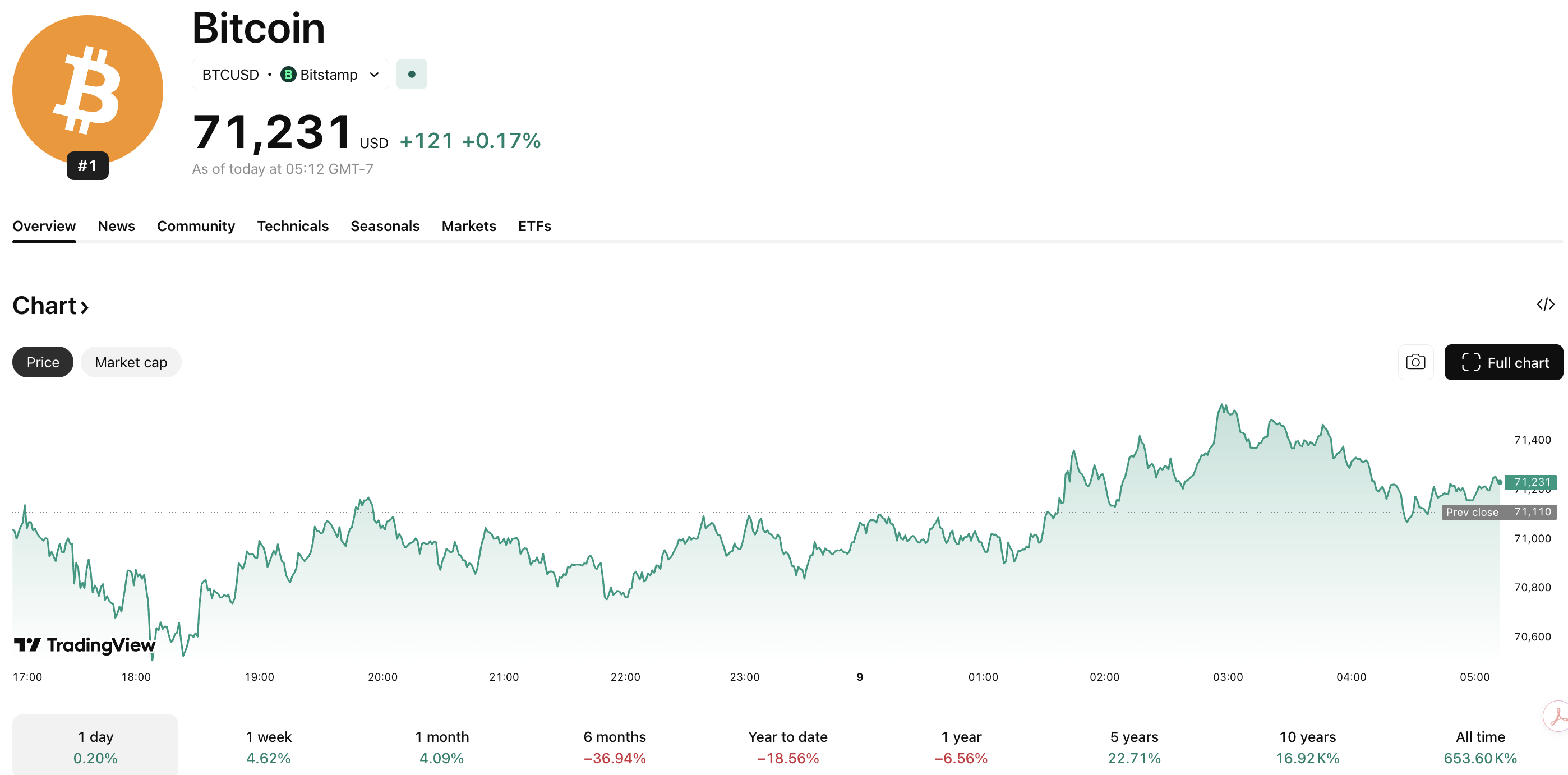
Bitcoin USD surged from around $68,000 to nearly $73,000 in hours after Iran began demanding crypto payments for oil tankers crossing the Strait of Hormuz, a move that has traders reassessing what it takes to reach a $100,000 Bitcoin target.
The catalyst this time isn’t a halving or an ETF filing. It’s a warship and a Bitcoin wallet address. More than $400 million in short positions were liquidated in the 24 hours following President Trump’s ceasefire announcement, and the real question now is whether this geopolitical demand shock has legs, or whether the rally fades once the ceasefire terms are tested.
JUST IN: ?? Iran to require ships passing through the Strait of Hormuz to pay tolls in Bitcoin, FT reports. pic.twitter.com/6yoIEys139
— Watcher.Guru (@WatcherGuru) April 8, 2026
Tankers email cargo details to Iranian authorities, pay a fee, roughly $1 per barrel, and have seconds to pay in Bitcoin. A fully loaded supertanker carrying two million barrels owes approximately $2M per crossing, settled entirely on-chain.
The Strait handles roughly 20% of the world’s oil supply. Every tanker crossing now represents a live Bitcoin transaction on a geopolitical scale. That context, not chart patterns, is what’s pulling institutional attention toward the $100,000 price debate.
(SOURCE: TradingView)
Can Bitcoin Price Hit $100K If Hormuz Pressure Holds?
Bitcoin’s move from $68,000 to $73,000 was sharp, but the more important number is what comes next. Analysts are projecting a move toward $75,000 if current momentum holds, citing $68,000 as the key near-term support level to watch. A clean hold above that floor, combined with sustained geopolitical demand, sets up the next leg.
Previous Iran de-escalation cycles showed Bitcoin USD quickly giving back gains once tensions cooled, which is the bear case here.
Three scenarios emerge from the current setup:
Bull case: Ceasefire frays, tanker toll enforcement escalates, and capital rotation into Bitcoin as a sanctions-proof settlement layer accelerates, price tests $85,000–$100,000.
Base case: Ceasefire holds for the two-week window, momentum stalls near $75,000, and Bitcoin consolidates amid lingering macro uncertainty.
Invalidation: A full diplomatic resolution removes the geopolitical bid. Bitcoin loses $68,000 support and retraces toward the mid-$60,000 range.
The data suggests the bull case requires sustained instability, which, historically, the Strait of Hormuz has delivered with uncomfortable regularity.
DISCOVER: Best New Crypto for 2026
Bitcoin Hyper Targets Early-Mover Upside as Bitcoin USD Tests Key Levels
Bitcoin at $72,000 is impressive. But holders who bought at $40,000 are not even sitting on a 2x, let alone a 10x. The asymmetric upside now sits earlier in the stack, in infrastructure plays being built on top of Bitcoin itself before the broader rally reprices them.
Iran’s use of Bitcoin for real-time settlement just validated exactly the kind of fast, programmable, low-friction Bitcoin transactions that Layer 2 infrastructure is designed to enable (Bitcoin’s base layer, famously, does not natively support settlement in seconds).
Bitcoin Hyper ($HYPER) is positioning directly in that gap. Marketed as the first-ever Bitcoin Layer 2 with Solana Virtual Machine (SVM) integration, the project claims faster transaction performance than Solana itself, while preserving Bitcoin’s underlying security model. The presale has raised over $32M at a current price of $0.0136783, with staking rewards available for early participants.
Features include a decentralized canonical bridge for BTC transfers and extremely low-latency smart contract execution. Layer 2 projects tied to Bitcoin’s momentum have drawn significant capital ahead of major rallies before.


