


Stablecoins have spent years being treated as a footnote in the broader crypto conversation - a utility layer that traders use to park capital between positions.
Key Takeaways
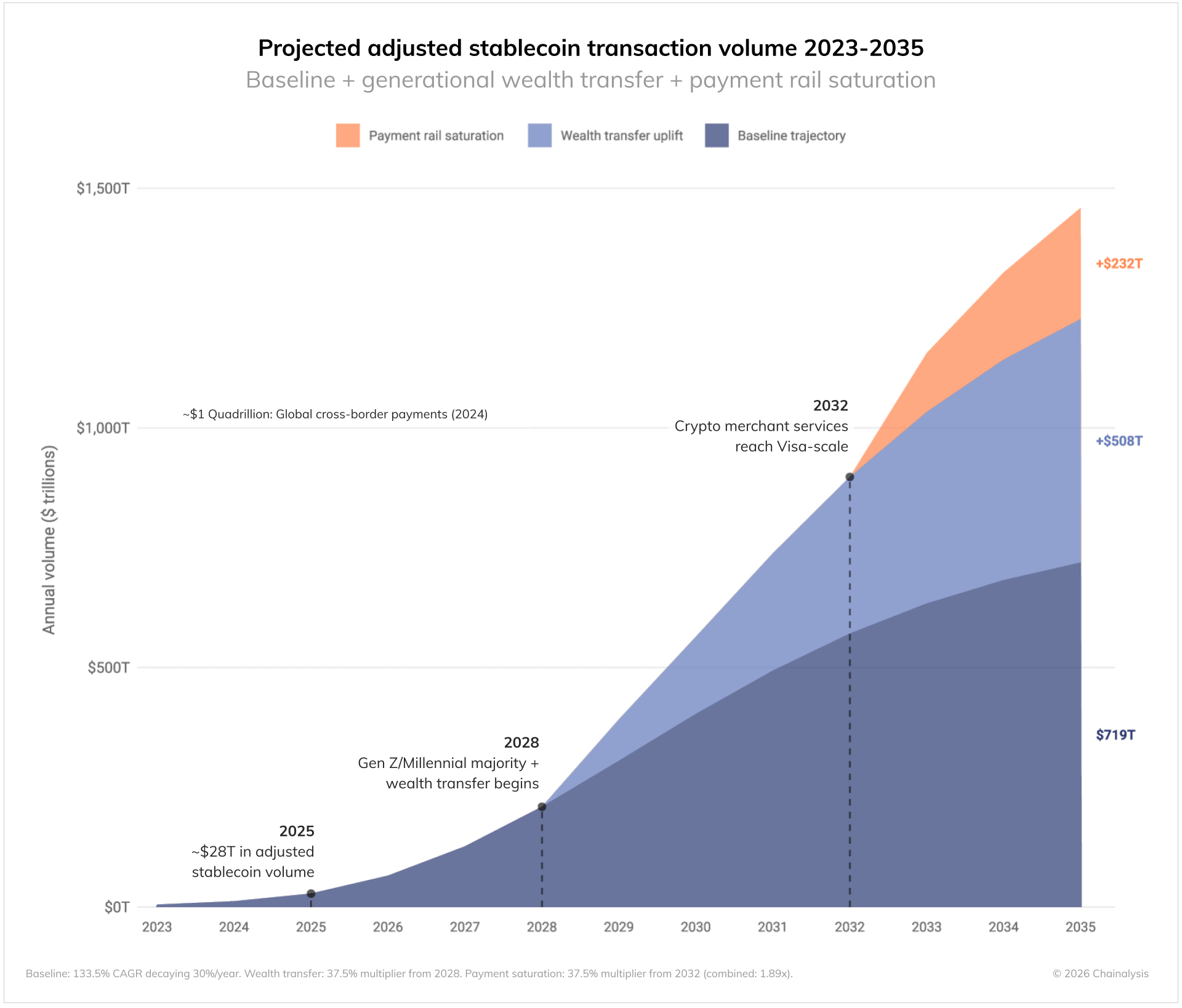
Chainalysis projects stablecoin transaction volume could grow from $28 trillion in 2025 to $719 trillion by 2035, with an upside scenario of $1.5 quadrillion.
Solana overtook Ethereum in monthly stablecoin settlement volume for the first time in February 2026, processing roughly $650 billion.
B2B stablecoin payments have surged from under $100 million monthly in 2023 to over $6 billion by mid-2025.
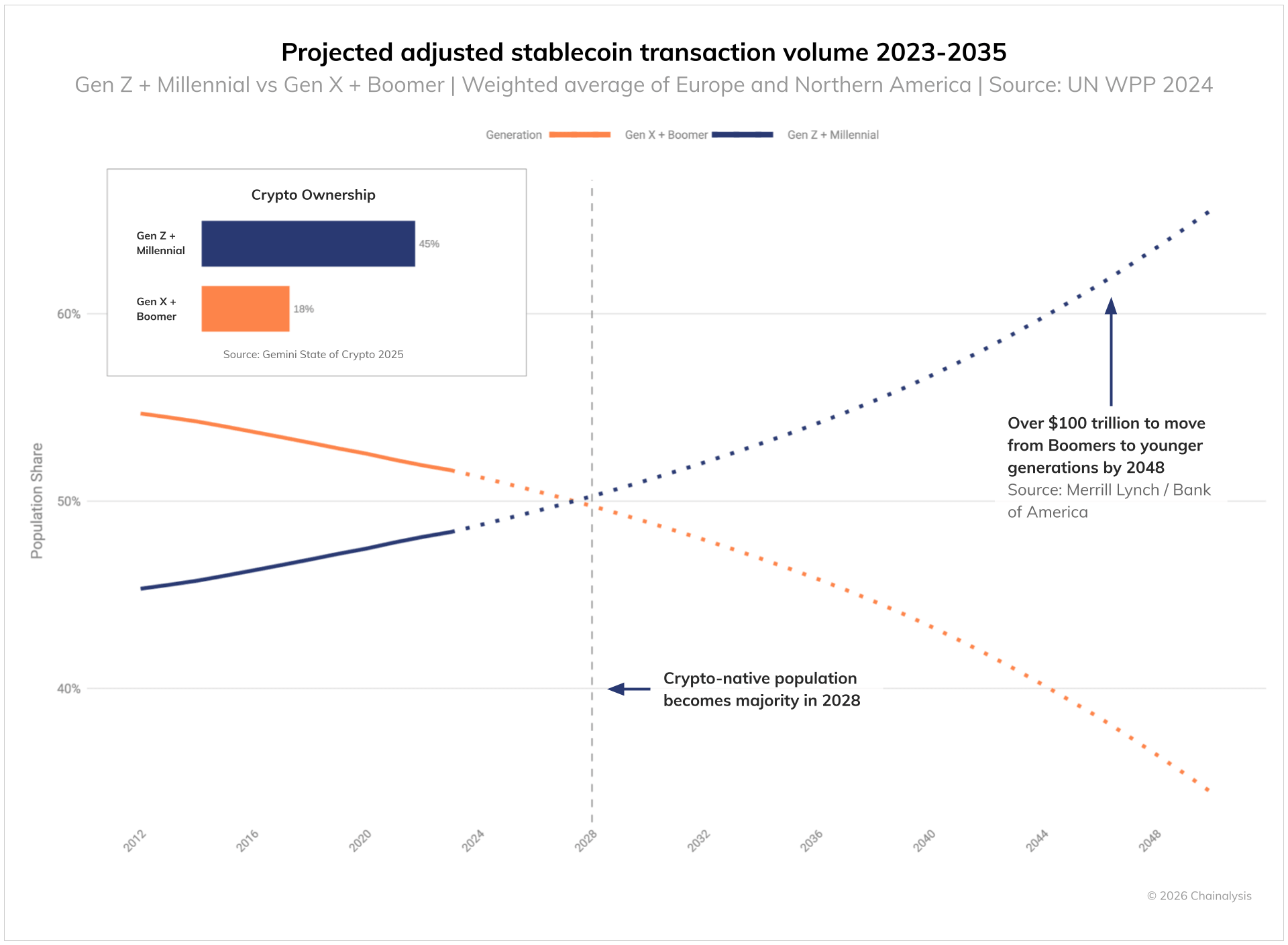
A $100 trillion generational wealth transfer beginning in 2028 is expected to redirect capital toward crypto at scale.
A new report from blockchain analytics firm Chainalysis published in early April 2026 makes a substantially different argument: that stablecoin infrastructure is quietly becoming the backbone of global payments, and that a confluence of regulatory shifts, generational capital flows, and corporate acquisitions is about to make that process irreversible.
The numbers in the report are large enough to invite skepticism. Chainalysis projects that inflation-adjusted stablecoin transaction volume, currently sitting at roughly $28 trillion annually, could reach $719 trillion by 2035 under baseline conditions.
If point-of-sale adoption saturates physical and e-commerce checkouts at scale, that figure climbs to $1.5 quadrillion – a number that would exceed the estimated $1 quadrillion in total global cross-border payments. For context, the growth from current levels to the baseline projection alone represents an increase of over 5,000%.
The Architecture Has Already Changed
The on-chain picture right now is more complicated than the projections suggest.
Santiment data from early 2026 shows Ethereum network stablecoin address activity sitting at its lowest point of the year, with active Tether addresses falling to levels not seen since December 2018 and USD Coin addresses dropping to their lowest since mid-December. On the surface, that reads as a contraction.
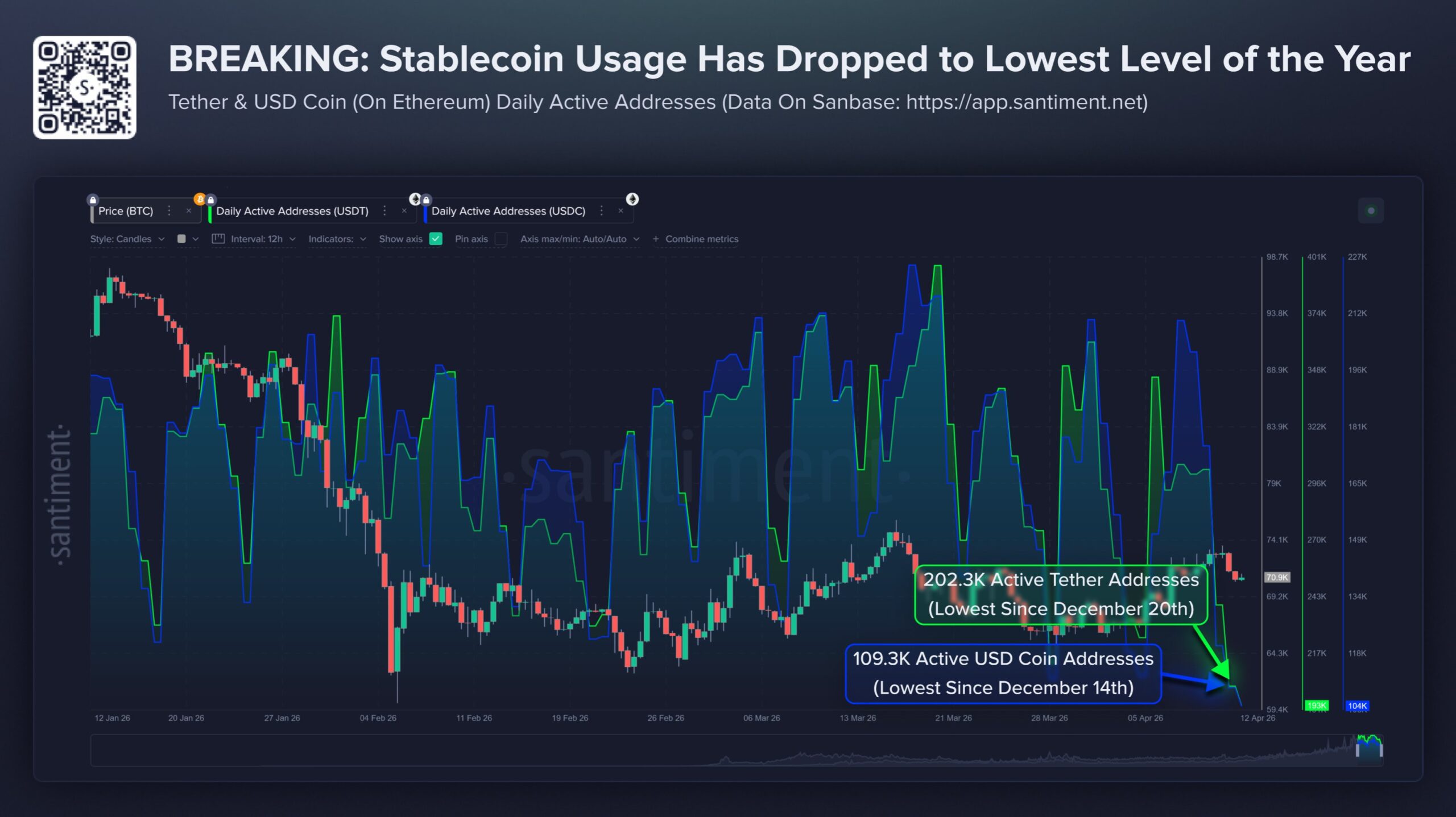
The explanation requires a layer of context. Approximately 95% of Ethereum’s transaction throughput now runs through Layer 2 networks like Arbitrum and Base, where fees are low enough to make stablecoin payments practical for everyday transactions. The main Ethereum chain is increasingly where institutional capital sits, not where it moves. Separately, Solana overtook Ethereum in monthly stablecoin settlement volume for the first time in February 2026, processing roughly $650 billion that month. The infrastructure story is less about a single network and more about a fragmented, competitive ecosystem where different chains are winning different use cases.
Business Adoption Is the Real Driver
The most significant data point in the current stablecoin picture is not speculative volume projections – it is what is already happening with B2B payments. Business-to-business transactions now account for roughly 60% of real-economy stablecoin volume. Monthly B2B stablecoin payments grew from under $100 million in early 2023 to over $6 billion by mid-2025. That is not a retail crypto trading trend. That is companies using digital dollars to move money across borders faster and cheaper than the correspondent banking system allows.
Projections from Morph suggest stablecoins could capture 10% of all global cross-border payments by 2030. Traditional financial networks are clearly paying attention. Stripe acquired stablecoin infrastructure company Bridge for $1.1 billion in 2025. Mastercard has partnered with BVNK and is reportedly pursuing a further acquisition valued at $1.8 billion. These are not exploratory bets – they are defensive positioning by companies that process combined volumes that stablecoins are explicitly projected to match between 2031 and 2039.
The Generational Component
The report places significant weight on what it calls the Great Wealth Transfer – an estimated $100 trillion in assets moving between generations between 2028 and 2048. The demographic argument is straightforward: Baby Boomers, who hold the majority of current wealth, are largely crypto-skeptical, while the generations inheriting that wealth are not. A January 2026 survey found that 40% of Gen Z trust crypto platforms, compared to 9% of Boomers.
Millennials are three times more likely than Boomers to hold alternative assets. Perhaps most starkly, 62% of Gen Z adults now describe their crypto wallet as their primary savings vehicle rather than a traditional bank account.
Chainalysis estimates that the wealth transfer alone will generate $508 trillion in annual stablecoin volume by 2035, distinct from the baseline organic growth trajectory. The incremental daily buying pressure from this capital migration is estimated at between $20 million and $28 million per day over the next two decades – modest in isolation, but compounding across a 20-year timeline.
Regulation as Accelerant
The GENIUS Act is seen as the the primary regulatory catalyst for the adoption curve the report is projecting. Regulatory clarity on stablecoin issuance and custody has been the persistent blocker for institutional adoption at scale. If that framework holds, it removes one of the few remaining structural barriers preventing large asset managers and payment processors from integrating stablecoin rails directly into their products.
None of this is guaranteed to unfold on schedule. Regulatory rollback, a prolonged risk-off environment, or a major stablecoin issuer failure could compress any of these timelines sharply. The $1.5 quadrillion scenario in particular requires a version of point-of-sale saturation that does not yet exist anywhere at meaningful scale.
What the data does support is that the underlying adoption trend – rising B2B volumes, competitive network development, and genuine institutional commitment from Stripe and Mastercard – is no longer theoretical. The argument that stablecoins remain a niche crypto instrument is increasingly hard to sustain.


