


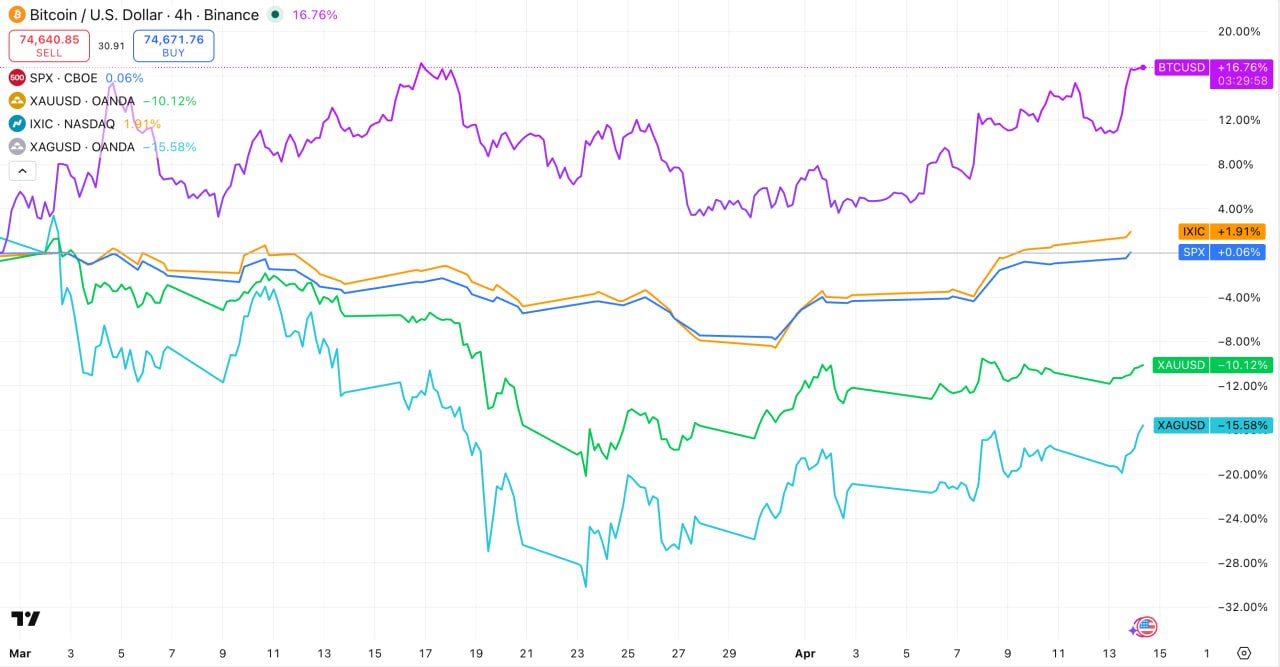
Bitcoin gained 17% since the Iran war began while gold lost 10% and silver fell 15%, traditional safe havens moved the wrong way.
Key Takeaways
Bitcoin up 16.76% since the Iran war began February 28.
Gold down 10.12%, silver down 15.58% over the same period.
S&P 500 and Nasdaq gained 0.06% and 1.91% respectively.
50 SMA at $72,091 curling upward for first time since April 12 crash.
RSI fully converged at 71.32.
Bitcoin is trading at $74,740 on April 14, up 16.7% since the Iran war began on February 28. Over the same period, gold lost 10%, silver fell 15.58%, the S&P 500 gained less than 0.1%, and the Nasdaq added 1.91%.
The six weeks that produced those numbers include the US-Israel strikes on Iran, the assassination of Khamenei, the closure of the Strait of Hormuz, the Islamabad talks collapse, and a US naval blockade. Every event that historically sends money into safe havens sent Bitcoin higher instead.
Gold didn’t just underperform. It moved in the opposite direction.
What the Chart Confirms
According to data from TradingView, Bitcoin’s price at $74,743 sits $2,652 above the 50 SMA at $72,091, and for the first time since the April 12 crash, that average is curling upward. Through the selloff it fell. Through the recovery it flattened. Now it’s rising. That’s a structural shift, not a one-session observation.
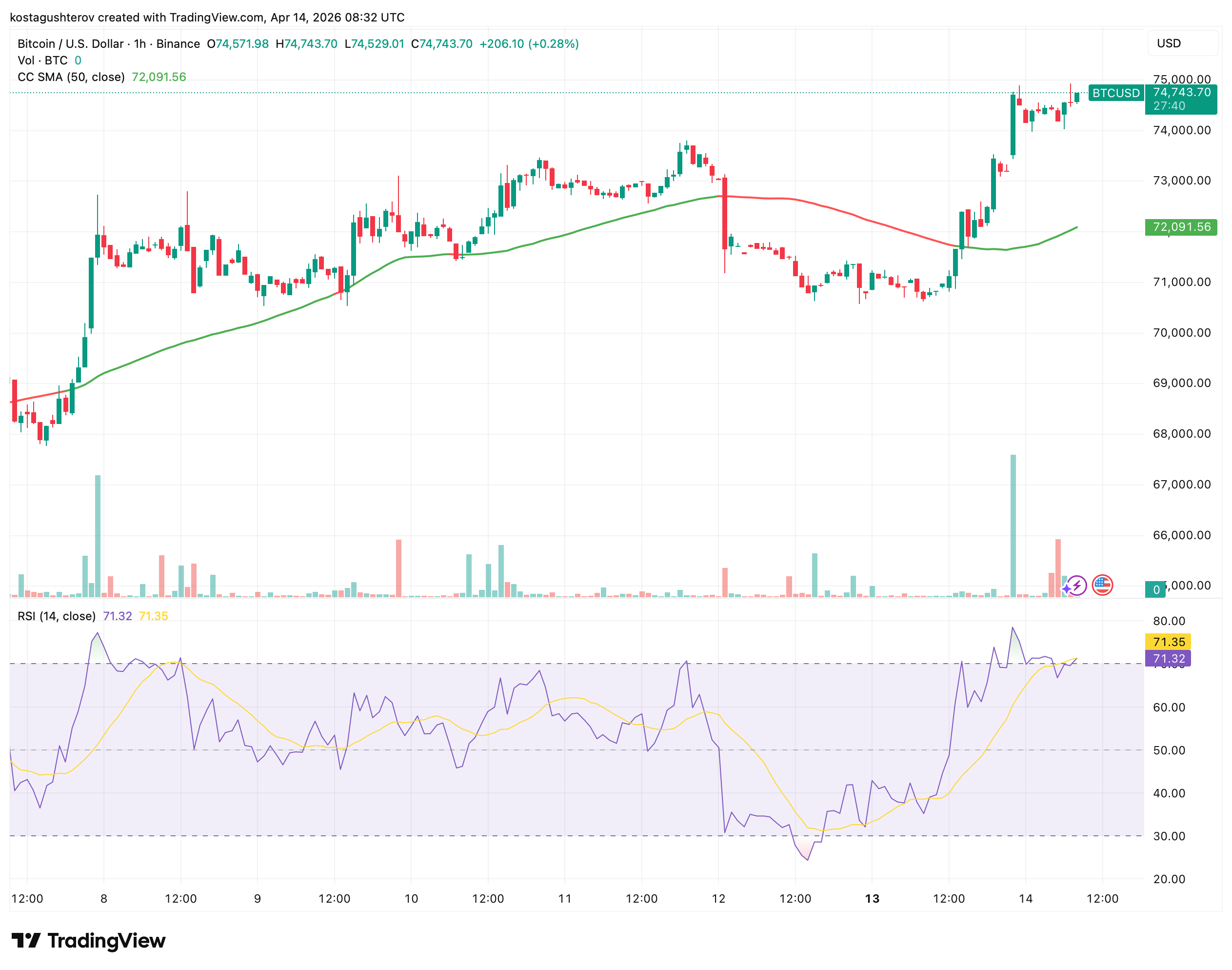
The RSI at 71.32 with the signal line at 71.35 has fully converged, the signal line has caught up and crossed marginally above the RSI. In overbought territory that means the speed of the move has normalized completely. Price is holding the range without extending it. Consolidation, not distribution, but the next leg needs a new catalyst to begin.
Why the Comparison Matters
The standard narrative for Bitcoin during geopolitical stress is that it behaves like a risk asset, selling off when equities sell off, recovering when equities recover. The February 28 to April 14 period breaks that narrative cleanly. Equities went nowhere. Gold and silver, the assets that are supposed to absorb geopolitical fear, lost double digits. Bitcoin gained 17%.
Three explanations are possible and none are mutually exclusive. Institutional allocation is rotating out of gold and into Bitcoin as a harder, more portable store of value. The Iran war disrupted physical commodity markets, gold and silver move through supply chains the conflict directly affected, while Bitcoin has no supply chain to disrupt. Or the market has decided that Bitcoin’s scarcity argument is more durable than gold’s in a world where the Strait of Hormuz can be closed overnight.
The data doesn’t identify which explanation is correct. It identifies that the decoupling happened during the most sustained geopolitical stress event in the Middle East since 2003.
What’s Next?
If the decoupling holds through a confirmed second round of ceasefire talks, Bitcoin extends the narrative advantage it has built over six weeks, 17% while everything else went sideways or down is a number that rewrites institutional allocation models. The rising 50 SMA and a consolidating RSI give that extension a technical base to build from.
If the blockade produces a genuine risk-off shock before talks are confirmed, not the negotiating kind of uncertainty the last six weeks delivered, but the shooting kind, Bitcoin faces the test the comparison chart hasn’t yet run. Gold and silver are already down 10–15%. A sudden escalation would reveal whether Bitcoin’s decoupling is structural or whether it was positioned correctly for one specific type of geopolitical stress and not another.
The distinction matters more than any price level. Bitcoin at $74,743 above a rising 50 SMA is a technical setup. Bitcoin outperforming gold by 27 percentage points during an active war is a thesis. The next two weeks will stress-test which one is doing the actual work.


