

In blockchain systems, there has always been a core question: can already staked assets be “reused”?
In traditional models, the answer is definitely no, and the reason is very simple—staking and the system are uniquely bound.
Simply put: when users stake assets into a network, those assets have a single function, which is to maintain the security of that network, such as participating in validation, consensus, block production, etc. And once staking is completed, those assets are locked and only serve one system.
But with the development of modularity and shared security, the industry began to explore a new direction: can the same staked assets serve multiple systems?
This is today’s topic: Restaking Mechanism.
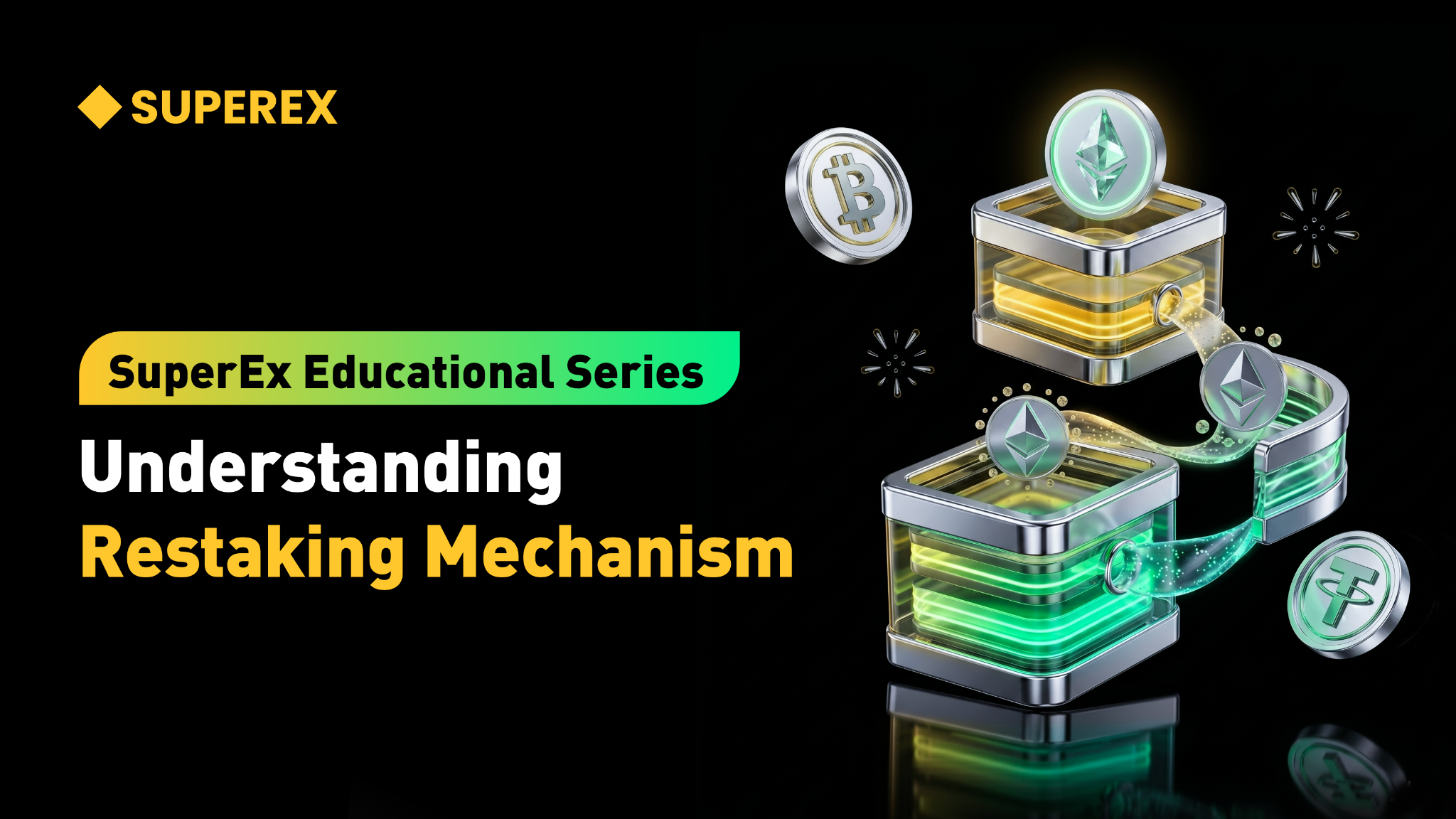
The emergence of Restaking is an advancement in both system security and resource efficiency
Let’s start with a simple definition: Restaking refers to a mechanism where, on top of the original staking, already staked assets are reused to provide security support for other systems.
The core change is straightforward: one stake, multiple uses.
This mechanism mainly addresses two problems:
First, low utilization of security resources: in traditional models, a large amount of assets are locked in a single network, but their security capacity is not fully utilized.
Second, new systems lack a security foundation: many new projects need security support, but cannot quickly build their own validator networks.
So, Restaking provides a middle-ground solution: allowing existing security resources to be used by more systems.
The core logic of Restaking
The operation of Restaking can be understood as adding a layer of “authorization” on top of the original staking.
Simply put, when a user has already staked assets into a network—for example, to participate in consensus—they can further choose to “re-authorize” those assets for use by other systems. These systems can then rely on these assets to obtain security guarantees.
The key point is: the assets do not move, but the security responsibility is extended.
Looking deeper, this “re-authorization” actually changes the scope of the asset’s function, rather than the state of the asset itself.
In traditional staking, one asset corresponds to one security objective, such as maintaining consensus for a single chain. In Restaking, this one-to-one relationship is broken—one asset can simultaneously serve multiple security needs.
This means the asset is no longer just “locked,” but becomes a reusable security resource.
The essence of this change is not technical implementation, but a shift in responsibility structure: when you choose to participate in Restaking, you are essentially deciding that the same asset will be responsible for multiple systems.
This also explains why Restaking must be accompanied by strict rules—because once something goes wrong, the impact is no longer limited to one system, but multiple networks that rely on this shared security.
Structurally, a three-party relationship is formed
Stakers (provide assets)
Validators (perform validation)
Consumer systems (receive security)
These roles are connected through a set of rules.
In this structure, each role’s responsibilities evolve:
Stakers are no longer just earning base rewards; they must consider whether the additional risk is worth it.
Validators need to allocate effort across multiple systems and ensure correct execution in different environments.
Consumer systems gain security capabilities that they originally did not have by connecting to this framework.
This relationship can be understood as:
Assets provide the “security foundation”
Validators provide the “execution capability”
Systems provide the “use cases”
When these three are combined, a new security structure is formed. Security no longer belongs to a single network, but is shared and relied upon by multiple systems. This is the most fundamental difference between Restaking and traditional staking.
How Restaking is implemented
In practice, Restaking is typically implemented through smart contracts and validation mechanisms.
Simply put, staked assets remain locked in the original network, while through additional protocols, they are mapped to other systems. Validators can then choose to participate in validation tasks for these systems.
If behavior is correct, they earn additional rewards.
If issues occur, such as incorrect validation or malicious actions, penalty mechanisms are triggered.
The same asset carries multiple responsibilities.
From an implementation perspective, the key is not “moving assets,” but expanding the validation scope.
The assets remain in the original network, but through protocol design, their security backing is extended to other systems.
In other words, these systems do not directly control the assets, but “borrow” the security commitment they represent. This avoids frequent asset transfers and reduces complexity between systems.
Validator participation and resource allocation
In real operation, validators typically choose which systems to participate in.
Different systems may have different requirements, such as validation frequency, data types, and response time. Validators must select based on their capabilities, rather than passively participating in all tasks.
This leads to a real constraint: validation resources are limited.
If validators participate in too many systems, execution quality may decline. If they participate in too few, they may miss out on rewards.
So in practice, this mechanism becomes a resource allocation process.
Key elements in implementation
Asset locking and authorization mechanisms
Validation task allocation
Reward distribution logic
Penalty mechanisms
Among these, the most critical is the penalty mechanism.
Because Restaking risks are cumulative, if one system fails, it may trigger penalties on the same asset.
Therefore, the system must clearly define:
What behavior is considered a violation
Under what conditions penalties are triggered
How the scope of penalties is determined
At the same time, the reward mechanism must match the risk. Validators take on more responsibility, so they require higher returns. Otherwise, participation incentives will be insufficient.
For consumer systems, they must also pay for this security, usually through fees or incentive structures.
Overall, Restaking is not just a technical problem, but a mechanism design problem.
Balancing efficiency, rewards, and risk becomes the core challenge. Only when these are properly aligned can Restaking operate stably. Otherwise, it can easily lead to insufficient participation or uncontrolled risk.
The relationship between Restaking and shared security
Restaking is an important way to implement shared security—it provides the source of security resources:
Shared security provides the structure
Restaking provides the asset backing
Together, they can build a larger security network
1-minute recap
Restaking = reuse of staked assets
One asset can serve multiple systems
Core value = improving the efficiency of security resources
Conclusion
The evolution of blockchain has always been about optimizing resource usage.
From single-chain security, to shared security, and now to Restaking, security is evolving from an “isolated resource” into a “reusable capability.”
Restaking does not change the essence of staking, but it changes the scope of its usage. When the same asset can support multiple systems, the structure of the entire network becomes more interconnected.



