


Chainlink's exchange reserve has fallen from 141.5M LINK to 130.9M in 25 days, culminating in a single-session net outflow of 970,430 tokens on April 25, the largest since December 2, 2025.
Key Takeaways
Exchange reserve fell from 141.5M to 130.9M since April 3.
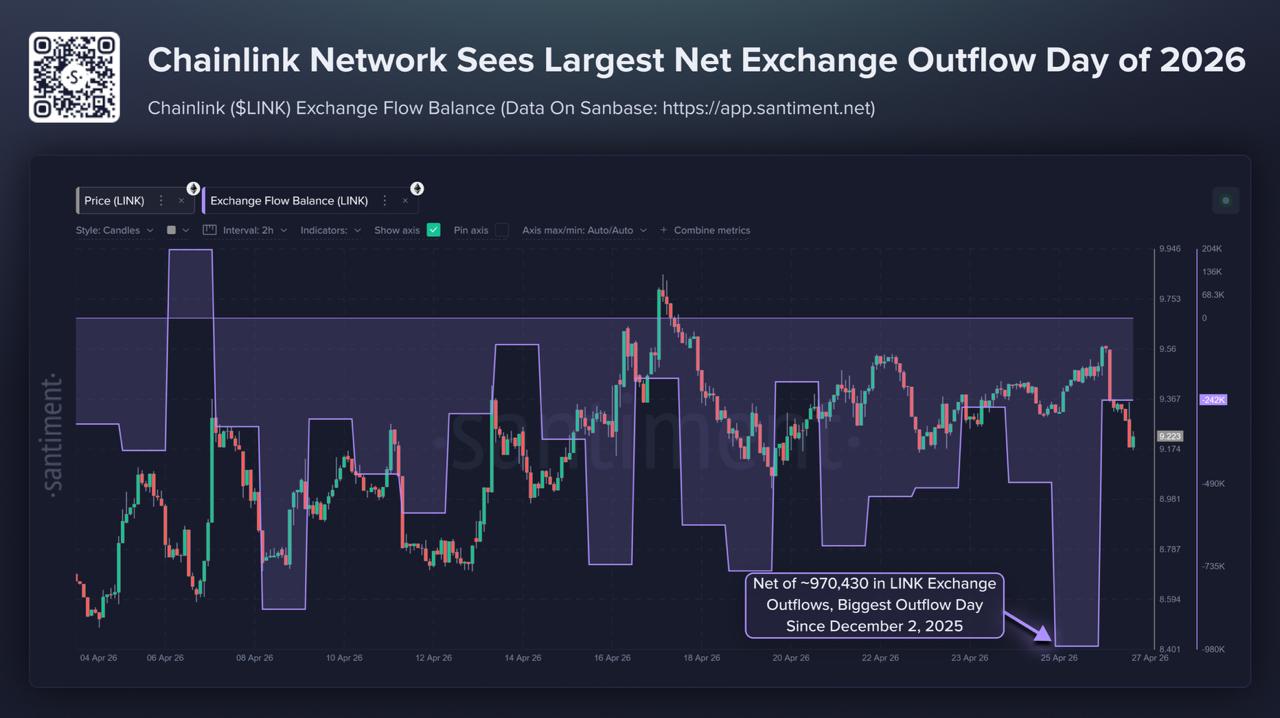
April 25 net outflow: 970,430 LINK (~$8.95M), 2026’s largest single day.
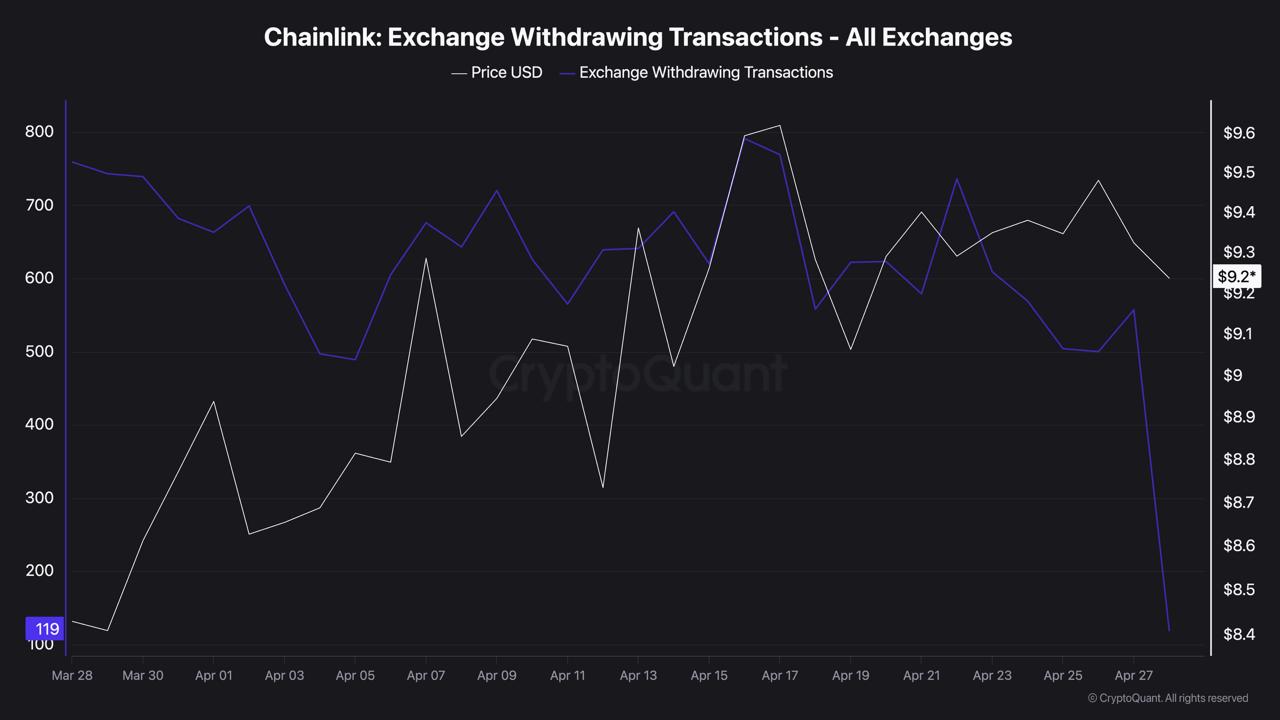
Withdrawal transactions at 119, the lowest count in 30 days.
Exchange inflow at 179.8K, near the floor of the entire observation window.
Supply ratio down from 0.142 to 0.130 since April 3.
Price below all three MAs: 50, 100, and 200 all between $9.35 and $9.37.
RSI(14) at 42.31, approaching but not yet at oversold.
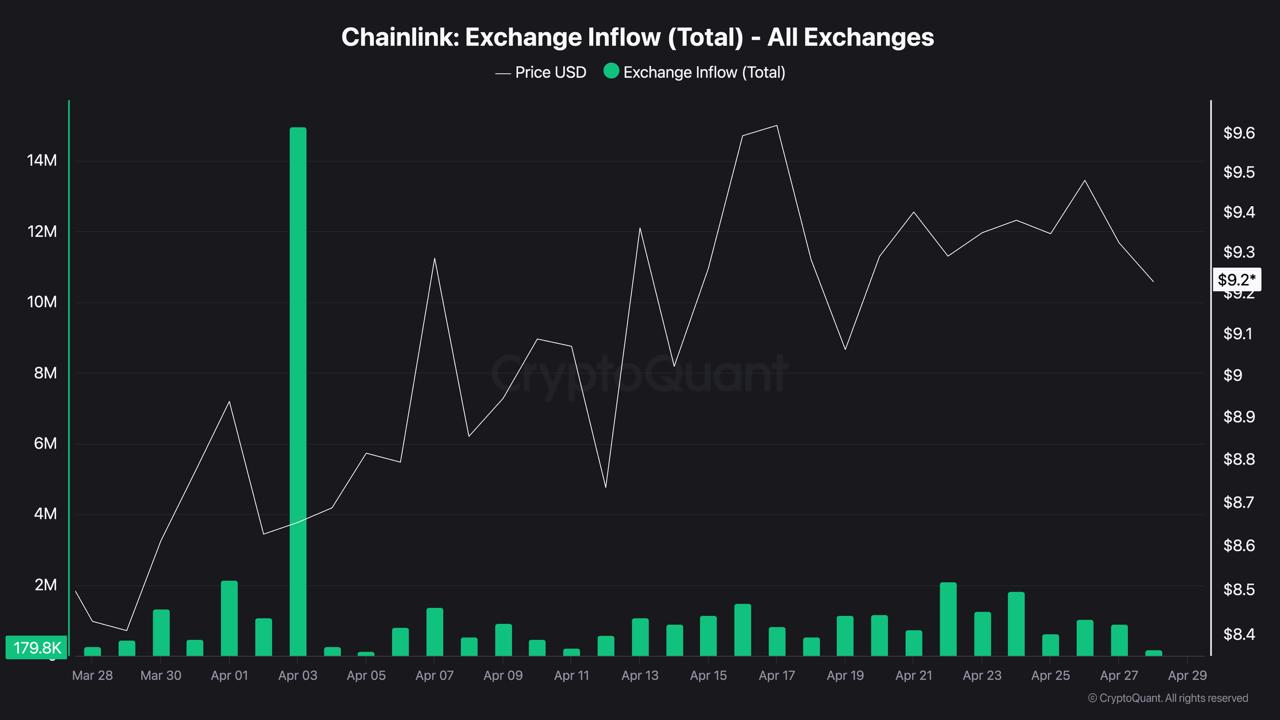
On April 3, 15 million LINK moved onto exchanges in a single session, the largest inflow event in the 30-day window. Exchange reserve peaked the same day at 141.5M and has not recovered since. What followed was not the sell pressure that a deposit of that scale typically signals. Price did not collapse. It climbed from roughly $8.70 on April 3 to $9.90 by April 17. The 15M Chainlink tokens that arrived did not convert to selling.
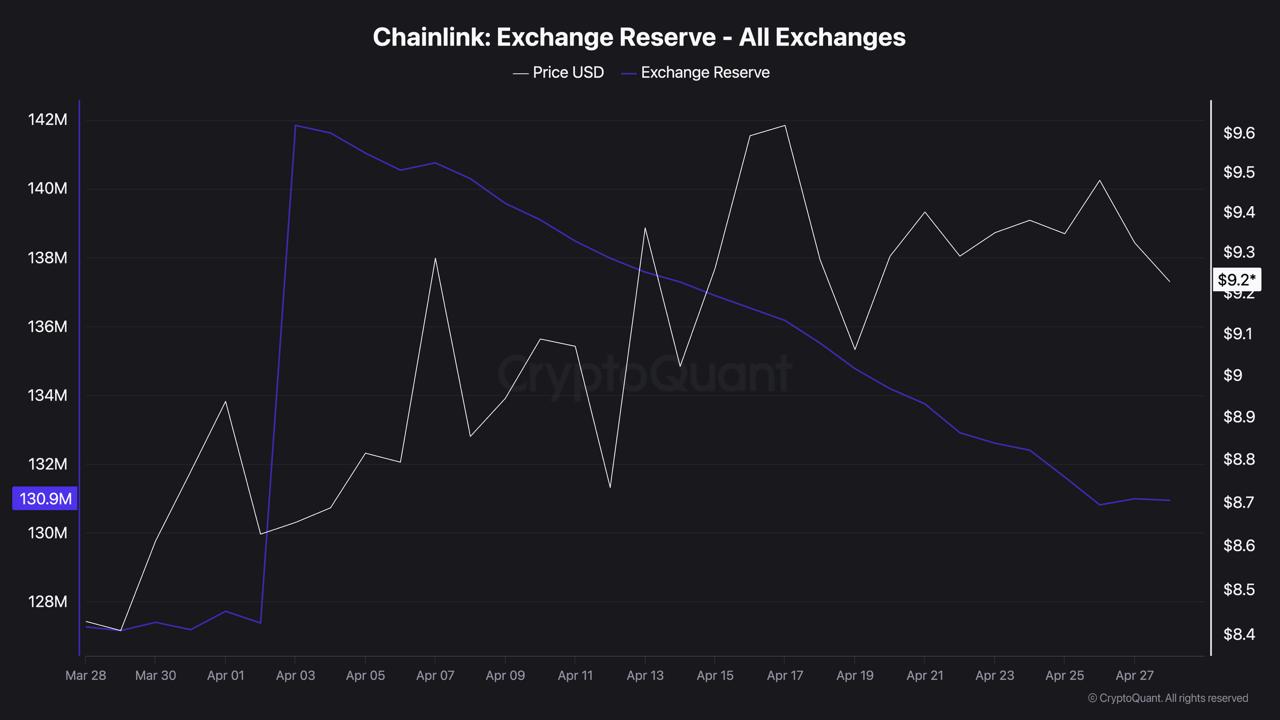
A deposit that becomes distribution shows up in two ways: sustained price weakness as sell orders execute, and elevated inflow levels as the seller recycles capital back onto exchanges between tranches. Neither condition materialized. Inflow normalized to a range between 179.8K and 2M per session after April 3, and price rose 13.8% over the following two weeks. The April 3 deposit was a repositioning event. Whoever moved 15M LINK onto exchanges either sold a portion into the April 17 rally and withdrew the rest, or moved the entire block back off exchanges in tranches across the 25 days that followed. The reserve data shows the net result either way: all of it is gone.
The Transaction Count That Reveals Who Is Withdrawing
By April 27, exchange withdrawing transactions had fallen to 119, the lowest reading in the 30-day window, down from a peak of approximately 800 on April 17. Fewer actors withdrawing while the reserve is still declining means the average size per transaction is rising. When count falls and volume holds, the withdrawals are concentrating into fewer, larger movements.
Recent Santiment data puts a number on this: 970,430 Chainlink tokens left exchanges in net terms on a single day, the largest such event since December 2, 2025. That is not 119 small wallets moving a few thousand tokens each. That is one or a small number of actors moving a concentrated position in a single session. The behavior pattern, large withdrawal with low transaction count and no inflow replenishment, does not match retail exit. Retail exits are high count, low size, and typically accompanied by rising inflow as holders deposit to sell. None of those conditions are present.
The Supply Ratio Returning To Its Starting Point
The exchange supply ratio data, revealed by CryptoQuant, now at 0.130, has retraced the entire gain that the April 3 inflow spike produced. From March 28 through April 1, the ratio sat between 0.127 and 0.128. The April 3 inflow pushed it to 0.142. Twenty-five days of net outflow have returned it to 0.130, erasing that entire move.
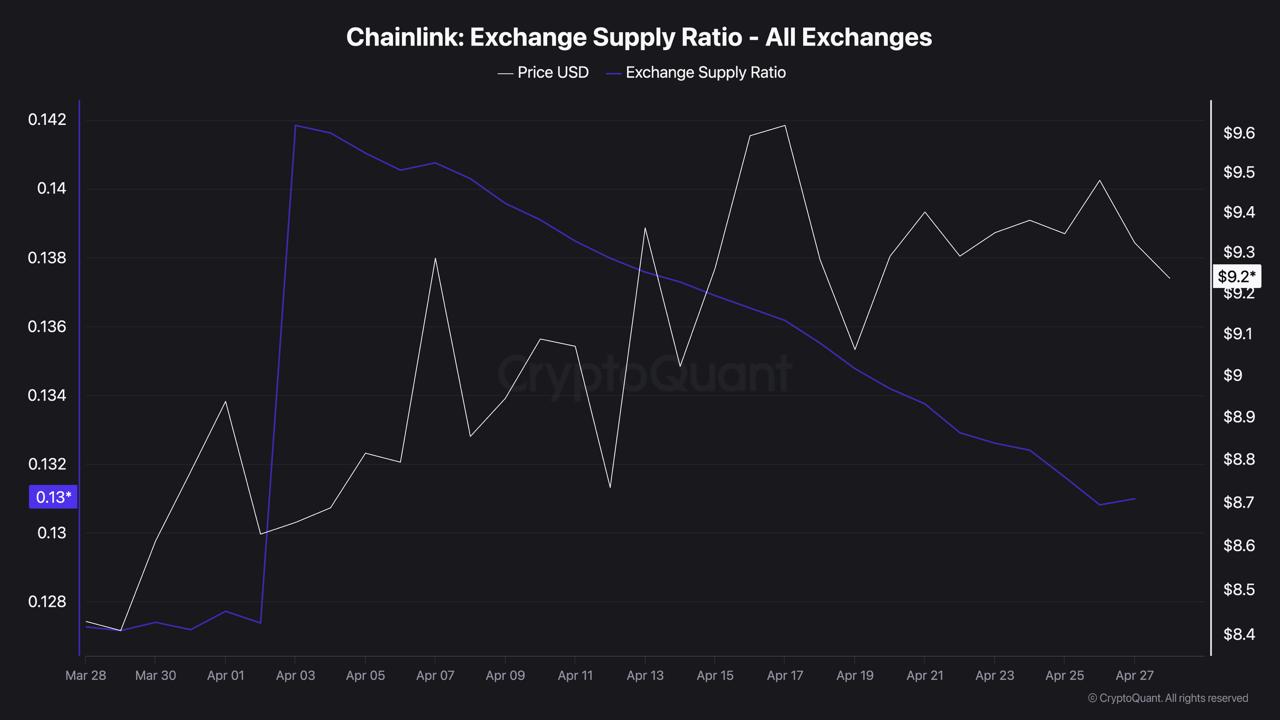
What the ratio measures is not just the count of tokens on exchange but the proportion of total supply available for immediate sale. At 0.130, 13 of every 100 tokens in existence can be sold with a single exchange order. At the April 3 peak, that figure was 14.2. The direction of that change, not the absolute level, is what the on-chain setup is communicating.
Price Below The Ma Cluster While Supply Thins
At $9.22, the alt coin trades below its 50, 100, and 200-period moving averages, all compressed into the $9.35 to $9.37 range. Three moving averages converging into a two-cent band signals a market that has spent enough time rangebound for all three to flatten and merge. Historically on this chart, that compression resolves directionally: price either reclaims the cluster and treats it as support, or bounces against it as resistance and loses $9.00.
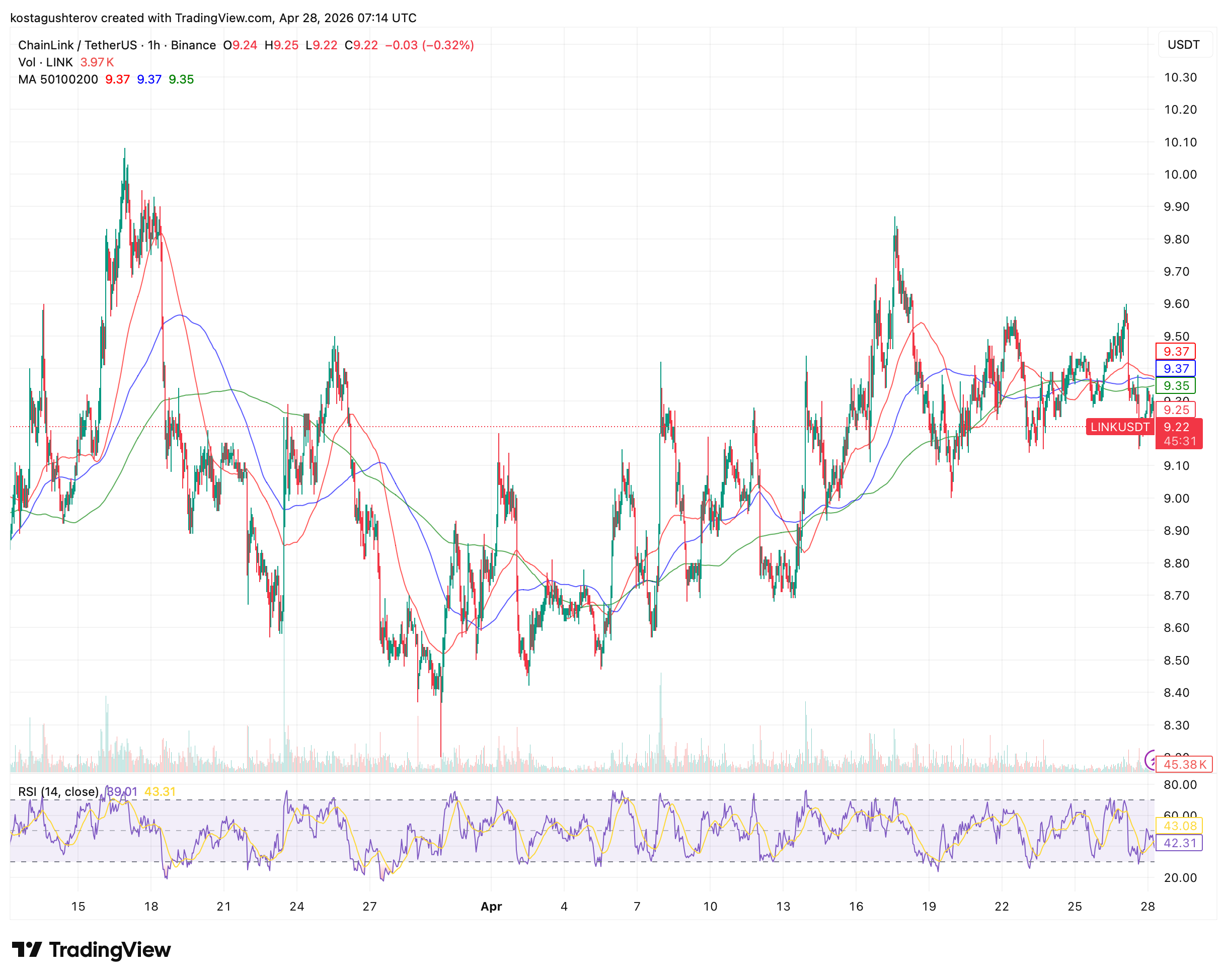
RSI at 42.31 is approaching oversold without reaching it. The prior oversold reading on this chart arrived during the March and early April washout when price was in the $8.40 to $8.70 range. The current RSI at 42 with price at $9.22 represents a higher momentum reading at a higher price level than the previous bottom. Selling pressure is exhausting itself at a structurally stronger level than it did in March. That is not a bullish signal in isolation, but it is a different condition than a lower-low in RSI at a lower-low in price.
The central tension is this: five independent on-chain metrics point toward supply removal, while price sits below a key technical decision zone. Either the supply leaving exchanges is front-running a price move that has not happened yet, or the actors withdrawing are moving LINK to venues or use cases that do not support spot price. The inflow chart is the mechanism that distinguishes these two readings.
The Bearish Case Built From The Same Data
Large withdrawal events do not confirm accumulation. They confirm movement. A single actor moving 970,430 Chainlink tokens off a centralized exchange could be transferring to an OTC desk for a block sale, moving to a venue not captured in the CryptoQuant dataset, or depositing into a DeFi protocol for yield rather than holding spot. Each of these removes supply from the tracked reserve without representing directional conviction. If OTC desks or untracked venues absorb this LINK and eventually sell it, the outflow data will prove to be a timing artifact rather than a structural shift.
The inflow chart is what separates accumulation from OTC rotation. Both distribution through OTC desks and cross-venue transfers eventually require exchange reloading: sellers need to return to a liquid venue to liquidate. The 30-day inflow window shows no sign of reloading at scale. At 179.8K on April 28, inflow is at its floor. OTC distribution with a lag of 25 days and no visible reloading is a longer silence than short-term rotation typically produces. That does not close the bearish case, but it narrows it.
Conclusion
The weight of evidence as of April 28, 2026 favors supply removal over distribution. Five signals, reserve declining from 141.5M to 130.9M, supply ratio back to 0.130, inflow at 179.8K, withdrawal transactions at a 30-day low of 119 with per-transaction size implying institutional scale, and a 970,430-token single-day net outflow on April 25, are not collectively consistent with a market reloading for sale. They are consistent with a market reducing available sell pressure before a directional move.
The confirmation signal is a daily close above $9.37, the MA cluster, with withdrawal transactions recovering above 400 while inflow stays below 1M. That combination would confirm the supply removal is translating into price-level defense. The denial signal is a daily close below $9.00 accompanied by inflow rising above 3M, which would indicate the withdrawn supply is returning to exchanges for liquidation and the structural case inverts. The MA cluster resolves this within five to seven trading days.


