


Bitcoin trades at $75,600 on April 30, 2026, below all three moving averages with RSI at 41 on both signals. The short squeeze setup that institutional funds monitor requires three converging conditions. None are active yet.
Key Takeaways
BTC price on April 30: $75,600.
RSI(14): 41.00 faster signal, 40.48 slower signal, converging.
Distance to institutional support zone: $5,600 to $70,000 top, $10,600 to $65,000.
Short squeeze trigger 1: STH-SOPR below 1.0, retail selling at a loss, not yet confirmed.
Short squeeze trigger 2: SSR stablecoin influx to exchanges, not yet elevated.
Short squeeze trigger 3: funding rate at -0.015% to -0.020%, currently near zero.
Current funding rate: approximately 0%, historical extreme was -0.25% in 2018-2019.
MA stack: descending, 50 at $76,408, 100 at $77,104, 200 at $77,479.
The Three Conditions And Why None Are Active
According to a CryptoQuant report, three conditions must converge before institutional funds activate long positions in the $65,000 to $70,000 zone. When Bitcoin’s STH-SOPR falls below 1.0, recent buyers are selling at a loss — retail is capitulating and institutional capital is absorbing at depressed prices. When the SSR shows a stablecoin flood to exchanges, institutional dry powder has arrived and is positioned to buy. When funding rates reach -0.015% to -0.020%, short sellers are overleveraged and one sustained price move upward triggers forced covering that amplifies the rally into a squeeze.
None of these three conditions are currently active. STH-SOPR below 1.0 requires price to have declined enough that recent buyers are underwater. The April 7 low was $66,500 and buyers from the April 21 to April 24 rally entered between $72,000 and $79,800, those buyers are underwater at $75,600 only if they entered above current price. The SSR stablecoin influx is not elevated. The Binance USDT Z-Score confirmed systemic depletion at -1.75 in the prior session, the opposite of the flood the framework requires. And the funding rate chart shows current readings near zero, not at the -0.015% threshold that signals overleveraged shorts.
The Sequence
These three conditions do not arrive simultaneously. They arrive in sequence, and the sequence determines entry timing. STH-SOPR breaks below 1.0 first, it measures current selling behavior and responds immediately to price decline. This is the earliest signal and the most visible during the selloff itself. SSR stablecoin influx arrives second, institutional capital responds to price levels, not to SOPR readings. Stablecoins reload to exchanges when price reaches pre-set accumulation targets. This signal appears at or near the price floor, not before it. Funding rate reaches the squeeze threshold last, overleveraged short positions accumulate over days of sustained negative sentiment, not hours. It is the slowest-moving signal and the hardest to manufacture artificially.
A trader who waits for all three simultaneously will miss the entry because by the time funding reaches -0.015% to -0.020% with SSR already elevated and SOPR already below 1.0, price has already bounced from the floor. The CryptoQuant report presents these as simultaneous conditions. They are sequential ones. SOPR below 1.0 signals the decline is mature. SSR elevation signals institutional capital has arrived. Funding at -0.020% signals the squeeze is ready to trigger. Each condition confirms the previous one rather than co-occurring with it.
$75,600 Is Not $70,000
The report identifies $65,000 to $70,000 as the institutional support zone for Bitcoin where the short squeeze setup activates. Current price is $75,600. The distance to the top of that zone is $5,600, a 7.4% further decline from here. The CryptoQuant framework is not wrong in its structure. It is premature in its application to the current price level.
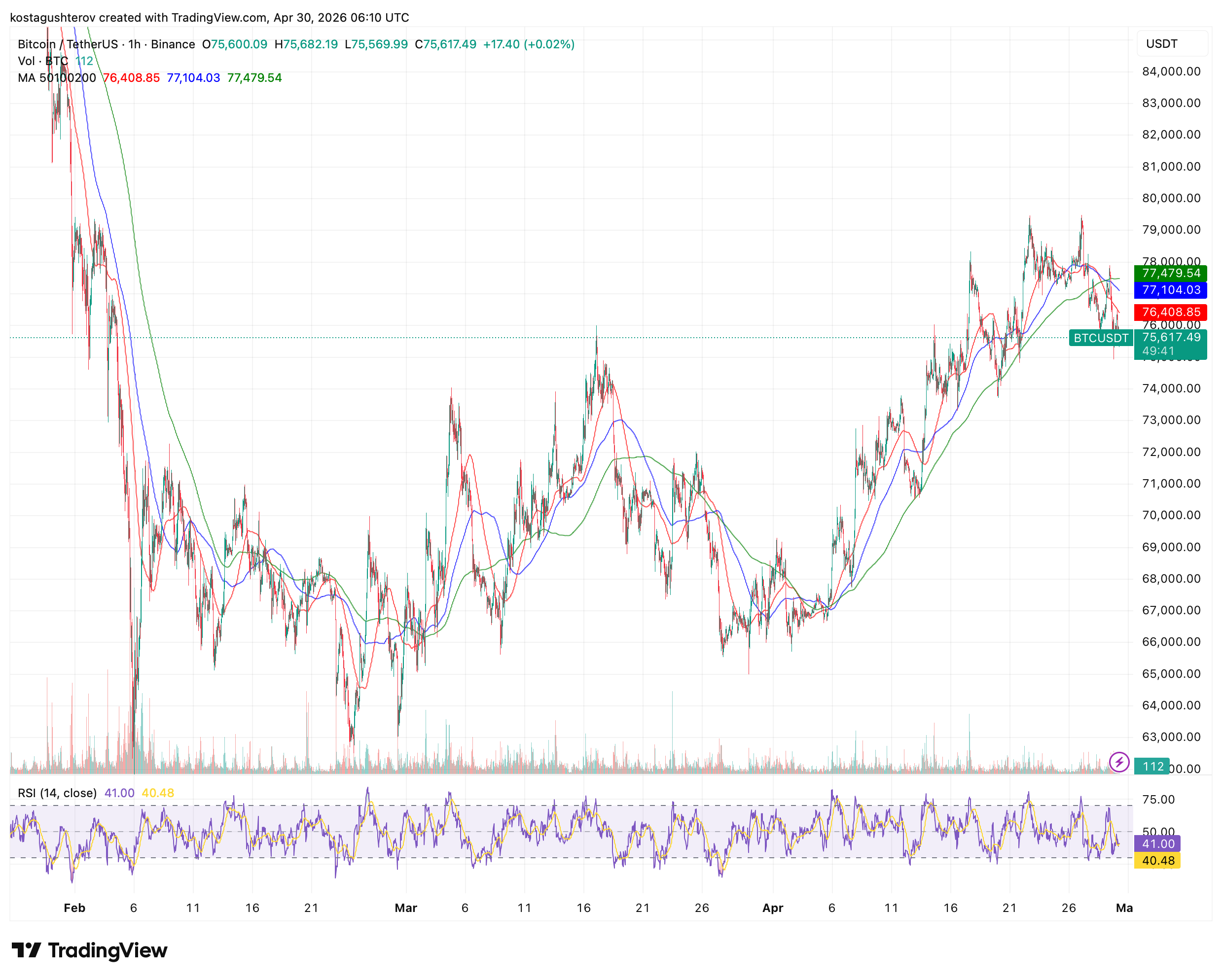
The bullish counter does not require the $65,000 to $70,000 zone at all. If the April 7 low at $66,500 and the April 19 low at approximately $72,000 are holding as a pattern of higher lows, the current pullback to $75,600 is a third higher low forming above both prior floors. In that reading the short squeeze setup is irrelevant because price never reaches the zone it requires. The MA stack overhead is the test that separates these two readings: a reclaim of $77,104 within 48 hours makes the higher low reading the dominant interpretation.
The descending MA stack confirms the current directional pressure. Price is below the 50MA at $76,408, the 100MA at $77,104, and the 200MA at $77,479. All three are above price and declining. RSI at 41.00 on the faster signal and 40.48 on the slower — two signals converging within 0.52 points of each other — means the momentum deterioration is consistent across timeframes. This is not a short spike down producing an oversold reading. It is a sustained, measured decline where both momentum signals are tracking the same direction at nearly identical levels.
Why -0.015% Is Mild And Why That Makes It Reachable Within Days
The -0.015% squeeze trigger the CryptoQuant report names is mild by the full historical record. The 2018-2019 bear market saw funding reach -0.25%. The 2020 COVID crash reached -0.15%. At those extremes, short sellers were structurally overleveraged for months. At -0.015%, they have been overleveraged for days. The current reading near zero means the derivatives market has not begun building the short position the squeeze would unwind — but the distance between zero and -0.015% is small enough that three to five days of sustained selling pressure at current levels would close it.
This matters for timing. Funding at -0.015% does not require a catastrophic decline to activate. At the current pace of price deterioration — $75,600 with RSI converging at 41 across both timeframes — a move to $72,000 over three to five days would be sufficient to build the negative funding the framework requires while simultaneously bringing price into the lower end of the institutional support zone.
The Zone Answers In Seven Days
As of April 30, 2026, the short squeeze preconditions are directionally forming but have not triggered. Price is moving toward the zone. The signals are not there yet.
The confirmation signal for the setup activating is a daily close in the $70,000 to $72,000 range with funding reaching -0.010% or below on the same session. That combination would indicate price has entered the institutional support zone while derivatives sentiment is deteriorating — the first two conditions of the three-signal sequence beginning to converge. The denial signal is a reclaim of $77,104, the 100MA, within 48 hours without the support zone being tested, which would confirm the current pullback is a higher low rather than the beginning of the decline the framework requires. The 50MA at $76,408 is $791 above current price and answers within 24 hours. The $70,000 zone answers within seven days if the current directional pressure holds.


