


Toncoin surged 37% on May 5 after Pavel Durov announced Telegram will replace the TON Foundation as the blockchain's primary operator and largest validator.
Key Takeaways:
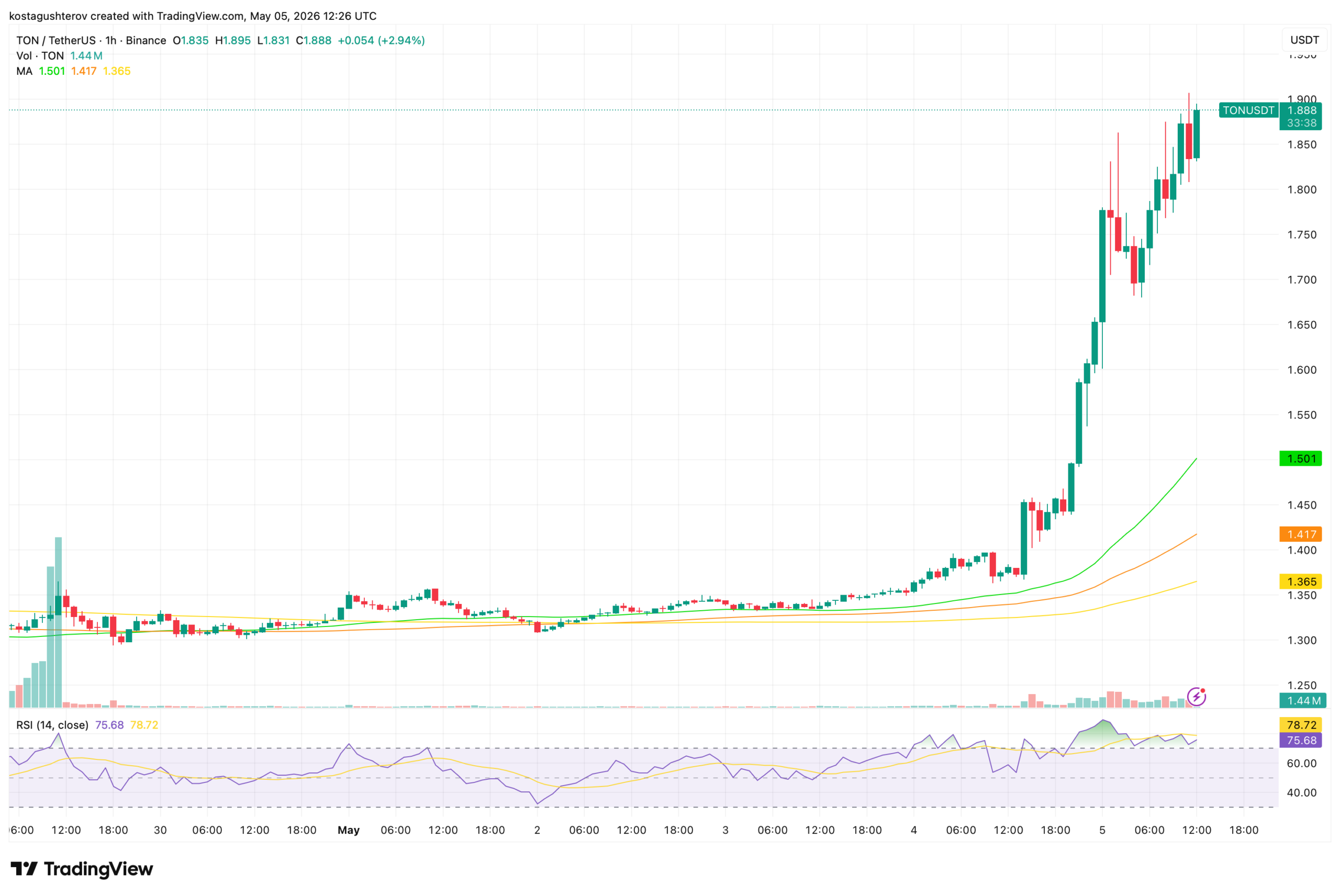
TON at $1.888, up 37% on May 5.
Telegram replaces Swiss-based TON Foundation as primary operator.
Telegram becomes largest validator: staking 2.2M TON.
Transaction fees cut sixfold to 0.00039 TON per transaction.
Block production: 400ms after Catchain 2.0 upgrade April 9.
RSI: 75.68, overbought on 1H chart.
Spot volume: Heating classification on May 5 per CryptoQuant.
Returns to Telegram’s original 2018 blockchain vision.
This Is Not a Leadership Change
Toncoin traded in a flat range between $1.30 and $1.35 for five consecutive days before May 5. In approximately 24 hours following Pavel Durov’s announcement, price moved from $1.35 to a session high of $1.895, a 40% move on a single catalyst. At the time of writing TON trades at $1.888.
The announcement itself is structurally significant beyond the price move. Telegram is replacing the Swiss-based TON Foundation as the primary operator of The Open Network. Telegram will become the network’s largest validator, staking approximately 2.2 million TON. The initiative is branded “Make TON Great Again.”
Framing this as a leadership change misses the structural point. Telegram has approximately 950 million users. The TON blockchain’s primary value proposition is accessibility through Telegram’s Mini Apps ecosystem. Until this announcement, Telegram was a distribution partner for a blockchain operated by a separate Swiss foundation. After this announcement, Telegram is the blockchain operator. That is not a governance update. It is the removal of organizational distance between product and infrastructure: vertical integration at the protocol level.
Fees in TON have dropped 6× — to nearly zero.
Next step — Telegram replaces the TON Foundation as the driving force behind TON and becomes its largest validator.
The focus shifts to tech superiority.
New https://t.co/Me0w683UiK, new dev tools, new performance upgrades.…
— Pavel Durov (@durov) May 4, 2026
Fee Cut, 400ms Blocks, and a Developer Roadmap Already in Motion
The operational changes accompanying the announcement are specific and already partially implemented.
Transaction fees have been cut sixfold, dropping to approximately 0.00039 TON per transaction, roughly $0.0005 at current prices. That fee level makes microtransactions and in-app tipping economically viable for Telegram’s user base. A fee of half a cent per transaction is not a barrier to casual in-app payments. A fee of three cents was.
Block production times fell to 400 milliseconds following the Catchain 2.0 update on April 9. Near-instant block confirmation at that speed enables responsive Mini App experiences that match the latency expectations of messaging users. A blockchain that confirms in 400 milliseconds is usable in a chat interface. One that confirms in seconds is not.
A revamped ton.org website and new developer tools are expected within two to three weeks. The infrastructure roadmap is sequenced: fee reduction and speed improvements first, developer tooling next. That sequence prioritizes the user experience changes that drive adoption before the developer experience changes that drive building.
The Volume Pattern Before the Announcement
The CryptoQuant Spot Volume Bubble Map for TON shows the largest volume concentration of the past month occurred at the $1.30 to $1.35 price range, the exact level where price sat flat for five days before the announcement. The May 5 reading shows a Heating classification at $1.7786 with 32.972M in volume.
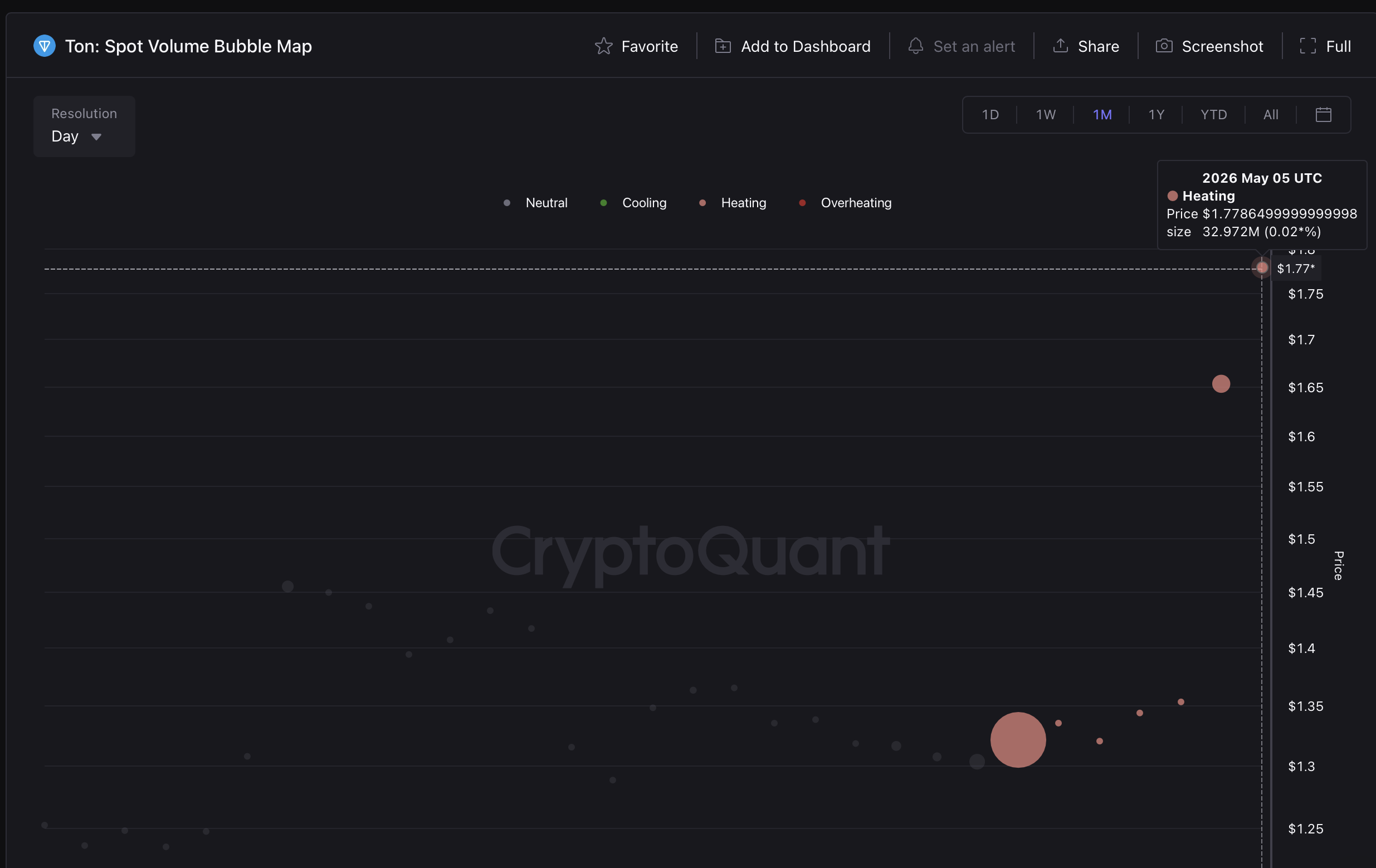
The large volume bubble at the $1.30 to $1.35 base level is the most significant data point in the chart. It represents concentrated buying at the lowest price point of the visible window, during the quiet period before the announcement. Price went nowhere for five days while that volume accumulated. Then the announcement arrived and the accumulated position became a 40% move.
That pattern describes informed positioning at the base rather than reactive buying at the top. The current Heating classification on May 5 confirms active volume is still present at higher levels. The move has not exhausted into Overheating territory yet, which typically precedes sharp reversals.
The 2018 Vision and What Was Lost Between Then and Now
Telegram’s return to direct blockchain control is explicitly framed as a return to the original 2018 vision. In 2018, Telegram raised $1.7 billion to build a blockchain integrated with its messaging platform. A 2020 legal settlement with the SEC forced Telegram to abandon direct involvement, leading to the creation of the independent TON Foundation.
The five years between 2020 and 2025 saw the TON Foundation build a functional blockchain and ecosystem, but without Telegram’s direct operational involvement. The gap between Telegram’s product and TON’s infrastructure was organizational: separate entities with shared interests but separate governance.
Durov’s announcement closes that gap. Telegram taking validator control and operational leadership is not the beginning of a new project. It is the completion of a project that was interrupted by regulatory force in 2020 and is now resuming under a different legal and regulatory environment.
Overbought at $1.888, But the Structural Change Does Not Expire
The RSI on the 1H chart reads 75.68 on the shorter timeframe and 78.72 on the longer. Both are in overbought territory. A 40% move in 24 hours on a single announcement typically produces overbought conditions. The question is whether the fundamental change behind the move is large enough to sustain price at elevated levels or whether the RSI signals a near-term pullback before continuation.
The 50-MA sits at $1.501, the 100-MA at $1.417, and the 200-MA at $1.365. Price at $1.888 is $0.387 above the 50-MA, a significant distance that will compress either through price pulling back or the MA catching up over time. Neither outcome invalidates the structural thesis. Both describe the same thing: a market that moved faster than its moving averages.
The counter-argument is straightforward. A 37% single-day move on an announcement is frequently a sell-the-news event. Traders who positioned during the $1.30 to $1.35 accumulation phase have 40% unrealized gains. The rational action for that cohort at current levels is partial profit-taking, which produces the pullback that the RSI is warning about.
What limits the bear case: the structural change announced is not reversible in the short term. Telegram becoming the primary validator and operator of TON is not a statement or a roadmap item. It is an operational decision that changes the network’s governance structure. That change does not expire if price pulls back.
The confirmation signal is TON holding above the 50-MA at $1.50 on a daily close. That level represents a 12% pullback from current price and the first major technical support below the breakout. A hold above $1.50 would confirm the $1.30 to $1.35 accumulation zone has been permanently repriced as the structural base for the new operational framework.
The denial signal is TON losing $1.50 on a daily close and returning toward the pre-announcement range of $1.30 to $1.35. That outcome would confirm the announcement was priced in at the top rather than at the base and that the structural change has not yet translated into sustained demand at higher prices.
Telegram took control of TON. The fees are cut. The speed is there. The 950 million users are already in the app. The 37% move priced in the announcement. The daily close above $1.50 is when the market decides whether it priced it correctly.


