

In Ripple news today, JPMorgan, alongside Ondo Finance, Mastercard, and Ripple, completed the first near-real-time cross-border redemption of a tokenized US Treasury fund on the XRP Ledger on May 7, 2026, settling in under five seconds outside traditional banking hours via the Kinexys platform.
The transaction, involving Ondo’s OUSG fund backed by short-term Treasury bills, is the first production-scale demonstration that a Tier-1 bank’s interbank settlement rails can interoperate with a public blockchain ledger for real-world asset delivery.
The question the market now has to answer is whether this is an isolated proof-of-concept or the opening move in a structural shift, one where major banking institutions abandon purely private blockchain environments in favor of hybrid architectures that use public ledgers for finality and liquidity.
The answer has direct implications for how RWA tokenization scales, and for which settlement rails capture institutional volume as that market matures.
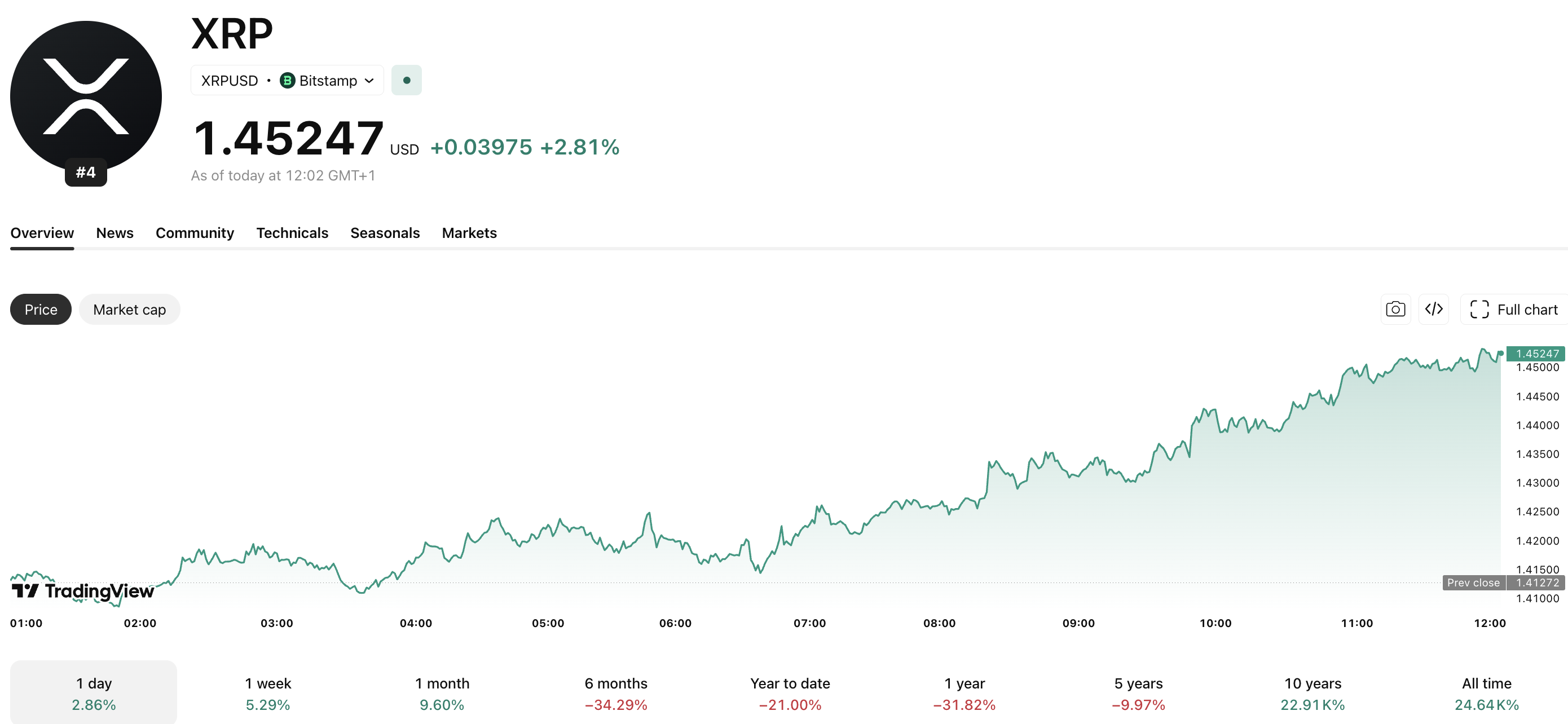
(SOURCE: TradingView)
Ripple News: What the Kinexys-XRPL Settlement Actually Achieved
The transaction mechanics are crucial. Ondo redeemed OUSG, a tokenized U.S. Treasury fund for accredited investors, using the XRP Ledger.
Mastercard’s Multi-Token Network relayed the redemption to Kinexys, JPMorgan’s blockchain platform, which then delivered US dollars to Ripple’s bank in Singapore. This process was completed in under 5 seconds on the asset side, with fiat delivery finalizing in about 30 minutes via traditional networks.
This speedy settlement time is significant; traditional cross-border Treasury redemptions typically take one to three business days. The XRPL’s low fees, quick settlement, and lack of mining-based confirmation are why it was selected over Ethereum for this institutional-grade transaction. Kinexys has processed over $3 trillion, firmly establishing itself as a leader in production infrastructure.
The OUSG fund primarily holds three- to six-month US Treasury bills, making this pilot pivotal for a critical asset class in global finance.
While tokenized deposits have surged into the billions, this marks the first integrated cross-border redemption of that asset class, highlighting its importance, as Markus Infanger, Senior VP at RippleX, emphasized.
? WATCH: #Ripple just made HISTORY.
For the FIRST TIME EVER, a tokenized U.S. Treasury fund settled across borders and banks in near real-time.
• Ondo redeemed OUSG on the $XRP Ledger.
• Mastercard routed it.
• JPMorgan delivered USD to Ripple's Singapore account. https://t.co/NuIn7HeJ7u pic.twitter.com/WrzLjG5WU0— RippleXity (@RippleXity) May 6, 2026
Why a First-of-Its-Kind Settlement Is a Structural Signal, Not Just a Milestone
JPMorgan’s Onyx division’s selection of the public XRPL for settlement signifies a strategic move towards a hybrid blockchain architecture, reinforcing Ripple’s vision of the XRPL as a vital institutional settlement layer.
This decision comes as the DTCC prepares to launch a tokenization service in 2026, increasing competition among JPMorgan’s Kinexys and Ripple’s infrastructure while adding mainstream legitimacy to the market.
With the US Treasury market valued at approximately $27 trillion, even limited tokenized adoption could surpass current crypto transaction volumes. Ian De Bode of Ondo Finance points out that linking public blockchain with interbank settlements could enable 24/7 global markets.
Ripple’s focus on cross-chain RWA integration aligns with growing institutional demand, while BlackRock’s interest in blockchain asset products signals that major asset managers are taking on-chain infrastructure seriously, further solidifying the relevance of the JPMorgan-XRPL transaction.
Bull, Base, Bear: Three Paths for Institutional XRPL Adoption From Here
$XRP long positions are getting heavy again! ?
Retail traders continue piling into longs while institutional activity has slowed down.
Funding remains elevated, showing the market is leaning heavily to one side. pic.twitter.com/3iHLBDz6vb
— CryptoBusy (@CryptoBusy) May 7, 2026
Bull case: The consortium successfully expands the pilot to additional tokenized asset classes (like equities and corporate bonds) and jurisdictions in Q3 2026. Three or more Tier-1 banks onboard to XRPL, with regulatory clarity from the SEC and OCC enhancing compliance. This positions XRPL as the leading settlement layer for institutional RWA tokenization ahead of the DTCC’s launch.
Base case: The pilot expands gradually to one or two asset classes, with limited new counterparties as institutions conduct compliance reviews. Kinexys transaction volume increases steadily, with tokenized Treasury volumes hitting double-digit billions by Q4 2026. XRPL captures a meaningful share of RWA settlement, alongside Ethereum competitors, but XRP’s price sees limited re-rating as revenue largely benefits infrastructure operators.
Bear case: The SEC or OCC restricts 24/7 tokenized trading, undermining the pilot’s value proposition. Alternatively, if the DTCC launches a service mandating participation, it could shift institutional volume away from public blockchains, rendering the proof of concept uncommercially viable.
The near-term outcome aligns with the base case, as the infrastructure is established, but regulatory hurdles remain. Institutional adoption will build over quarters, not weeks, but the trend is clear.
The next key indicators will come from the Ripple news consortium’s Q3 2026 expansion announcement and the DTCC’s upcoming tokenization service launch, which may either incorporate or compete with public blockchain settlement.
The timeline for XRPL to secure a second major banking partner before the DTCC launch hinges on the speed of compliance at peer institutions, making compliance at peer institutions the critical factor rather than the technology itself.


