

ZEC is trading at $574 at the time of writing, pressing against the zones that triggered its November collapse and rejected its December recovery attempt - this time arriving with all major MAs below price and RSI at 85.95.
Key Takeaways
ZEC at $574, up 69% in one month.
This zone triggered the November downtrend and rejected the December retest.
All three MAs below price.
200 MA reclaimed in April breakout.
RSI at 85.95 against signal of 69.65.
Upper macro target: ~$750 descending trendline
Macro support: $200-$210.
The $575-$590 zone is not a random technical level. It is the one of the prices where Zcash reversed in November after it peaked in November, before starting a multi-month collapse. When price attempted to recover in December, it returned to this zone and failed again: a failed retest that confirmed the level’s resistance strength and reset the downtrend. Both events happened at the same zone, from different momentum conditions, with the same outcome. The November rejection, the December failure, and the current approach are not three separate events. They are one unresolved question that the market is now forcing to a conclusion.
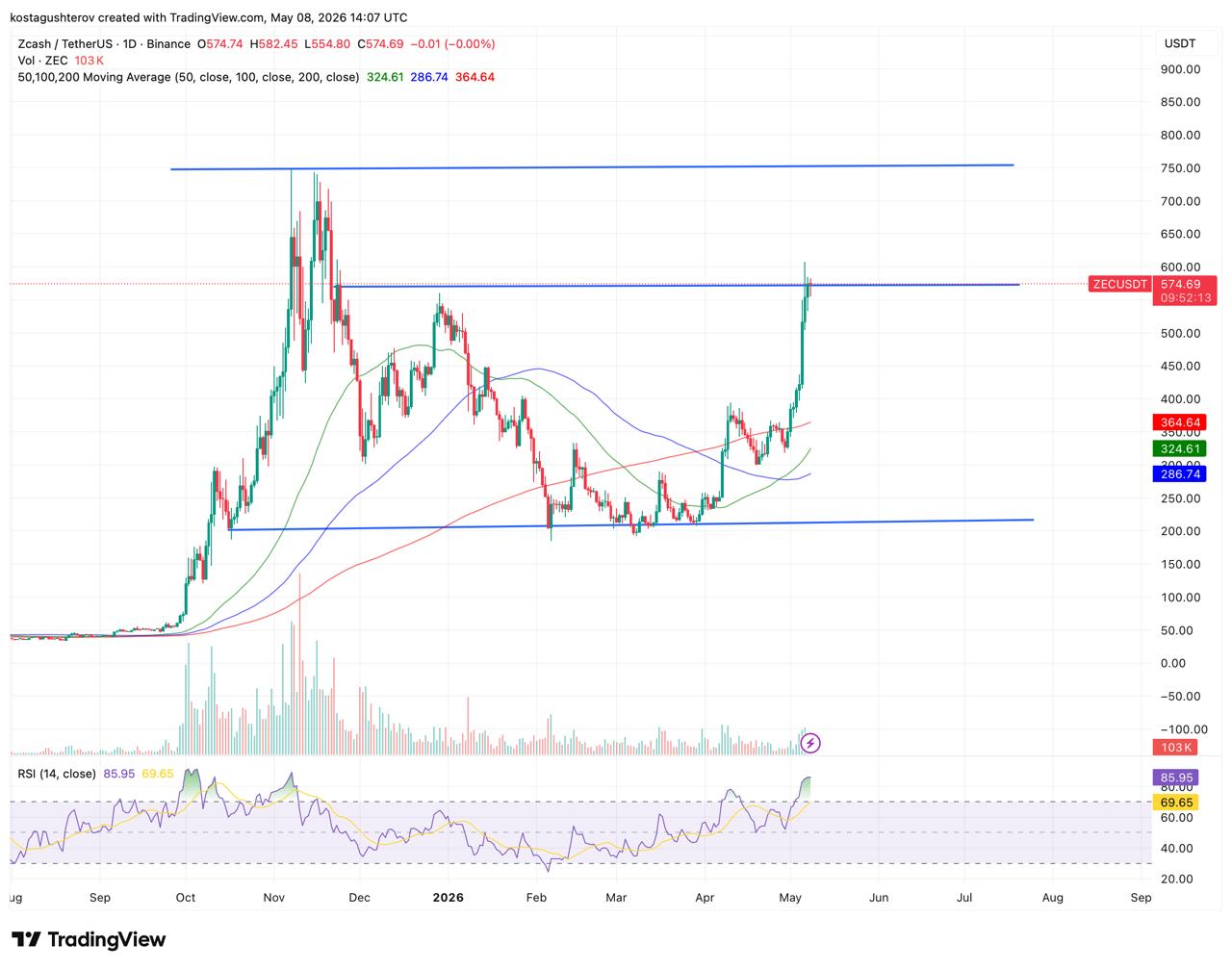
What makes the current approach structurally different from the prior two is the condition of the moving averages. In November, the MA structure was bearish: price was losing support levels on the way down. In December, the MAs had not yet recovered. Now, all three moving averages sit below current price: the MA 50 at $324.61, the MA 100 at $286.74, and the MA 200 at $364.64. Price is 57% above the 200 MA according to the 1D chart from Tradingview, which reclaimed in April and triggered the acceleration that produced the 69% monthly gain. The technical foundation beneath the current resistance test is categorically stronger than either of the prior two approaches.
Why the Third Test Is the Most Important
The third test of a resistance level is structurally the most important: markets have memory, and the weight of two prior rejections either breaks the level or confirms it permanently. A resistance level that survives three distinct tests from improving momentum conditions becomes increasingly credible as a ceiling. A resistance level that finally breaks on the third test, after two prior failures, tends to break with conviction, because the sellers who defended it twice have already been absorbed by the buyers who pushed price back to it three times.
The monthly gain, reported by CoinMarketCap, is the clearest signal that buyer pressure is not weak. Zcash moved from the $200-$210 accumulation zone, where buyers defended price repeatedly across February and March, through all three major moving averages, and arrived at $575-$590 with volume expansion supporting the move. That is not the profile of a level being tested on exhaustion. It is the profile of a level being tested with genuine demand behind it. Whether that demand is sufficient to flip the zone from resistance to support is the only question the chart has not yet answered.
RSI at 85.95 and the Window Problem
RSI at 85.95 against a signal of 69.65 is a 16.30-point spread that reflects the speed of the recent move more than its sustainability. An RSI above 85 does not predict a reversal: during strong trend reversals, RSI can remain elevated for extended periods before mean-reverting. What it does is compress the decision window. RSI at 85.95 does not make the breakout less likely. It makes the window for a clean breakout shorter, because at that reading, every session of sideways price action brings selling pressure closer.
The practical implication is timing. If ZEC consolidates at current levels for several sessions without breaking above $590, the RSI will begin returning toward its signal line, and selling pressure from profit-takers in the 69% monthly move will build. A breakout that does not happen quickly at this RSI level tends not to happen cleanly: it either resolves in the next few sessions or the RSI reset forces a pullback that tests whether $575-$590 holds as support from below. That pullback scenario is not bearish by default. A successful retest of $575 as support after a brief RSI reset would actually be the most structurally constructive outcome: it would convert the resistance zone into a confirmed support level with a cleaner momentum profile for the approach toward $750.
Two Scenarios and What Resolves This Structure
The bull case requires a daily close above $590 on above-average volume within the next 72 hours. That would constitute a confirmed breakout of the zone that has rejected ZEC twice and open the path toward the descending macro trendline near $750, a further 30.5% upside from current price. The $750 level represents the upper boundary of the six-month structure: breaking it would signal a full trend reversal from the November peak.
The bear case is a rejection at current levels that mirrors the November and December outcomes. Given RSI at 85.95 and the 69% monthly gain, a rejection here would likely be sharp: profit-takers have significant gains to protect, and two prior resistance confirmations give sellers a well-defined technical basis for entries. The first support on a rejection is the $575 zone itself if tested from above, then the $364.64 MA 200 as the next structural level. A daily close below $540 within 48 hours would indicate the third test has failed and that the resistance zone has held for a third consecutive time, which would shift the structure back to range-bound between $575 and the MA support cluster below.


