


Two analysts are pointing at the same copper chart this week, but they are measuring different things, and the gap between those measurements may determine when altcoins move.
Key Takeaways
Copper hit ATH $6.62, +8.60% in May.
Altcoin market cap flat at $200 billion.
Copper/gold ratio just turned after five years.
ETH/BTC and copper/gold track near-identically.
Ratio recovery, not price alone, is the cleaner signal.
The nominal signal and its hidden qualifier
Analysts Ash Crypto posted a two-panel chart on May 12 showing copper on a monthly timeframe above the altcoin market cap excluding the top 10. The copper chart, sourced from Capital.com, shows the metal closed May’s candle at $6.54 with an intramonth high of $6.62, a new all-time high, and a monthly gain of 8.60% per the chart header. Ash’s post stated the gain as 8.75%; the chart figure is 8.60%. The altcoin “Others” market cap, pulled from TradingView, sits at $200 billion at the time of wrting.
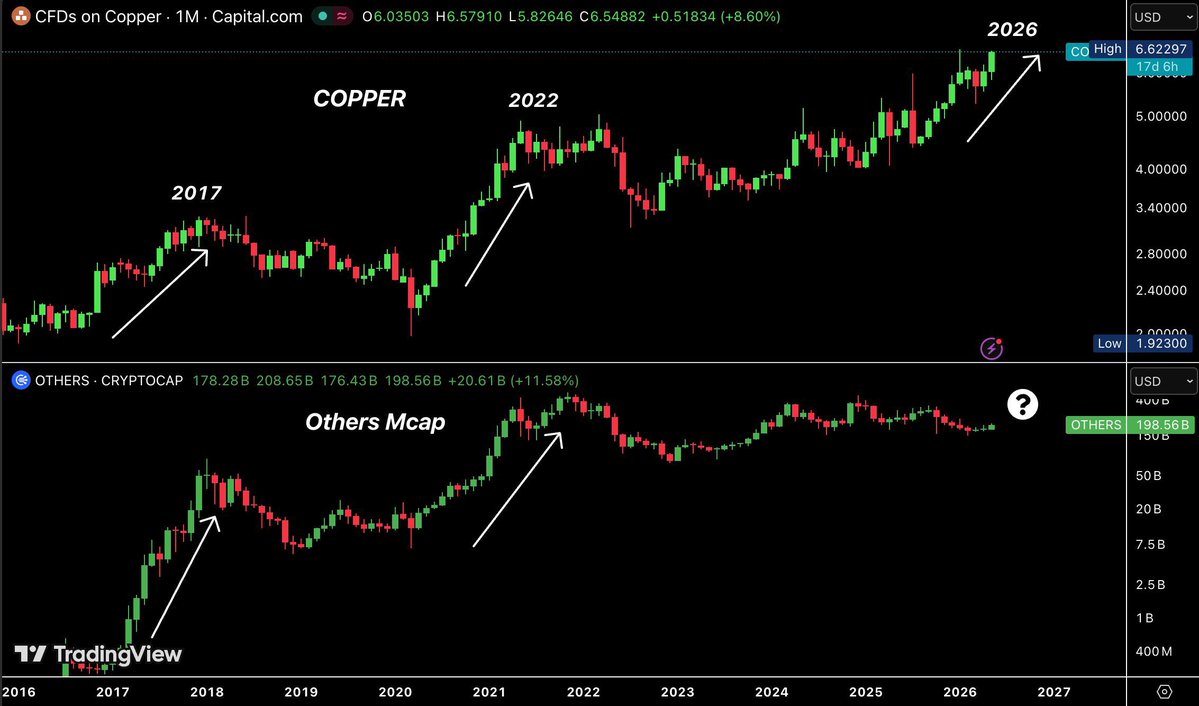
The historical pattern Ash draws on is direct: copper peaked in early 2017, and the altcoin market cap surged roughly six months later. Copper peaked again in 2021 and altcoins followed in shape, with a delay. His argument is that copper has now hit an all-time high while altcoins are flat, so the delay is happening again.
That framing is correct as far as it goes. What it leaves unmeasured is the denominator.
What the ratio shows that the price does not
On the other hand, Michaël van de Poppe is not tracking copper against the dollar. He is tracking copper against gold, and the distinction matters considerably. Gold went effectively vertical through the final quarter of 2025, meaning copper’s dollar price was rising into a period when the traditional safe-haven was also rising sharply. A commodity that gains while gold gains is not necessarily signaling a risk-on environment: it may simply be riding the same inflation or geopolitical premium.
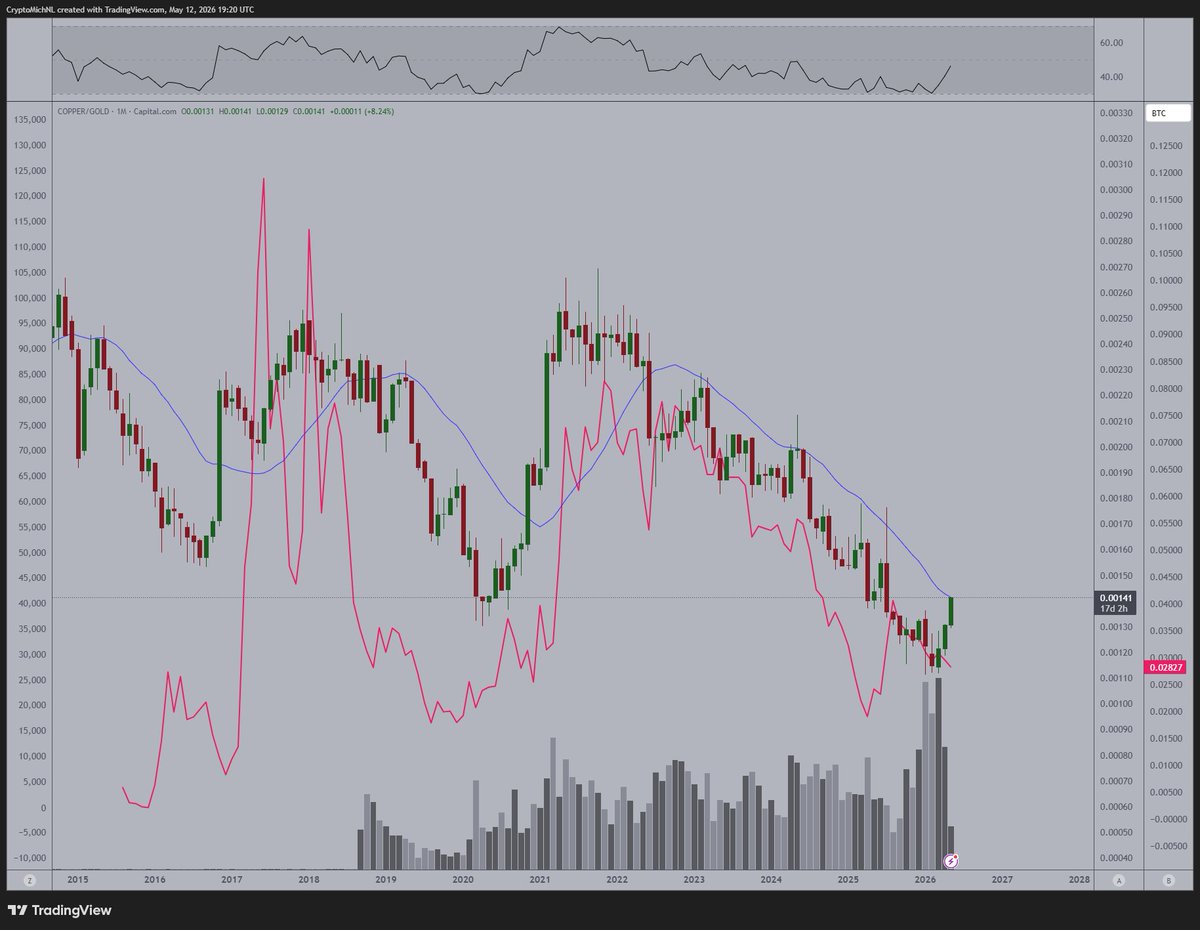
The copper/gold ratio corrects for that. Van de Poppe’s weekly chart on TradingView shows the ratio spent approximately five years in a downtrend before beginning to curl upward in early 2026. That five-year compression period coincides almost exactly, he notes, with the duration of the altcoin bear market measured against Bitcoin. The overlay he presents is ETH/BTC plotted against the copper/gold ratio: the two lines trace the same arc across the 2015–2026 range with close fidelity.
The copper/gold ratio is a tighter altcoin leading indicator than copper’s dollar price, because it strips out the inflation and safe-haven demand that can drive nominal copper higher without any genuine improvement in global risk appetite. Van de Poppe’s conclusion follows from this: with copper now beginning to outpace gold on the weekly chart, the business cycle signal is shifting to risk-on, and altcoins measured against Bitcoin historically follow that shift.
Why a rising copper price does not guarantee an altcoin rotation
The correlation between ETH/BTC and copper/gold is visually striking, but correlation across two assets over a decade does not establish causation or guarantee forward replication. Altcoin bear markets versus Bitcoin are shaped by Bitcoin-specific forces: the halving cycle, regulatory pressure on specific chains, narrative rotation among crypto traders, and the emergence of Bitcoin spot ETFs drawing institutional capital that does not rotate into altcoins. None of those forces appear in the copper/gold ratio.
In 2017 and 2021, altcoins did not merely follow copper: they followed the rotation out of defensive assets into cyclical ones, a rotation the copper/gold ratio captures and the copper price alone obscures. But those rotations also coincided with crypto-native catalysts: the 2017 ICO wave, the 2021 DeFi and NFT explosion. A copper/gold recovery in 2026 arrives without an obvious crypto-native catalyst of equivalent scale, which means the macro signal may be necessary but not sufficient.
Van de Poppe addresses this only partially. His stated expectation for “more upside in the coming 1–2 months” is a near-term positioning view, not a structural call, and he acknowledges short-term timing noise of weeks in either direction.
What the lag arithmetic implies
If the six-month lag from 2017 holds, an altcoin market cap still sitting at $198 billion in May 2026 has not begun the move that copper’s ratio recovery is historically associated with. The copper chart’s 2026 breakout annotation places the move starting in early-to-mid 2026. A six-month lag would put the altcoin response somewhere in the second half of 2026. The 2021 cycle, however, showed a compressed and simultaneous move rather than a clean six-month delay, which means the lag is variable and cannot be read as a fixed calendar signal.
What both analysts agree on, and what the charts from two independent sources confirm, is that the altcoin market cap at $198 billion has not yet responded to copper’s monthly breakout. The disagreement is not whether a response is coming but what triggers it: Ash Crypto frames it as a copper price catalyst, while van de Poppe frames it as a ratio-based risk-appetite shift.
The ratio framing is the more falsifiable one, which makes it the more useful one.
The two prices that will settle the debate by August
A copper/gold ratio that continues to make higher weekly closes through June 2026, combined with the altcoin market cap excluding the top 10 breaking above $250 billion within three months, would confirm van de Poppe’s thesis that the ratio recovery is already transmitting into crypto risk appetite.
A copper/gold ratio that reverses below its April 2026 weekly close before the altcoin market cap exceeds $220 billion would deny the thesis: it would mean the ratio turn was a false breakout and the macro-to-altcoin transmission channel that both analysts rely on did not activate in this cycle.


