


Two assets near historically low exchange supply levels are moving in opposite directions, and the netflow charts explain why.
Key Takeaways
BTC supply on exchanges: 5.6%, lowest since 2018, holding flat.
ETH supply on exchanges: 4.6%, up from 4.2% ten days ago.
Both still near record lows but diverging in direction.
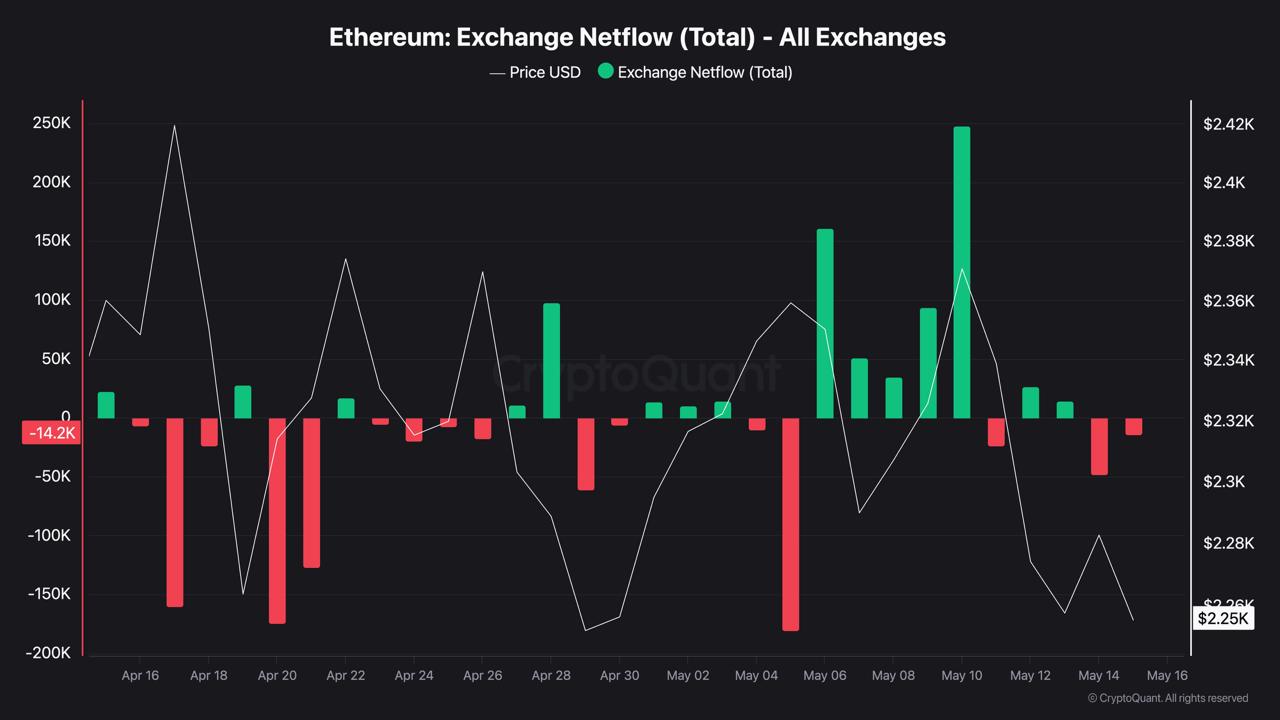
May 10 ETH inflow spike: approximately 240K ETH, chart’s largest bar.
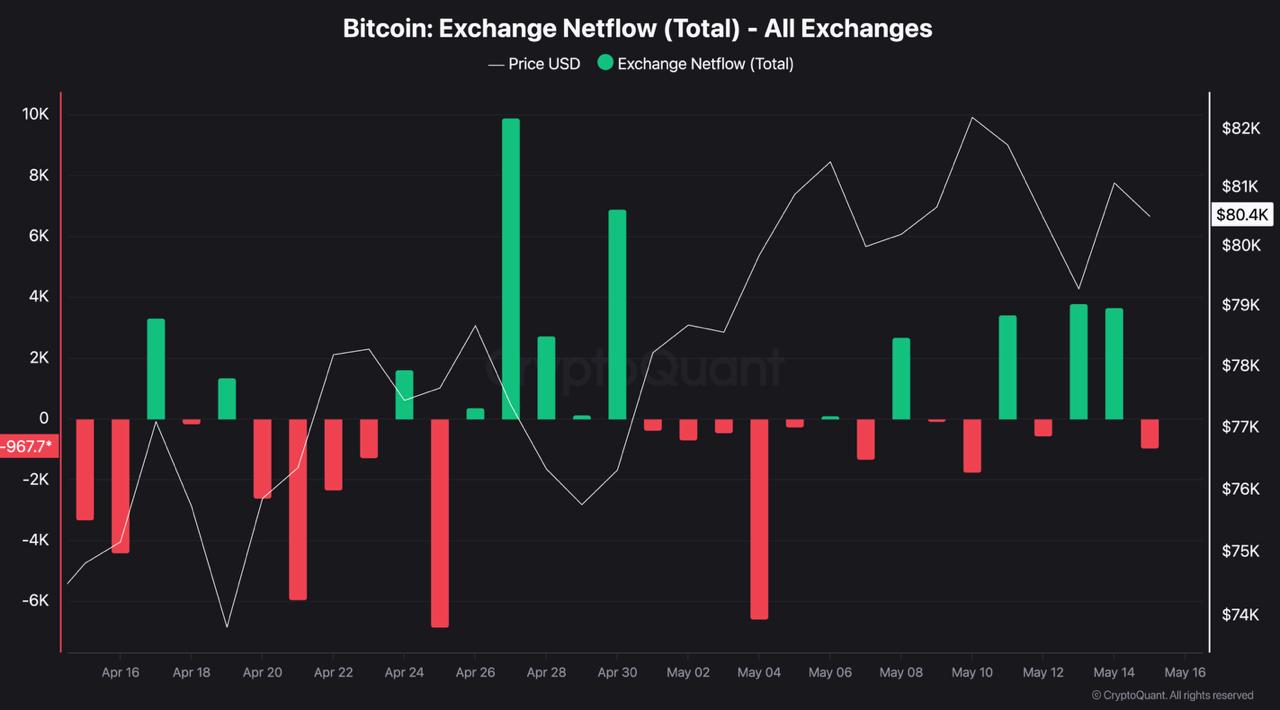
Current BTC netflow: -967.7 BTC. Current ETH netflow: -14.2K ETH.
What the supply percentages show
The percentage of each asset’s total supply held on known exchange wallets is one of the cleaner long-term behavioral signals in on-chain analysis: rising supply means holders are moving coins toward liquidity and potential sale, falling supply means the opposite. Santiment’s dual-asset chart tracking this metric for BTC and ETH, updated daily via Sanbase and spanning May 2025 to May 2026, shows two lines that declined together for most of the year before diverging in May 2026.
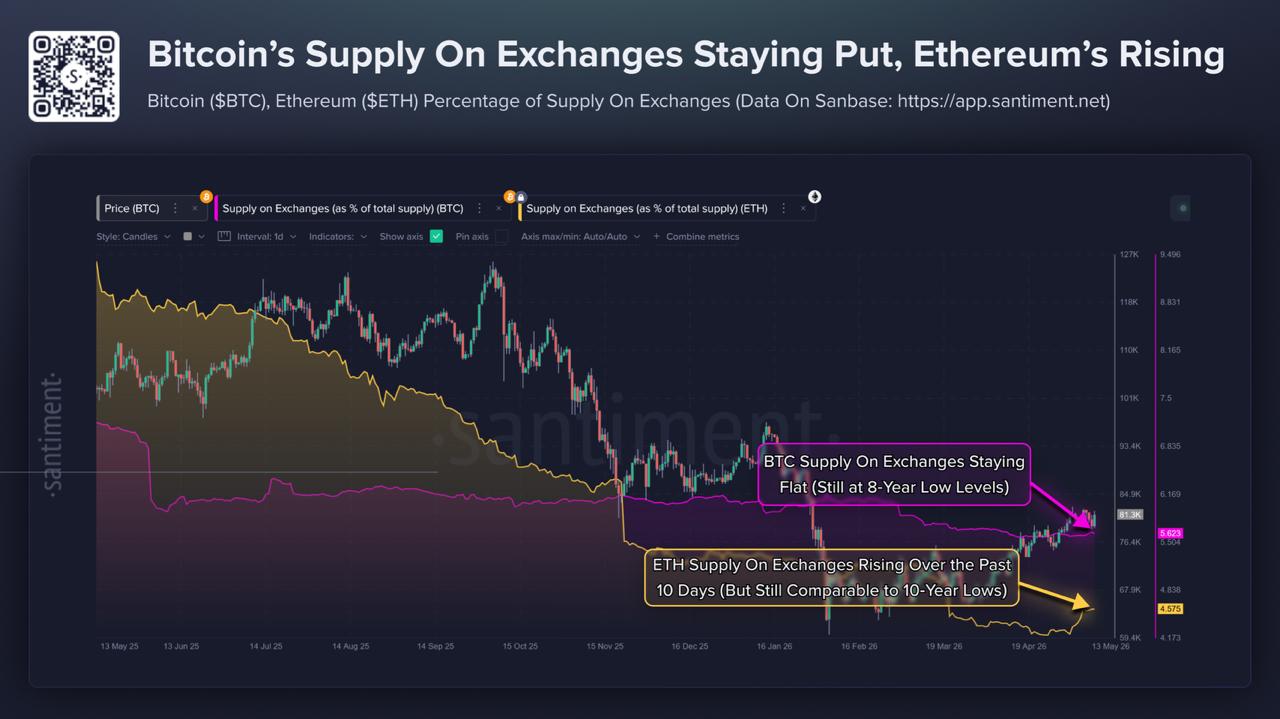
Bitcoin‘s exchange supply currently sits at 5.623%, confirmed by Santiment as the lowest level since 2018, an 8-year low. The yellow line on the chart has been declining steadily from approximately 9.5% at the chart’s start, and the Santiment annotation describes it as staying flat at current levels, meaning the decline has stalled rather than reversed. Ethereum’s exchange supply sits at 4.575%, up from 4.2% ten days ago, a rise of 0.4 percentage points. Santiment notes this is still near the lowest level since ETH began public trading in 2015, but the direction has changed.
When two assets are both near historically low exchange supply levels and one begins to diverge upward while the other holds flat, the divergence tells you more about the behavioral difference between the two holder bases than the absolute levels tell you about either asset individually. The question the supply percentages raise is not whether the levels are high or low in isolation but why the two are moving differently at the same moment.
What the netflow charts explain
The CryptoQuant exchange netflow charts for both assets, covering April 15 to May 16, 2026, provide the mechanism behind the divergence.
For Bitcoin, the netflow chart shows a volatile but roughly balanced pattern of inflows and outflows across the period, with the most recent reading at -967.7 BTC, indicating net outflow. The notable detail is that May 11 through May 14 produced a sequence of positive green bars in the +2.5K to +4K BTC range each day, yet the supply percentage held flat at 5.6% across the same period.
BTC exchange supply holding flat at 5.6% while recent netflow bars show positive inflows means Bitcoin is moving onto exchanges but being withdrawn at a matching rate, which describes an active holder base absorbing exchange deposits rather than a passive one simply not selling. The supply percentage stability is not the absence of activity: it is the result of two opposing flows canceling each other out, with withdrawal pressure keeping pace with deposit pressure.
For Ethereum, the mechanism is more direct. The chart shows May 10 produced a green bar of approximately 240,000 ETH, the largest single inflow bar on the chart. The days that followed, May 12 through May 15, show predominantly red bars and a current reading of -14.2K ETH outflow. ETH’s 0.4 percentage point rise in exchange supply over ten days traces directly to the May 10 inflow spike of approximately 240,000 ETH, the largest single-day inflow on the chart, and the outflow bars that followed have not yet been large enough to reverse what one session produced.
What the divergence means for each asset
The behavioral picture that emerges from combining both assets’ supply and netflow data is structurally different for each.
For Bitcoin, supply discipline is active rather than passive. Holders are not simply leaving BTC in cold storage and ignoring exchanges: they are depositing and withdrawing at roughly equal rates, keeping the exchange supply percentage stable at a level historically associated with reduced selling pressure. The 8-year low in exchange supply, maintained through a period that included a PPI-driven price shock and a subsequent recovery above $82,000, suggests the holder base is not being shaken out by short-term volatility.
For Ethereum, the May 10 inflow spike is the event that changed the picture. Whether that spike represented profit-taking by holders who accumulated ETH below $2,000 during February and March 2026 and were still in profit at May prices, or a separate cohort moving supply for other reasons, the result is the same: exchange supply rose, and the outflows since have not reversed it. The current ETH exchange supply at 4.6%, while still near historical lows, is moving in the wrong direction for the same thesis that BTC’s flat supply supports.
A return of ETH exchange supply to 4.2% or below, driven by sustained daily net outflow bars on the CryptoQuant chart, would indicate the May 10 spike has been absorbed and ETH holders are returning to net outflow behavior.
A continuation of ETH exchange supply above 4.5% through the end of May, accompanied by further positive netflow spikes comparable to May 10, would indicate the directional divergence from BTC is structural rather than temporary and the ETH holder base is in a distribution phase the BTC holder base is not replicating.


