

Wells Fargo, managing about $1.9 trillion in assets, significantly increased its Ethereum ETF holdings in Q1 2026, raising its position in BlackRock’s iShares Ethereum Trust ETF (ETHA) by 63.5% to 1.1 million shares and expanding its Bitwise Ethereum ETF (ETHW) stake by 37% to 257,000 shares, while reducing exposure to Bitcoin ETF, as per its 13F filing with the SEC.
The market is left wondering whether this reflects a long-term institutional view of Ethereum’s potential or a tactical move driven by Bitcoin’s recent underperformance.
WELLS FARGO EXPANDS ETHEREUM EXPOSURE
Wells Fargo sharply increased its Ethereum $ETH ETF exposure during the first quarter.
A new SEC 13F filing showed the bank expanded its ETHA holdings by 63.5%. Its iShares Ethereum Trust position rose to roughly 1.1 million shares.
Wells… pic.twitter.com/YsysFUBP2v
— BSCN (@BSCNews) May 13, 2026
Both Bitcoin and Ethereum experienced significant declines in Q1 2026, with Bitcoin dropping -24.1% to $66,000 and Ethereum falling 31.8% to around $2,023.
Wells Fargo’s proactive accumulation of Ethereum ETFs during this downturn highlights a commitment to a structural allocation rather than a short-term momentum play.
$ETH is still struggling to break the downtrend which started after Eric Trump said "Q4 is going to be unbelievable" last year.
BUT
The daily RSI is building higher lows instead of collapsing as it does on a bear trend.
This builds a strength under the hood and should… pic.twitter.com/52yAYQNYGq
— Vuori Trading (@VuoriTrading) May 15, 2026
Bitcoin ETF News: What Does the Wells Fargo ETF Reallocation Actually Signal?
Wells Fargo is reframing Ethereum from a speculative token into a programmable platform asset crucial for decentralized applications, tokenized securities, and on-chain settlement. Since at least 2021, their Investment Institute has positioned Ethereum as a “platform for decentralized applications,” contrasting it with Bitcoin’s “speculative store-of-value” role. The Q1 2026 13F filing indicates this internal framing is now reflected in capital allocation.
Model portfolio reallocations require internal approvals and compliance reviews, differentiating them from discretionary trades. When Wells Fargo increased its holdings in ETHA to 1.1 million shares and ETHW to 257,000 shares, it signified an institutional update rather than a trader’s personal view.
ETF flow data from Q1 2026 highlights Ethereum’s appeal: while Bitcoin ETFs recorded $8.02Bn in inflows and $8.52Bn in outflows, leaving a net negative position, Ethereum ETFs saw $2.03Bn in inflows against $2.79Bn in outflows, suggesting a more stable investor base. K33 notes that Ethereum ETF holders tend to have longer time horizons than Bitcoin ETF investors, who are short-term oriented.
Why Ethereum’s Staking Yield Changes the Institutional Portfolio Calculus
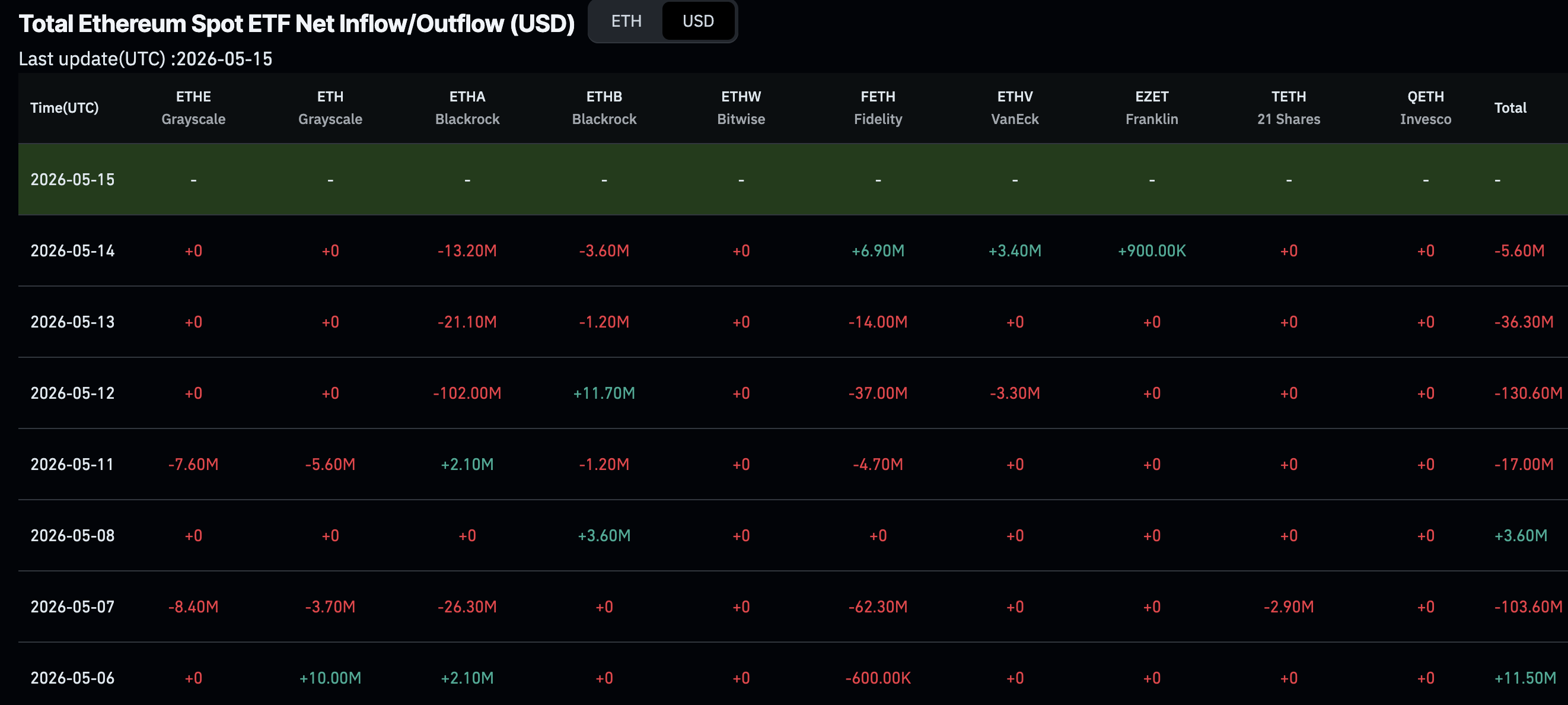
(SOURCE: CoinGlass)
The key structural difference between Ethereum and Bitcoin for institutional portfolios is staking yield. After the Merge, Ethereum’s proof-of-stake mechanism generates an annualized staking yield typically between 3–5%.
This yield fundamentally changes how ETH is classified in portfolios compared to Bitcoin, a non-yielding asset. Coinbase Institutional’s Q4 2025 outlook emphasized this yield as a significant factor in portfolio construction, a sentiment reflected in wirehouse-level research.
For institutional allocators, yield isn’t just attractive; it’s crucial for portfolio engineering. An asset like ETH, with a 3–5% yield, is treated similarly to tech equity dividends or corporate bond coupons, allowing for larger positions based on risk-adjusted returns.
However, it’s important to note that current US Ethereum ETFs, such as ETHA and ETHW, do not pass staking yields to investors due to regulatory constraints.
This means the yield narrative is about Ethereum’s intrinsic economics rather than an immediate cash-flow benefit from ETF ownership. Monitoring any regulatory changes that allow ETF-level staking could significantly impact existing return profiles.
Why Institutional Capital Has Been Waiting for Exactly This Move
Wells Fargo’s 13F disclosure serves as a guide for institutional capital in the wirehouse ecosystem, with model portfolios creating frameworks for crypto exposure. When Wells Fargo raised its position in the Ethereum ETF to 1.1 million shares, it indicated thorough due diligence.
Similarly, BlackRock’s IBIT has set the standard for Bitcoin ETFs following interest from wirehouse firms, with ETHA benefiting from BlackRock’s reputation. J.P. Morgan’s Q1 2026 disclosure of substantial investments in spot Bitcoin ETFs shows increased institutional participation in crypto.
Legislative efforts such as FIT21 and the CLARITY Act could classify Ethereum as a commodity alongside Bitcoin, potentially easing compliance concerns for conservative investors. Wells Fargo’s reallocation might be anticipating this regulatory change.


