

Solana price went from $255 to $84, and most of the market’s predictions moved from bullish to bearish. But Meta AI predicts otherwise. Zuckerberg’s model looked at where SOL sits today and predicts it’s one of the most undervalued setups in the large-cap space.
The target? $350 to $500 by end-2026.
Meta AI’s bull case is built on competitive dominance that is already being demonstrated in production rather than promised on a roadmap. Sub-second finality, sub-$0.01 fees, and throughput that continues pulling developers and users away from Ethereum L2S are not future catalysts; they are current advantages that compound with every new application built on the network.
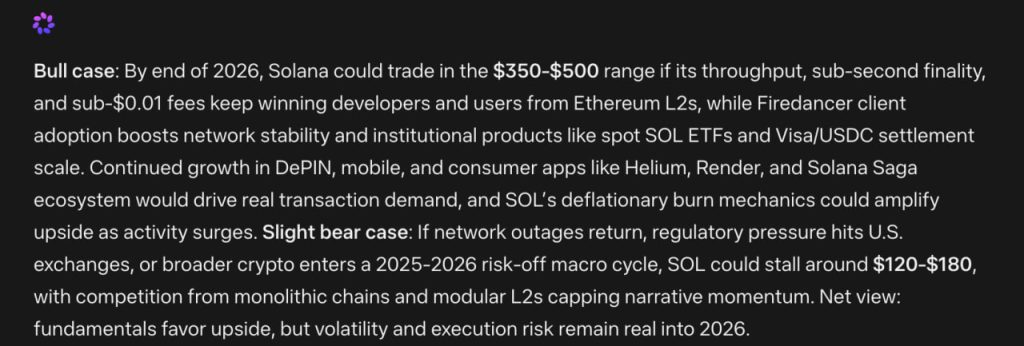
Firedancer client adoption is the next step up, boosting network stability to the point where the outage narrative that has followed Solana for years becomes impossible to sustain.
The institutional layer is forming on top of that foundation: spot SOL ETFs are live, Visa is settling USDC payments on-chain, and the combination of those 2 alone represents a demand profile that is structurally different from any previous SOL cycle.
Meta AI goes further into the ecosystem stack, flagging DePIN, mobile, and consumer apps, including Helium, Render, and Solana Saga, as drivers of real transaction demand that feeds directly into SOL’s deflationary burn mechanics. More activity means more supply removed from circulation, which means the bull case gets stronger as adoption grows rather than plateauing.
The bear case is specific enough to respect. Network outages returning, regulatory pressure hitting US exchanges, or a broader 2026 risk-off macro cycle could stall SOL around $120 to $180, with competition from monolithic chains and modular L2S capping the narrative momentum that drives speculative inflows.
Meta AI closes with a verdict that is direct: fundamentals favor upside, but volatility and execution risk remain real.
Something Has to Give: What’s Meta AI Predicts Next?
Solana is trading at $84.36 on the daily, and the chart is a 10-month story of peak euphoria followed by complete surrender. Price hit $255 in August 2025, spent the next 5 months in a grinding downtrend through every attempted recovery, crashed to $70 in February 2026, and has been range-bound between $75 and $100 ever since.
4 months of sideways action after a 67% drawdown is either distribution or accumulation, and Meta AI is firmly in the accumulation camp.
The structure, since February, is actually healthier than the price suggests. Higher lows have been printing quietly across March, April, and May, and the recent push toward $95 before pulling back to $84 shows buyers are present and willing to step in.
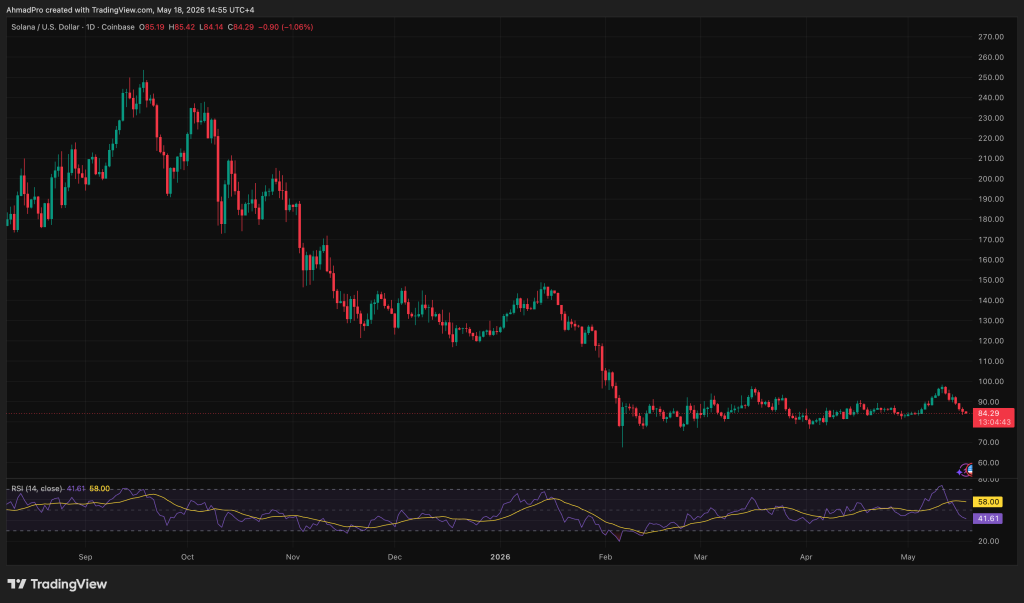
The problem is that every rally attempt has stalled at the same $95 to $100 zone, which is the ceiling that needs to crack for this chart to change character.
Resistance is $95 to $100, the level that has rejected every meaningful recovery attempt since February. A clean daily close above $100 with volume is the signal that shifts the structure from range-bound to breakout.
Above it, $120 is the next reference, and $150 is where the real overhead supply from the November distribution begins. Support is $78 to $82, the base of the current range, and the level Meta AI’s bear case floor sits just above.
Meta AI predicts a $350 to $500 target, but Solana needs $100 first. The chart is at the exact point where that story either starts or gets delayed again.
META Puts LiquidChain as The Next 1000x Potential Crypto
Multi-chain DeFi is broken, and the people losing money because of it already know it.
Assets trapped in isolated pools. Bridges that fail at the worst possible moment. Slippage is cutting into returns before a transaction even settles. Moving value between Bitcoin, Ethereum, and Solana is supposed to be seamless. Instead, it is a gauntlet of fees, delays, and infrastructure that was never built to communicate with itself.
LiquidChain is not patching the problem. It is replacing the layer that causes it.
The project sits at Layer 3, above the existing chains, pulling their liquidity into a single unified execution environment. One deployment reaches all 3 ecosystems at once. No duplicate codebases. No fragmented pools splitting liquidity across disconnected networks. No bridging tax bleeding value out of every cross-chain interaction.
The architecture comes down to 4 components, each one targeting a specific failure point that costs users real money today. A Unified Liquidity Layer eliminates fragmentation. Single-Step Execution removes the multi-transaction overhead. Verifiable Settlement brings finality without trust assumptions. The Deploy-Once model means developers build once and reach everywhere.
The presale is live at $0.01454 per $LIQUID token with over $700K raised so far.


