


Total crypto futures volume came in at $5.0T in April 2026, marking the lowest monthly reading since October 2024 and a 9.6% decline from March's $5.5T.
Key Takeaways
April futures volume: $5.0T, lowest since Oct ’24, down 9.6% from March.
Peak-to-current decline: 54.2% from Oct ’25’s $10.91T high.
Binance holds 28.2% of total April volume at $1.41T.
Oct ’24 trough at $4.1T preceded a volume doubling within two months.
How far the market has fallen from its peak
The October 2025 peak of $10.91T now sits 54.2% above April’s reading. The contraction did not happen evenly.
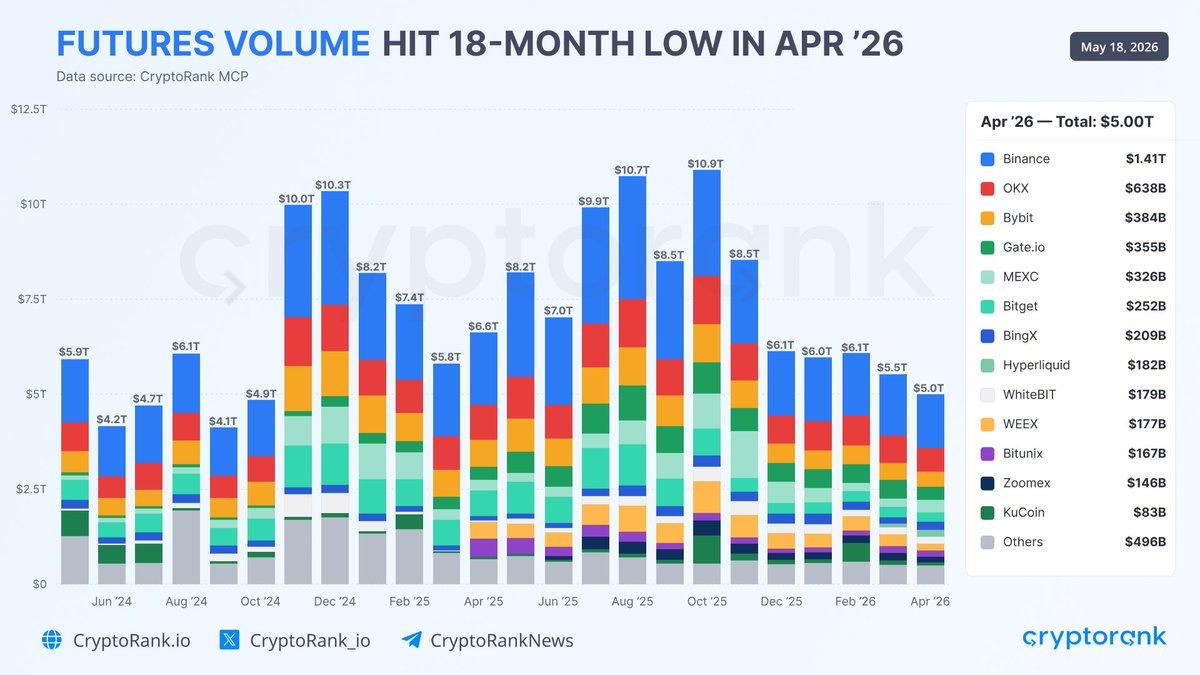
CryptoRank data shows the first month after the peak produced a decline of approximately 22%, followed by a second month the source records as approximately 28%. Two months of double-digit declines accounted for most of the damage. Since that initial crash, the rate of contraction has flattened to approximately 9% per month, with January and February 2026 showing a near-plateau before the decline resumed at a shallower gradient through March and April.
At $5.0T, April futures volume has now erased more than half of the market’s October 2025 peak activity, but the contraction is decelerating in a pattern that historically precedes recovery rather than continuation.
What the exchange breakdown says about market structure
Binance recorded $1.41T in April futures volume, representing 28.2% of the entire market at its 18-month low. OKX came second at $638B, less than half of Binance’s total. Bybit recorded $384B and Gate.io $355B. Below those four exchanges, the remaining participants each registered below $330B, with the combined Others category totaling $496B across all remaining platforms.
Binance’s $1.41T April volume represents 28.2% of the entire futures market at its 18-month low, a dominance share that no competitor approaches even in a contracting market. Analytically, when total volume compresses this sharply, market share tends to concentrate toward the largest platforms as smaller participants lose the activity needed to sustain liquidity. The exchange that enters a recovery cycle holding the largest share of a compressed market is structurally better positioned than those whose relative weight eroded alongside total volume.
The Oct ’24 comparison and what it does not guarantee
The most relevant historical parallel is the October 2024 trough. Volume fell to $4.1T that month before recovering to $10T by December 2024, a near-doubling in two months. The current $5.0T reading sits $0.9T above that prior trough, meaning the market has not yet reached the depth of the last comparable low.
The Oct ’24 trough at $4.1T preceded a volume doubling to $10T within two months, which does not guarantee a repeat but establishes that this market moves from floor to ceiling faster than any monthly average suggests. Two conditions supported that recovery: a sustained price rally and a macro catalyst. Neither is confirmed for the current period. The deceleration in the monthly decline rate is the first structural condition for a floor to form, but deceleration alone is not recovery.
If May 2026 volume holds above $5.0T or registers a smaller month-over-month decline than April’s 9.6%, the floor thesis holds. If volume falls below $4.1T, the market will have breached the prior comparable trough and the Oct ’24 recovery parallel will no longer apply.


