

HYPE rose from $38 on May 14th to $48.13 at the time of writing, a gain of approximately 24% across six days driven by three distinct catalysts that arrived in sequence rather than simultaneously.
Key Takeaways
HYPE rose from $38.32 low on May 13 to $48.13, a gain of approximately 24%.
Two catalysts hit May 14: CLARITY Act passing, Coinbase/Circle USDC deployer deal.
Social dominance peaked at 1.79% on May 14, 5-10x baseline, second wave May 17.
SPCX synthetic SpaceX perpetual launched May 18 on Hyperliquid, added approximately 7%.
The first two catalysts and what they confirmed
On May 14, two events landed within the same window. The CLARITY Act passed, providing regulatory clarity for digital assets in the United States. Coinbase and Circle named Hyperliquid their official USDC deployer. Santiment data shows social dominance spiked to 1.79% on May 14, a level the source describes as 5-10x the baseline reading for HYPE. Price moved from the May 13 low of $38.32 toward the mid-$40s on that first leg.
Both catalysts are external validations. The CLARITY Act improved the regulatory environment for the entire sector. The Coinbase and Circle designation confirmed institutional recognition of Hyperliquid’s infrastructure. Neither required Hyperliquid to do anything it had not already done. They are the market repricing existing capability at a higher confidence level.
Why the third catalyst is structurally different
On May 18, Trade.xyz launched SPCX, a synthetic SpaceX pre-IPO perpetual contract on Hyperliquid, priced at a $1.78 trillion implied valuation. HYPE added approximately 7% on that session. A second social dominance wave registered between 1.07% and 1.28% on May 17 to 18.
The CLARITY Act and the Coinbase deal validated Hyperliquid from outside; the SPCX launch validated it from within, and the distinction matters because external validation can be revoked while demonstrated platform capability cannot. SpaceX is a private company. Its pre-IPO equity cannot legally trade on regulated exchanges in the form that SPCX offers. Analytically, Hyperliquid’s platform created a synthetic instrument that replicates that exposure in the space the rules do not yet cover.
The source author frames this as the rails-phase thesis running backwards: instead of TradFi products moving onto blockchain infrastructure, crypto rails are generating TradFi-adjacent products that the regulated system structurally cannot produce. The source also projects synthetic markets for Anthropic and OpenAI as potential next steps, though this is the author’s forward inference, not confirmed news.
What the chart adds to the catalyst sequence
Two social dominance waves separated by three days confirm the market processed each catalyst independently rather than pricing all three in a single move, which is why the 24% gain held rather than retracing after the first leg. The TradingView daily chart shows price above all three visible moving averages: the yellow SMA at $41.38, the brown at $37.56, and the purple at $34.02, all rising. Analytically, no MA appears to have been tested since the move began, meaning the structure has not required a retest of any prior support level to sustain the advance.
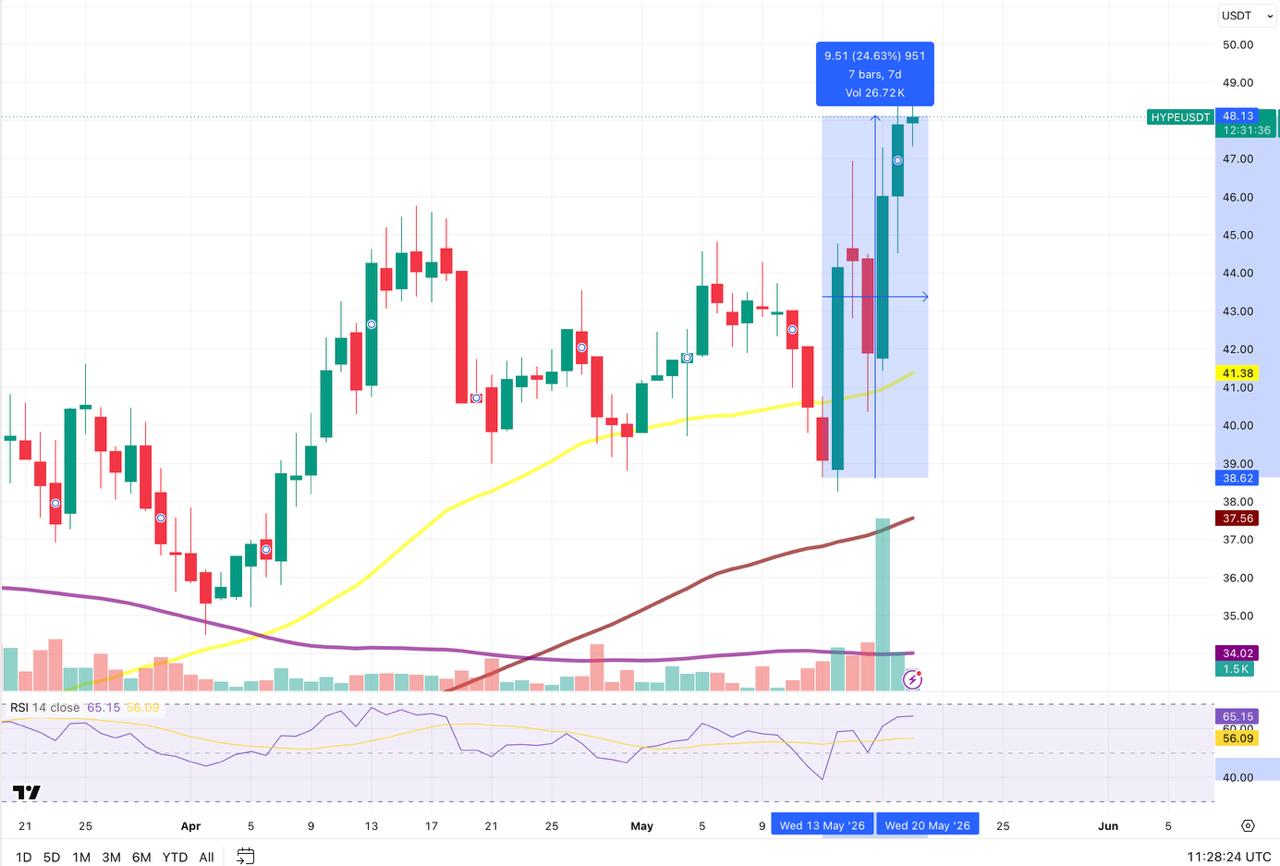
HYPE trading within $12 of its all-time high after a 24% move in six days puts the RSI at 65.15, nine points above its signal line, in a zone where momentum is confirmed but the next resistance is the ATH itself, not a moving average. The RSI is above 60 but has not reached 70, meaning momentum is strongly positive without triggering the overbought reading that historically precedes short-term consolidation. The volume picture is consistent with this: the largest volume bar on the visible chart appeared during the initial move, with the current session showing lighter participation as price approaches the ATH zone.
If HYPE closes above its all-time high on sustained volume within the next weeks, the catalyst sequence has produced a genuine breakout and the platform’s synthetic product capability is priced into a new range. If price stalls below the ATH and RSI rolls over from current levels, the three-catalyst move will have been fully priced into the existing range without producing a structural breakout.


