

The Digital Asset Market Clarity Act of 2025, H.R. 3633, passed the House on July 17, 2025, and is currently with the Senate Banking Committee, which scheduled its first markup for January 15, 2026.
This bill introduces a decentralization test to determine whether a token is regulated by the CFTC as a digital commodity or by the SEC as an investment contract, with implications for exchange listings and ETF development.
The Senate aims to pass the bill between March and May 2026 before the August recess. The market now anticipates whether this standard will effectively de-risk altcoins or if legislative uncertainties will hinder capital rotation.
Crypto Regulation: What the CLARITY Act Actually Does for Token Classification and Market Access
The Act establishes three asset categories: Digital Commodities under CFTC oversight, Investment Contract Assets with joint SEC-CFTC treatment, and Payment Stablecoins governed by the GENIUS Act banking framework.
Bitcoin and Ethereum are identified as key Digital Commodities, while tokens from ICOs begin as Investment Contract Assets and can transition to commodity status once they meet certain decentralization and maturity criteria.
Issuers must show that their blockchain is decentralized, no single party controls over 20% of governance or validator weight, or meets maturity benchmarks like transaction volume and operational history.
Successful SEC certification for decentralization allows reclassification under CFTC jurisdiction, eliminating the unregistered security label that hinders institutional adoption.
This isn’t a universal safe harbor; many tokens can’t meet the maturity thresholds without significant governance changes. Grayscale notes that established high-cap Layer 1 protocols, such as Solana and Avalanche, are best positioned for early commodity certification, while more centralized tokens will remain under Investment Contract Asset status.
Ripple’s legal officer, Stuart Alderoty, suggests that the bill supports their legal stance in the SEC litigation, indicating that XRP could be among the first to seek decentralization certification if the bill passes.
Why the CLARITY Act Now Functions as a Dual-Reading Signal for Institutional Crypto Allocators
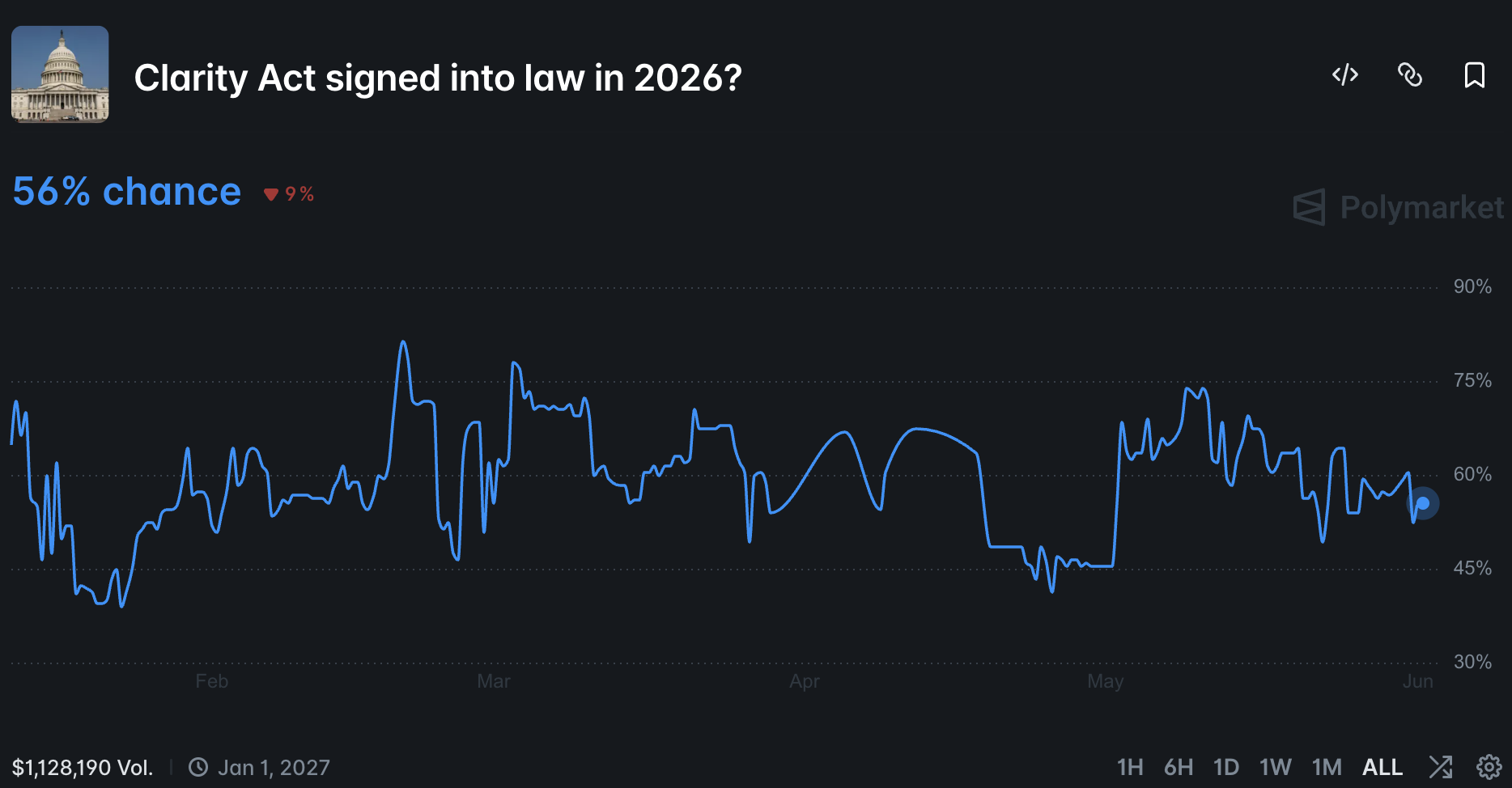
(SOURCE: PolyMarket)
The risk-on perspective hinges on an institutional pipeline that could be unlocked by a new decentralization certification mechanism.
Currently, custody banks, broker-dealers, and ETF managers are limited in their ability to add altcoin exposure due to unresolved securities classification risks dating back to 2017.
If a token like Solana or Avalanche gains a CFTC digital commodity designation under the CLARITY Act, it could eliminate compliance barriers for institutions, creating structural demand independent of retail sentiment.
Grayscale’s altcoin winners framework connects this institutional re-rating to a rotation thesis, allowing assets that meet decentralization criteria to access custody products and eventually spot ETF structures similar to Bitcoin ETFs.
Provisional registrations are expected within 90 to 180 days post-enactment, leading to a surge in listings that may act as a price catalyst.
Conversely, the risk-off view identifies three obstacles. The Senate bill requires 60 votes to overcome a filibuster, meaning it needs about 7 undecided Democratic votes before the August recess.
Additionally, the contested DeFi safe harbor provision could weaken support among banking lobbyists who prefer broader registration mandates.
Charles Hoskinson has also criticized the decentralization test for favoring proof-of-stake networks, adding uncertainty about which networks will pass certification.
Both interpretations share the same underlying facts, but the outcome depends on whether Senate Majority Leader Schumer can schedule a vote before the August 2026 recess and whether the DeFi safe harbor language remains intact during committee negotiations.
What FIT21’s House Passage and the Torres Ruling Tell Us About the Current Regulatory Re-Rating Signal
? Trump's pro-Bitcoin stance might be undermining the crypto industry's landmark legislation, the FIT21 Act. Analysts warn his support could split the community and hinder regulatory progress. Could this do more harm than good? #Trump #FIT21 #Crypto pic.twitter.com/KV0wfHiRU2
— TuananhKat (@kat_tuananh) May 30, 2026
The CLARITY Act’s market impact can be compared to the passage of the FIT21 Act in May 2024, which caused a brief price spike in major altcoins, including a 12% increase in XRP before it retraced amid Senate inaction.
This suggests that the regulatory clarity premium for assets like XRP, Solana, and Avalanche may already be partially priced in, given that the CLARITY Act passed the House in July 2025.
In contrast, the July 2023 Torres ruling in SEC v. Ripple, which determined that XRP sales on secondary markets were not securities transactions, led to a 74% price surge in XRP over 48 hours.
However, the anticipated institutional developments took 18 months to materialize, highlighting that while favorable rulings can create immediate price reactions, the current Senate dynamics and multi-variable dependencies might dampen the impact of the CLARITY Act.


