

In Bitcoin price news, US spot BTC ETFs concluded May with a record nine consecutive days of net outflows, shedding approximately $2.8Bn over that streak and roughly $1.3Bn in the final week alone, per CoinGlass data, marking the longest and deepest outflow run since these products launched in January 2024.
That reversal arrives directly after a phase of aggressive institutional accumulation in which US spot Bitcoin ETFs collectively absorbed enough supply to hold approximately 6% of all bitcoin in existence, creating a structural bid that anchored prices through the first quarter.
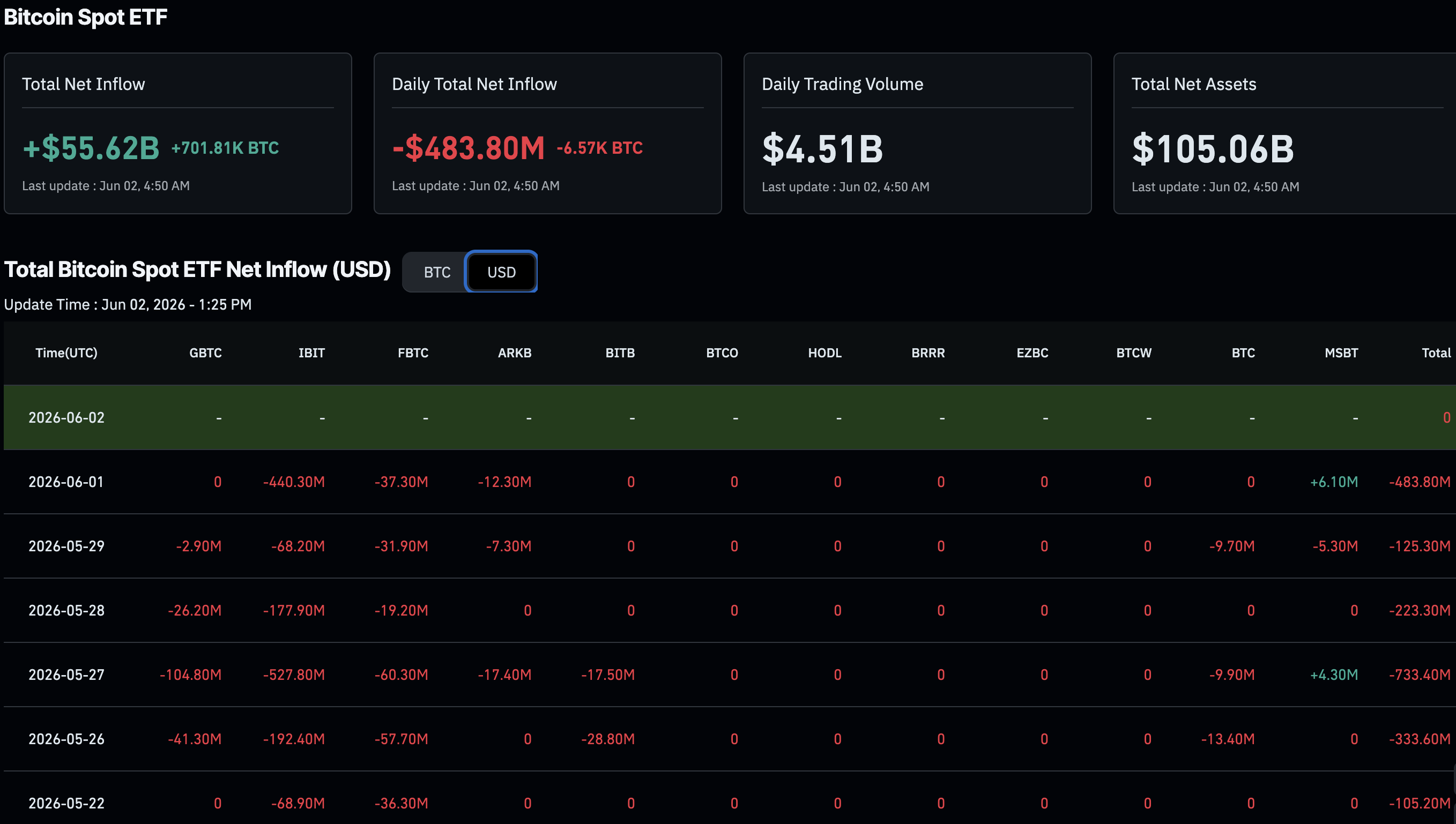
The open question the market must now resolve is whether this streak of outflows represents a durable contraction in institutional crypto demand or a temporary de-risking episode that has historically preceded the next directional move higher.
This ETF bleed comes as Bitcoin USD lost $70,000 support and is currently trading for around $69,400, a -4% drop over the past 24 hours, with analysts fearing a deeper drop is coming.
$BTC is hovering around the $69,500 level.
US stock futures are down today, while Gold is up.
Pre-market stock trading insights:
▫️Nasdaq futures is down 0.06% ?
▫️S&P futures is down 0.19% ? pic.twitter.com/EazAYNgwkb
— Ted (@TedPillows) June 2, 2026
Bitcoin ETF Outflows: What the Record Streak Actually Reveals About Institutional Positioning
Context significantly enhances the raw outflow figures. In a nine-day streak that ended May 31, net outflows reached $1.26Bn, including a notable $648.6M redemption on May 19, the largest since January 29, per CoinGlass data. This selling was concentrated and systematic rather than routine.
Fidelity FBTC and Grayscale GBTC led the redemptions, with BlackRock IBIT also experiencing $68.9 million in losses. IBIT, previously a net inflow leader, shifted into redemption territory, indicating that the selling affected both higher-fee products and institutional flags.
When Authorized Participants redeem ETF shares, the issuer sells underlying bitcoin, creating sustained selling pressure that retail cannot absorb. This led bitcoin to test a six-week low near $69,200.
By late May, year-to-date net inflows for US spot Bitcoin ETFs dropped to approximately $536M, down from over $2Bn earlier in the year, highlighting a sharp reversal in institutional interest.
Why the May Outflow Record Now Functions as a Dual-Reading Signal for Institutional Crypto Demand
The contrarian case highlights that cumulative net inflows into US spot Bitcoin ETFs are positive at around $57.1Bn, with total net assets near $98.9Bn.
This indicates that current outflows stem from weaker-conviction holders being flushed out, while the long-term institutional base remains solid.
Analysts from Bitrue and CoinDesk suggest this is more of a position-trimming event rather than a mass exit, as evidenced by BlackRock’s fund seeing no net flows on several occasions.
Conversely, a risk-off sentiment is driven by macro factors such as rising US Treasury yields, dollar strength, and geopolitical tensions, leading institutional investors to exit risk assets.
As rates increase, the opportunity cost of holding non-yielding assets like Bitcoin rises, making ETF vehicles the first choice for liquidation.
This correlation between macro shocks and Bitcoin’s price behavior is stronger than ever. A clear signal for a reversal would be a sustained return to net inflows across IBIT, FBTC, and GBTC, indicating renewed engagement from institutional allocators.
Bitcoin Price Structure: The Levels That Define What Happens Next
Very few people are asking this question.
What if $BTC is not lagging but leading?
Since March 2024, there has been one clear pattern.
Whenever Bitcoin has formed a local top, Nasdaq has done the same within 1-4 weeks.
This happened in March 2024, Jan 2025, October 2025, and… pic.twitter.com/JJKPC65oOg
— Ash Crypto (@AshCrypto) June 2, 2026
The Bitcoin price analysis indicates ongoing pressure, with a recent test of a six-week low around $69,200 before stabilizing. K33 Research notes that $83,000 is the break-even point for many spot Bitcoin ETF holders, leading to potential selling pressure if macro conditions don’t improve.
Immediate support is found between $69,000, with a deeper demand zone near $68,000. A significant upside reversal would require reclaiming $80,000 on volume, along with ETF inflows exceeding $200M for three consecutive days.
Bull case: If the Federal Reserve signals a pause or rate cut and Bitcoin inflows rise above $200M, it could reclaim $80,000 and target the $88,000 to $92,000 range.
Base case: If ETF outflows stabilize, Bitcoin may consolidate between $68,000 and $72,000 as institutional demand rebuilds.
Bear case: Rising Treasury yields and continued outflows could drive Bitcoin below $69,000, risking a retest of the $68,000 demand area and potential further decline to $65,000.


