

Goldman Sachs, managing over $3 trillion in assets under supervision, raised its 12-month KOSPI target to 12,000 from 9,000 on June 3, the second upward revision in less than a month, implying approximately 36% further upside from current levels and embedding a 2026 earnings growth estimate for South Korea’s benchmark index that has surged to 277% from just 48% at the start of the year.
The KOSPI is not a conventional equity index; it is one of the most tech-concentrated, cyclically sensitive, and globally liquid-dependent benchmarks in the world, with Samsung Electronics and SK Hynix now accounting for more than 50% of its market capitalization, making it a real-time barometer of institutional conviction in the global semiconductor and AI hardware cycle.
The open question the market must now resolve is whether Goldman’s aggressive re-rating of Korean equities constitutes a durable macro green light for Bitcoin and risk assets broadly, or whether the crypto read-through is an overstretched inference from a firm-specific equity call.
Goldman Sachs KOSPI Upgrade: What a 36% Upside Target Actually Signals for Global Risk Appetite
To understand why a Goldman Sachs KOSPI revision matters beyond Seoul trading desks, the transmission mechanism must be established before the conclusion. The KOSPI’s heavy weighting toward memory semiconductors means Goldman’s upgrade is simultaneously a statement about AI infrastructure demand, global manufacturing cycles, and, critically, the liquidity environment that sustains high-beta asset classes.
When Goldman Sachs states that “memory makers are gaining pricing power as computing demand grows faster than memory supply,” it describes a supply-and-demand dynamic that validates the same AI buildout narrative underpinning institutional crypto allocations.
Korea ??
“The Korean chase continues. Net allocation jumped 156 bps to 6.7%, while gross allocation rose 43 bps to 3.3%. Investors simply can't get enough of the trade.”. The Market Ear
Again friends, totally normal. (Inserts heavy sarcasm & walks away)
Chart: Goldman Sachs pic.twitter.com/oylTXwcMPg
— JTheretohelp1 (@JTheretohelp1) June 2, 2026
The macro-strategy implication is clear: Goldman’s call is not limited to Korean equities. The bank’s revised target embeds the view that the semiconductor upcycle will last longer than prior cycles, that earnings, not just multiple expansion, are driving the rally, and that any pullback represents a buying opportunity rather than a regime change.
That framing, applied at the institutional level by one of the most-followed equity research desks globally, serves as a signal to risk allocators everywhere that the growth trade remains intact.
South Korea’s equity market has historically served as a leading indicator of global risk-on phases because its export-oriented, tech-heavy composition means it reprices before slower-moving developed-market indices absorb the same earnings revisions.
When Goldman raises a KOSPI target by 33% in under a month, from 9,000 to 12,000, after already raising it from 8,000, it is not making a tactical trim; it is expressing high conviction that the liquidity and earnings environment support sustained risk appetite. That is precisely the environment in which Bitcoin has historically outperformed.
Why the Goldman KOSPI Upgrade Now Functions as a Dual-Reading Signal for Bitcoin and Crypto Allocators
The risk-on interpretation rests on a well-documented behavioral and structural correlation. South Korea is one of the most active retail crypto markets on the planet – the kimchi premium, which measures the price differential between Korean and global crypto exchanges, historically expands during periods of domestic equity euphoria.
The KOSPI has already more than doubled in 2026; if Goldman’s revised target holds, Korean retail investors sitting on significant equity gains have demonstrated, in prior cycles, a willingness to rotate a portion of those profits into Bitcoin and high-growth altcoins.
The institutional read is equally direct: Goldman’s upgrade of a high-beta, tech-sensitive EM index signals that global liquidity conditions are supportive of risk assets broadly, and Bitcoin’s correlation with that macro regime is well established.
The risk-off interpretation demands equal rigor. Goldman’s upgrade is driven almost entirely by semiconductor-specific factors, the AI and high-bandwidth memory cycle anchored to Samsung and SK Hynix, rather than by a broad liquidity expansion signal.
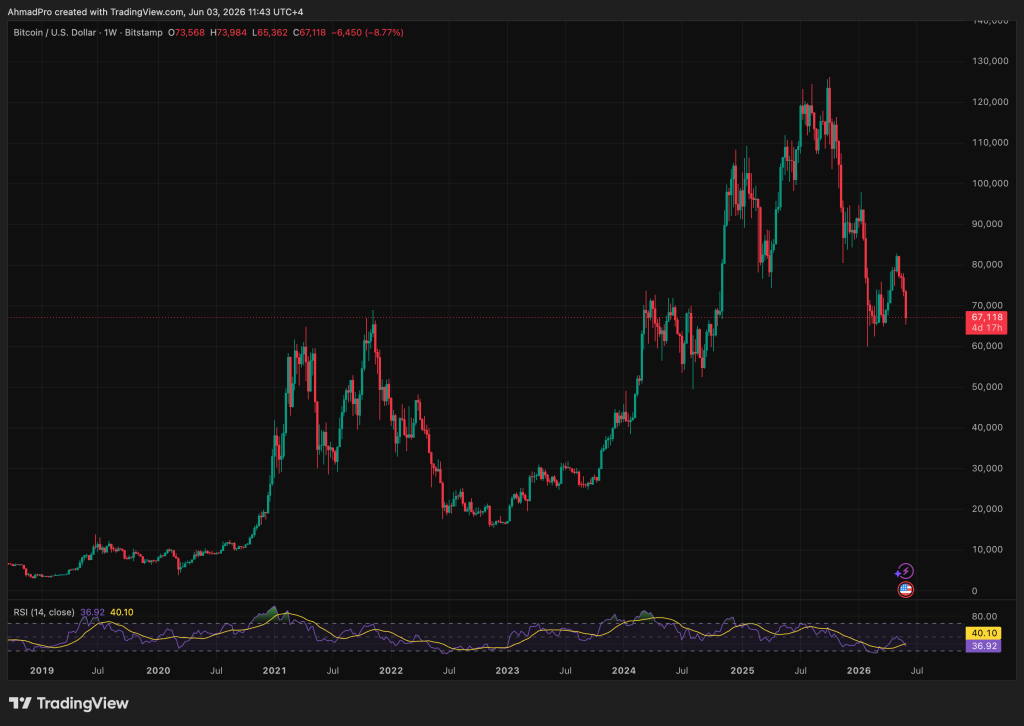
Rising equity markets can actively compete with crypto for institutional risk budget, particularly among allocators with fixed risk envelopes who must choose between EM tech equities trading at five times forward earnings and a Bitcoin position at current levels. A Goldman equity call is a firm-specific research output, not a central bank balance sheet expansion or a Fed pivot, the two macro regime changes that have most reliably preceded sustained Bitcoin bull phases.
Both interpretations share the same underlying data point: Goldman’s macro strategy team has the highest-conviction bullish view on Korean equities among major global banks, at a time when the KOSPI has already doubled.
The resolution of this dual signal depends on whether Bitcoin dominance (BTC.D) trends confirm a rotation into risk assets or whether on-chain accumulation data and ETF inflows validate that the same institutional appetite that is driving KOSPI is also flowing into crypto markets. Neither outcome is certain from the Goldman call alone, but the directional pressure is unambiguously risk-on.


