

Cardano (ADA) broke below $0.20 on June 4, 2026, its lowest price in more than five years, as four compounding Cardano news landed in rapid succession: the community’s governance vote fell 1.46 percentage points short of the supermajority needed to fund the Cardano Summit 2026, forcing its outright cancellation; the analytics platform TapTools shut down after four years citing unsustainable economics; founder Charles Hoskinson posted a four-word exit signal on X before warning publicly of a “wave of failures”; and the IOG roadmap funding proposal for 32.92M ADA remained locked in governance deadlock.
ADA is now down 93% from its 2021 all-time high of $3.09, down 77% from its early-2026 peak near $1.00, and down roughly 70% over the past year.
The open question the market must now resolve is whether Cardano’s governance system is maturing through necessary friction, a community asserting real fiscal discipline, or whether it is voting against itself at precisely the moment the ecosystem can least afford austerity.
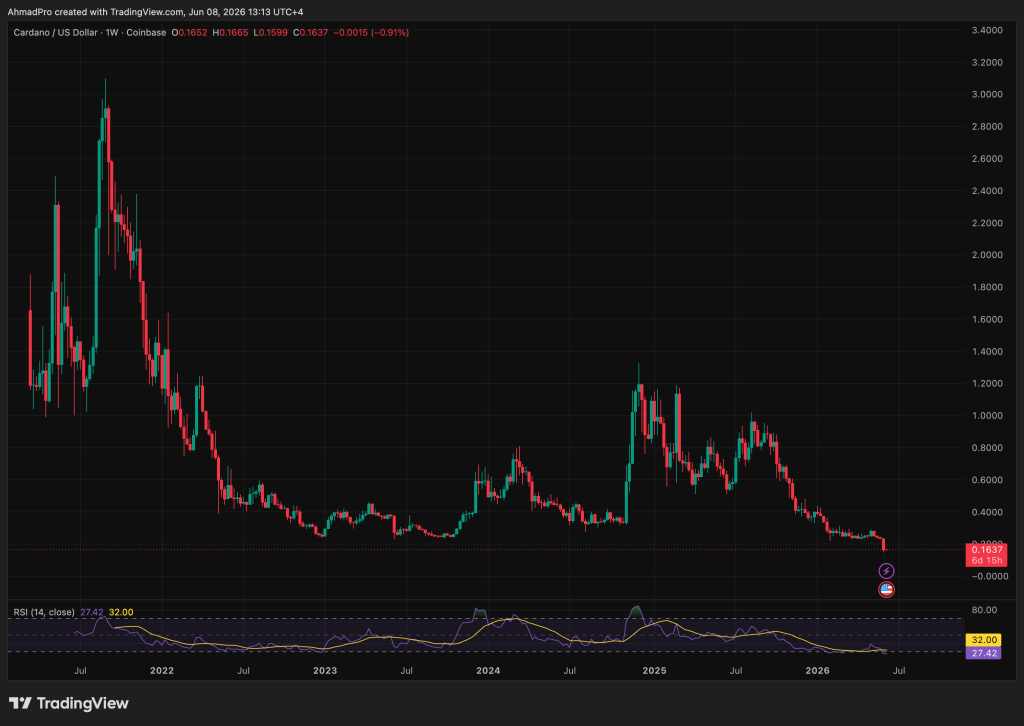
What the 1.46-Percentage-Point Miss Actually Reveals About Voltaire Governance
Context significantly enhances the raw vote figures. The Cardano Foundation submitted a treasury proposal requesting 7.8M ADA, approximately $2M at prevailing prices, to fund the Cardano Summit 2026, the network’s flagship annual conference planned for Singapore.
Under the Voltaire governance framework, treasury withdrawals require a 66.67% supermajority from Delegated Representatives, or DReps, the on-chain governance participants who hold proxy voting authority from ADA holders. The final result: 65.21% in favour, with 135 DReps voting yes, 61 against, and 24 abstaining, falling 1.46 percentage points short of the required threshold.
The Constitutional Committee approved the measure but holds no authority to override a DRep shortfall. The Cardano Foundation, notably, did not vote on its own proposal, a decision that drew community attention given that its participation could have influenced the outcome.
Governance requires not only participation, but also a commitment to accept collective decisions. The Cardano community has spoken and we respect the outcome.
Following the outcome of the Treasury proposal votes, the Cardano Foundation's proposed Cardano Summit 2026, will not…
— Cardano Foundation (@Cardano_CF) May 30, 2026
With treasury funds withheld, organizers cancelled the Summit outright, not for lack of available ADA in the treasury, but because governance refused to release it.
A blockchain ecosystem cancelling its own marquee conference by active democratic choice is a category of symbolic damage that compounds far beyond the event itself, it tells builders, sponsors, and institutional observers that the community is pulling back, not holding the line.
The Summit vote did not occur in isolation. A companion proposal to fund a TOKEN2049 pavilion passed separately, creating a split outcome that illustrates the community’s fractured spending posture rather than a unified philosophy.
That fracture is the signal beneath the vote: Cardano’s governance infrastructure is functioning mechanically, but producing outcomes that its own founder describes as self-defeating.
Cardano News: What “I’m Taking a Break. TTYL” Actually Communicates to the Market
Charles Hoskinson’s four-word post on X on June 3, 2026 – “I’m taking a break. TTYL.”, triggered an additional 10% decline in ADA within hours. Taken alone, a founder announcing a short pause from social media is unremarkable.
Read against the backdrop of everything Hoskinson had said in the 48 hours prior, it landed as something closer to a public disengagement signal at the worst possible moment. The market read it that way immediately.
I'm taking a break. TTYL
— Charles Hoskinson (@IOHK_Charles) June 3, 2026
In a YouTube monologue posted days earlier, Hoskinson had warned explicitly of a wave of failures across the ecosystem. “This is where we’re at as an ecosystem,” he said. “I said at the beginning of the year, we’re going to see a lot of people collapse because the markets are really bad.
There’s going to be a wave of failures in the ecosystem.” Founders projecting confidence during downturns is an industry norm. Hoskinson did the opposite – naming the problem publicly and in precise terms.
That framing matters because it shifts the bear case from cyclical to structural: when the builder most responsible for the network’s credibility characterises the ecosystem’s trajectory as a predicted collapse, not a temporary dip, the market prices accordingly.
Charles basically telling $ADA holders it's over… pic.twitter.com/2P05TU5JHq
— Pledditor (@Pledditor) June 3, 2026
His frustration centred specifically on treasury deployment. “There doesn’t seem to be a lot of community desire to spend the treasury to take these ventures to the next level,” he said, adding, “What control do I have? What power do I have?” CryptoTimes subsequently clarified that Hoskinson is not resigning – he is stepping back from public videos, interviews, and social posts.
The dual reading holds: the long-term commitment posture remains intact, but the operational break signal, issued mid-crisis without a concrete return timeline, left the ecosystem without its most visible coordinator at the moment it most needed direction.
Whether that reads as a founder buying space to think or a founder signalling exhaustion with a governance structure he cannot move is the interpretive question markets are currently pricing.


