


In U.S. spot Bitcoin news, ETF outflows reached $1.72 billion for the week ending June 6, 2026, the largest single-week redemption from the product class since April 2025, as BTC price shed nearly 18% in its worst weekly performance of the year before staging a 1.5% recovery to $63,100 today.
The figure did not arrive in isolation: it coincided with a fresh Iran-Israel military escalation that sent oil prices soaring more than 5%, a stronger-than-expected U.S. nonfarm payrolls print that revived Federal Reserve rate-hike anxiety, and an accelerating institutional rotation into AI equities that has measurably compressed crypto allocations across multi-asset portfolios.
The analytical question is no longer whether the current ETF exodus constitutes a meaningful structural break from the inflow regime that defined late 2024 and most of 2025; it is whether the forced selling is approaching exhaustion, or whether a deeper reassessment of Bitcoin’s role in institutional portfolios is underway.
Bitcoin News Today: ETF Flow Structure and the Macro Transmission, What the Numbers Are Actually Showing
The $1.72 billion weekly figure, sourced from aggregator SoSoValue, extends a four-consecutive-week outflow sequence whose cumulative total now stands at $5.4 billion, a drawdown that has compressed total spot Bitcoin ETF assets under management from approximately $104 billion to $94 billion.
The most diagnostic single data point within that aggregate is BlackRock’s IBIT, which absorbed $440.3 million of the $483.8 million in net outflows recorded on June 1 alone, making it the dominant vehicle through which institutional selling expressed itself.
IBIT’s outsized contribution matters precisely because the fund has functioned as the primary institutional sentiment indicator since the spot Bitcoin ETF product class launched in January 2024. When IBIT moves, it reflects the allocation decisions of the largest and most risk-managed buyers in the market.
The macro transmission mechanism here was not subtle. Bitrue Research analyst Andri Fauzan Adziima attributed the selling directly to a combination of rising inflation expectations, elevated Treasury yields, and diminishing probability of near-term Federal Reserve rate cuts, conditions that structurally disadvantage non-yielding, speculative assets.
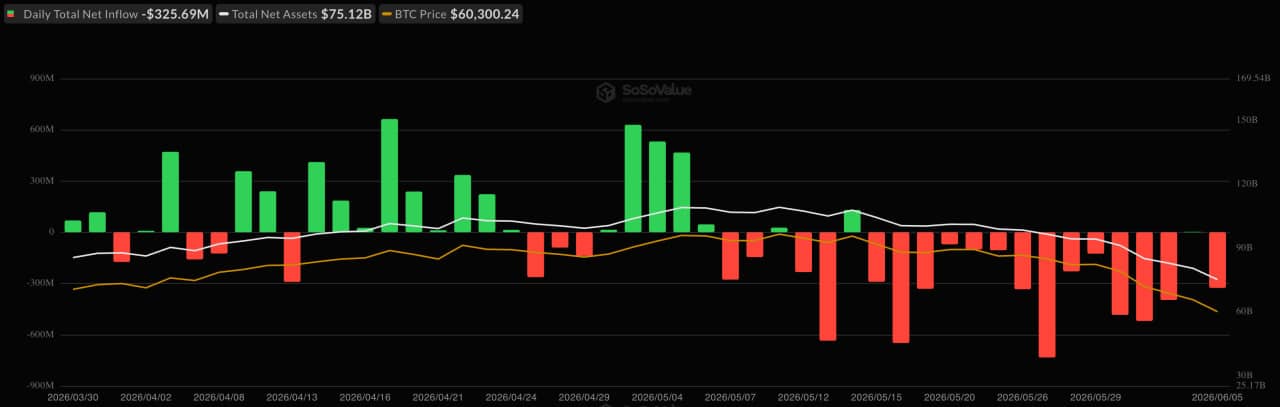
Source: SoSoValue
When the risk-free rate rises or is expected to remain elevated, the opportunity cost of holding Bitcoin in an ETF wrapper increases, and portfolio risk managers at institutional firms tend to reduce exposure via the most liquid vehicle available, which is the ETF. The nonfarm payrolls beat on Friday reinforced that dynamic by signaling a labor market too resilient to justify near-term Fed easing.
Simultaneously, Galaxy Research analysts have characterized the outflow pattern as reflecting a “real directional recalibration rather than routine hedge adjustments,” which distinguishes the current episode from the short-duration, liquidity-driven redemptions that have periodically appeared since the ETF launches.
The AI equity rotation adds a second, distinct transmission channel: capital that previously found Bitcoin’s asymmetric return profile attractive has, in the current environment, found comparable asymmetry in AI-exposed equities, NVDA, MRVL, and MU, all of which posted double-digit weekly moves before sharply reversing on Friday, a reversal that provided Bitcoin with what may be its most immediate short-term support catalyst. The elevated Treasury yield environment underpinning that rotation has been a persistent headwind for crypto pricing throughout the current outflow sequence.


