

Multiple on-chain indicators suggest Bitcoin may be undervalued at current prices, but historical parallels show cheap can get cheaper before a recovery begins.
Key Takeaways
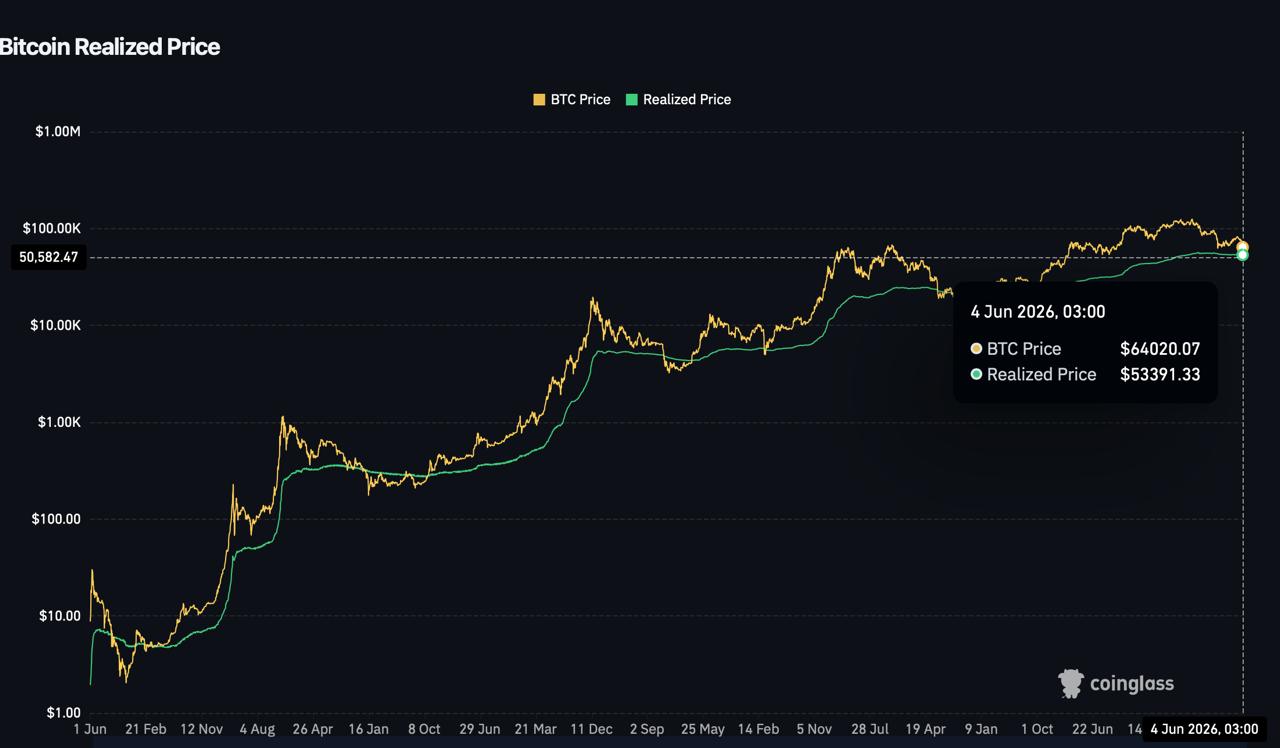
BTC traded 20% above the realized price of $53,391 on June 4.
The realized price reflects the aggregate cost basis of all Bitcoin holders combined.
MVRV ratio sits at 1.1, its lowest level since the 2022 bear market floor.
SOPR dropped to 0.986, meaning holders are actively selling at a loss.
Exchange reserves fell to 2.71M BTC, the lowest reading in this data series.
Spot Bitcoin ETFs recorded $4.32B in net outflows across May and June.
Grayscale’s Zach Pandl flags the CLARITY Act and leveraged holders as the two deciding variables.
On-chain metrics may support accumulation on a long horizon, but do not confirm a bottom.
Bitcoin has been under sustained pressure heading into today’s session. The asset trades at $61,600 as of June 10, down 2% in the past 24 hours and 8% over the past seven days, according to CoinMarketCap data. That puts it roughly $2,400 below the $64,020 level recorded in the on-chain datasets referenced throughout this article, which carry a June 4 timestamp.
The directional read from those metrics has only sharpened since: every valuation signal discussed below was already flashing undervaluation at $64,020, and at $61,600 the same signals look more stretched in the same direction.
The question worth asking now is not how far Bitcoin has fallen. It is whether what the blockchain data shows constitutes a genuine discount, or simply a market that has not finished correcting. Multiple independent on-chain metrics converge on the same reading: undervalued relative to long-run historical averages, but not yet at the extreme distress levels that marked prior cycle floors.
What Is the Realized Price, and Why Does It Matter?
Before getting into the specific numbers, it is worth explaining what the realized price actually represents, because it is the foundation for most of the metrics in this article. Every Bitcoin that exists last moved on-chain at some price. Someone bought at $20,000, someone else at $90,000, someone else at $5,000. The realized price takes all of those individual acquisition prices and averages them across the entire circulating supply. It is, in effect, the aggregate cost basis of all Bitcoin holders combined.
This makes it fundamentally different from a simple moving average of market price. It does not care about recent price swings. It reflects what people actually paid, weighted by how many coins changed hands at each price level. When market price is above the realized price, the average holder is sitting on an unrealized gain. When it drops below, as it did briefly in late 2022, the average holder is underwater. That level, where market price meets realized price, is where the most severe capitulation has historically occurred. It is the point at which even patient long-term holders may face psychological pressure to exit.
As of June 4, the realized price stood at $53,391. Spot was $64,020. The network, in aggregate, looks like it is still in profit, but the cushion appears narrower than at any point since the 2023 recovery. At today’s price of $61,600, that cushion may have compressed further to roughly 15%.
MVRV at 1.1: The Market Looks Barely Above Breakeven
The MVRV ratio (Market Value to Realized Value) is essentially the ratio between the current spot price and the realized price expressed as a single number. At 1.1, it suggests the market is trading at 1.1 times the aggregate cost basis, barely above breakeven for the average holder. Historically, MVRV readings below 1.0 have marked the deepest capitulation floors: briefly in 2019, and again in late 2022 post-FTX. Readings above 3.0 have consistently flagged cycle tops. The current 1.1 sits at the opposite end of the range from euphoria.
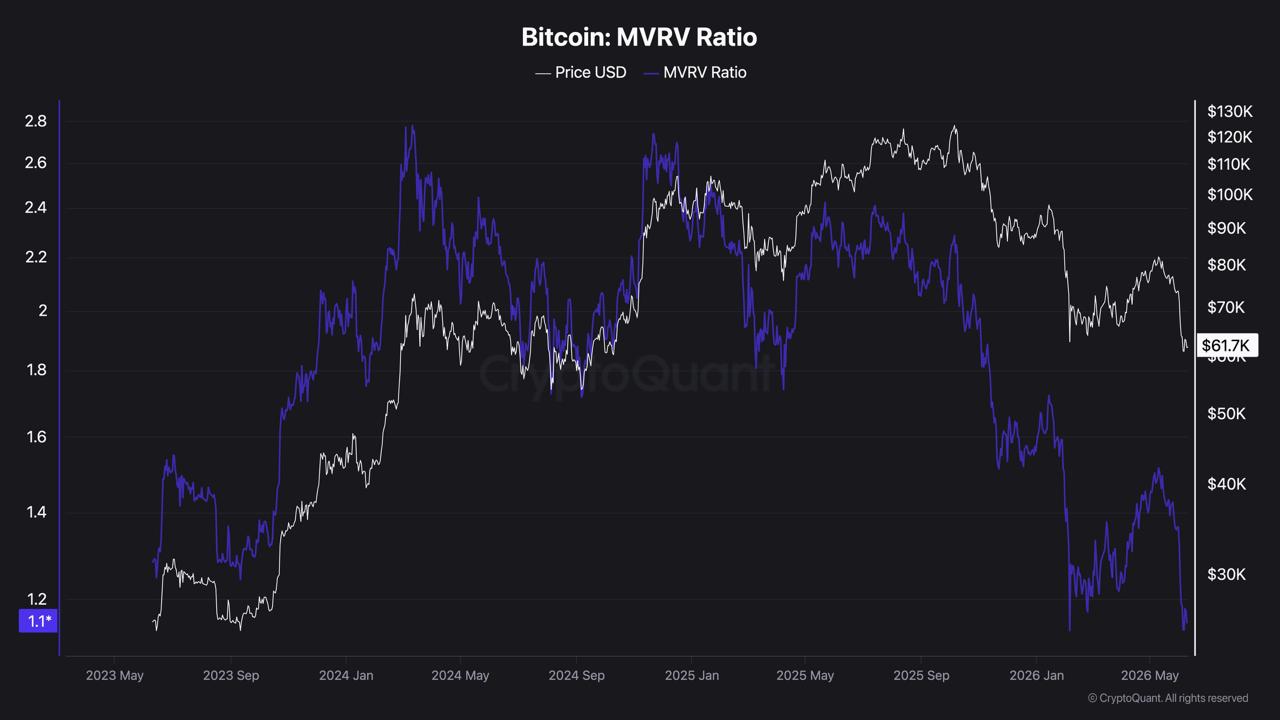
What looks worth noting here is the directionality. MVRV peaked at roughly 2.7–2.8 during the November 2024 and January 2025 highs, then compressed steadily as price declined. A drop from 2.8 to 1.1 may represent the removal of most of the speculative premium built up during the bull run.
The market looks like it has, by this measure, digested the majority of its excess. Whether it needs to go further depends on whether a washout to MVRV below 1.0 may be required to reset the cycle, something that has happened in every bear market prior to 2024, but which Grayscale Head of Research Zach Pandl argues may not be necessary this time given the structural changes in how Bitcoin is held and traded.
SOPR Below 1: Who Is Selling, and What It Might Tell Us
SOPR (Spent Output Profit Ratio) measures the realized profit or loss ratio of all coins moved on-chain on a given day. A value above 1.0 means the coins transacted that day were, on average, sold at a gain relative to when they were acquired. Below 1.0 means they were sold at a loss.
The current reading of 0.986 suggests that the average coin being spent right now may be moving below its acquisition cost. In practical terms, this looks like holders who bought during the 2025 rally are selling at a loss rather than waiting for recovery, which could be the behavioral signature of capitulation rather than profit-taking.
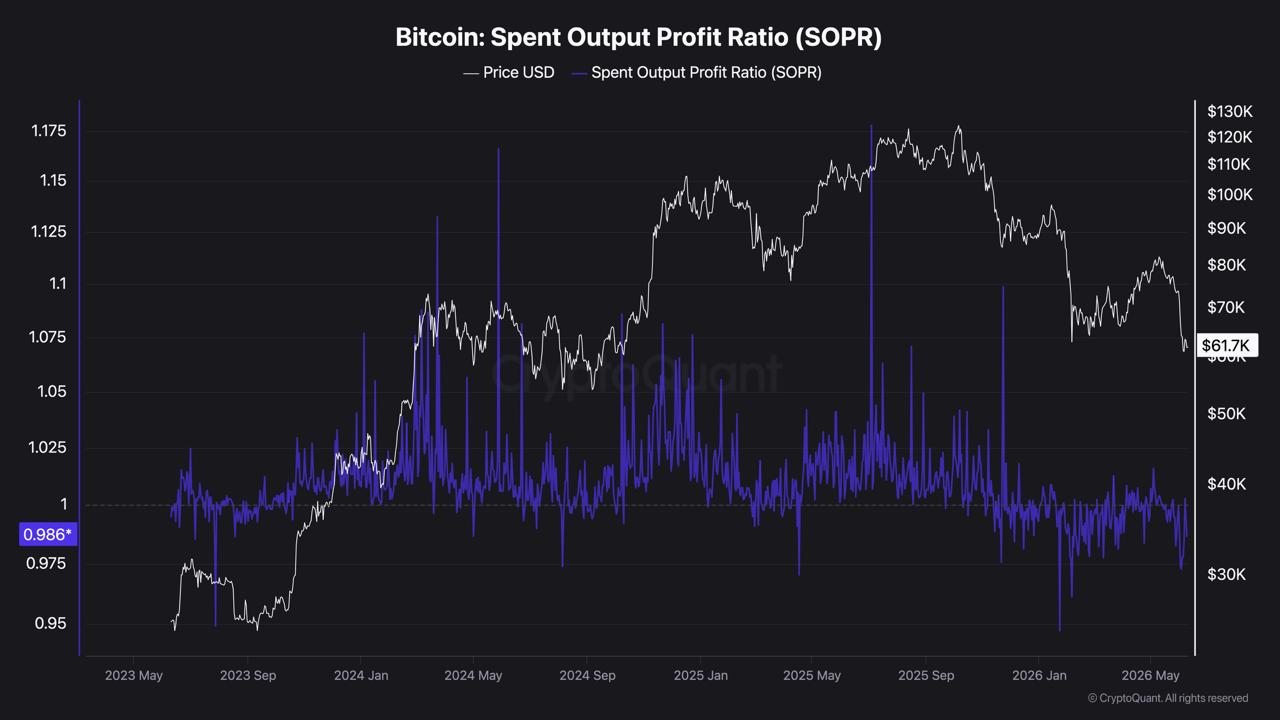
There is an important nuance here that is easy to miss. SOPR below 1.0 is not inherently bearish as a standalone fact. What matters is how far below 1.0 it goes and how long it stays there. During the post-FTX collapse in November 2022, SOPR briefly touched 0.95, a significantly deeper loss realization than the current 0.986.
The shallowness of the current dip below 1.0 might suggest either that the cohort of distressed sellers is smaller, or that the average loss they are realizing is more modest. Both interpretations look consistent with a less severe bear phase than 2022. The risk is the reverse reading: if SOPR stays below 1.0 for an extended period without price finding a floor, it may indicate that sellers are not being absorbed by buyers willing to accumulate. That scenario could push MVRV lower and potentially compress the market-to-realized premium toward zero.
Exchange Reserves: The Slow Drain Nobody Is Talking About
Bitcoin exchange reserves across all platforms tracked by CryptoQuant have declined to approximately 2.71M BTC, down from a peak of around 3.22M BTC in mid-2024. That is roughly 510,000 BTC removed from exchange custody over roughly 18 months, a 16% reduction in the immediately sellable supply.
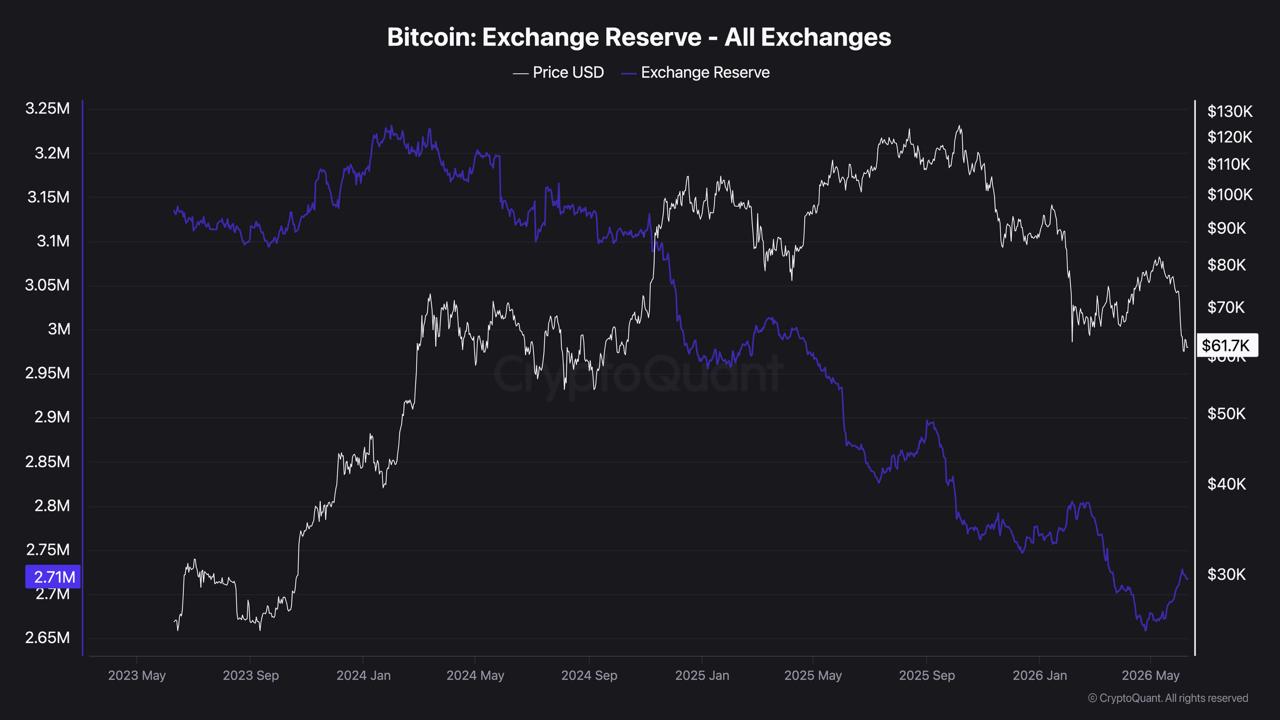
The timing of this drain looks analytically significant. It did not happen during a rally when holders were depositing coins to take profit. It happened continuously through the price decline, which might mean the entities pulling coins off exchanges are treating the current price level as worth holding, not as an exit opportunity. There is a straightforward interpretation and a more cautious one. The straightforward reading is that this may represent structural accumulation by long-term holders and institutional custodians who have no intention of selling at current prices.
The more cautious reading is that some of this coin movement could reflect transfers between exchanges and OTC desks or custodial wallets that do not necessarily represent a change in selling intent. What looks less debatable is the supply arithmetic: fewer coins on exchanges means any demand spike could have less available supply to absorb it, which looks like it could accelerate price recovery when buying pressure returns.
ETF Flows: The Institutional Mood Shift
Spot Bitcoin ETF monthly flow data from SoSoValue provides the clearest window into how institutional allocators may be behaving. The picture over the past six months looks like a study in reversal. March and April 2026 brought combined net inflows of $3.29B, the strongest two-month stretch since the post-approval surge in early 2024. Then it stopped. May 2026 recorded $2.43B in net outflows, followed by $1.89B in further outflows through June 4, a swing of over $4.3B from inflow to outflow in eight weeks.
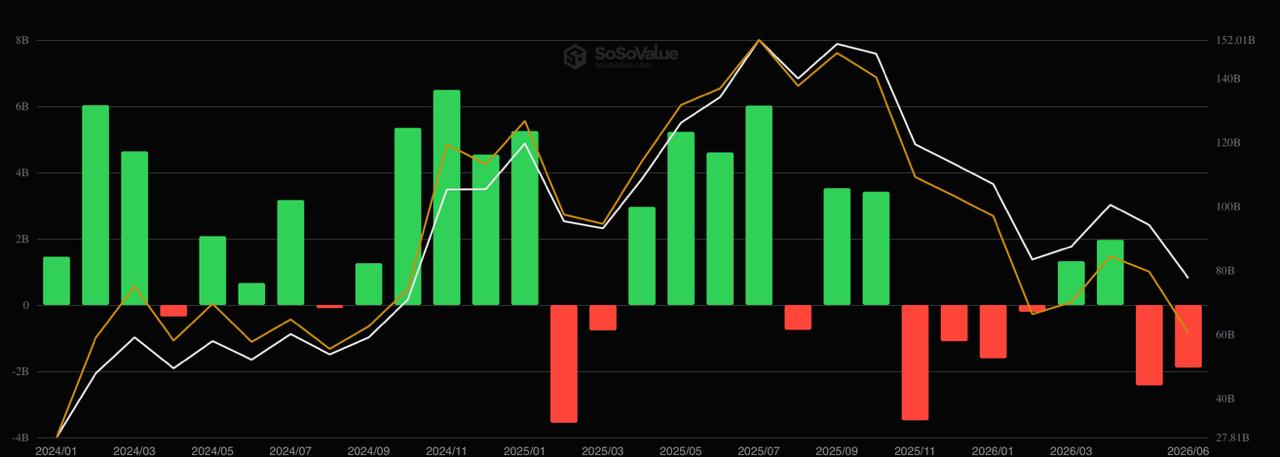
The practical implication looks clear: one of the primary demand channels supporting Bitcoin’s price recovery may have gone from active buying to active selling. ETF redemptions require authorized participants to sell underlying Bitcoin into the spot market, meaning outflows are not just a sentiment signal but could represent direct sell-side pressure on price.
The historical parallel from the same dataset looks mildly encouraging: January and February 2026 also saw back-to-back outflow months totaling roughly $1.8B before inflows resumed in March. That prior outflow episode resolved without requiring a deeper price low. Whether the current, larger outflow episode might follow the same pattern remains the key unknown.
The Two Variables That Might Decide What Comes Next
Grayscale’s Zach Pandl, writing on June 9 in the Grayscale macro report “Is Bitcoin Cheap Yet?” framed the near-term outlook around two specific catalysts rather than broad market sentiment. The first is the CLARITY Act. This is the primary U.S. digital asset market structure bill currently pending in the Senate. Pandl noted that prediction markets place Senate passage at roughly a coin flip.
A positive vote could establish regulatory definitions that have been absent from U.S. crypto markets for years, the kind of clarity that may remove a specific barrier institutional allocators cite when justifying limited crypto exposure. A failure or extended delay keeps that barrier in place and removes a potential near-term trigger for demand. The second is the stability of large leveraged Bitcoin holders. This looks like the less visible but potentially more impactful variable.
Entities carrying significant Bitcoin exposure through collateralized loans or leveraged futures positions may face automatic deleveraging pressure as price falls. If forced liquidations cascade at scale, they could drive MVRV and SOPR to the deeper distress readings that the current data has not yet reached. The difference between a shallow bear market and a severe one might come down to how much leverage needs to be unwound. 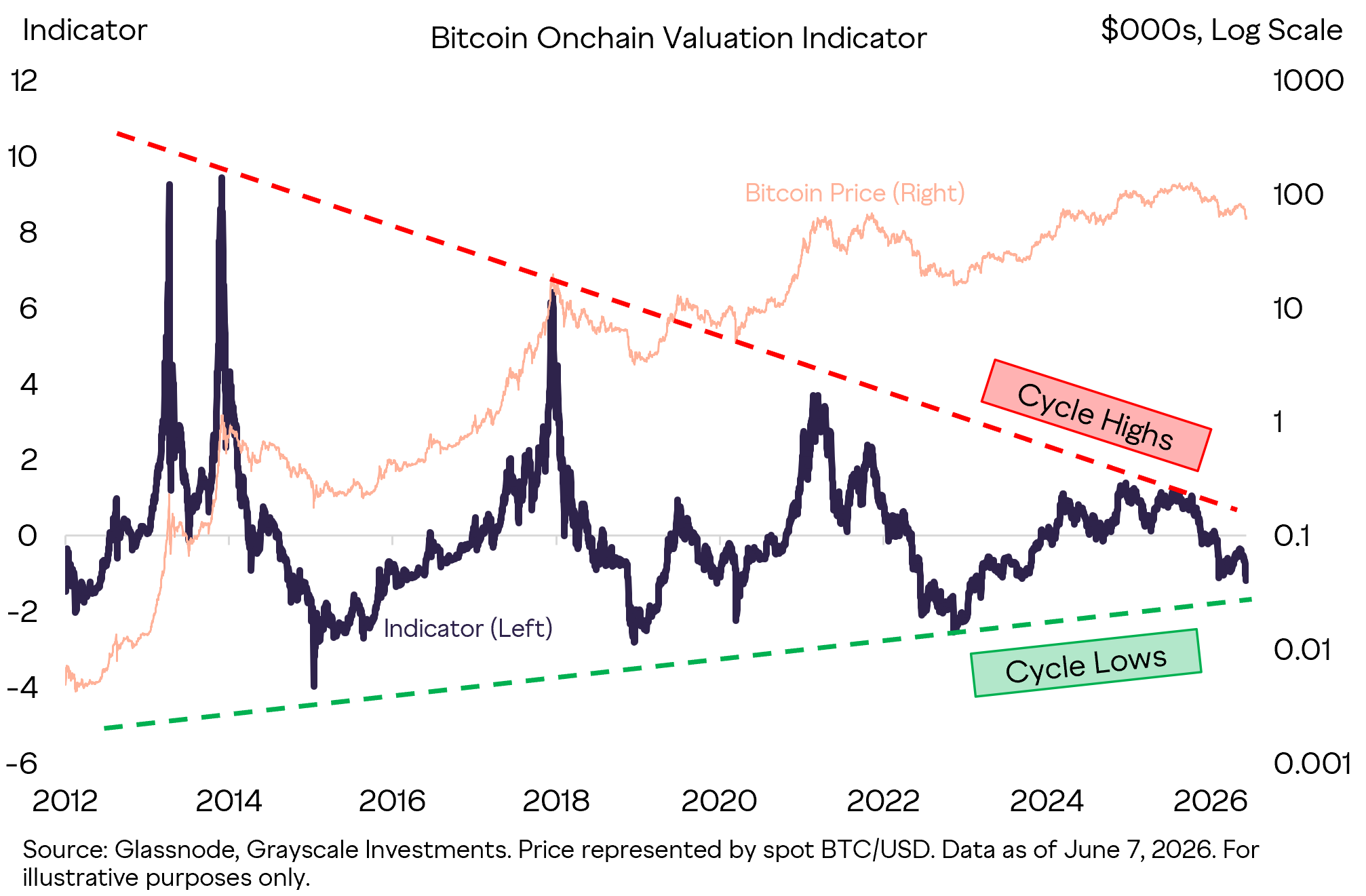
Weighing the On-Chain Evidence
The on-chain picture as of early June looks internally consistent. MVRV at 1.1, SOPR below 1.0, a market price roughly 15% above the network’s aggregate cost basis at current levels, and exchange reserves at a structural low all look like they point toward a market that may be cheap by historical on-chain standards. The part the metrics cannot resolve is timing and depth.
The Grayscale composite onchain valuation indicator, built from Glassnode data through June 7, looks like it sits below its long-run average but above the levels associated with the worst prior cycle bottoms. There may be measurable distance between current valuations and the kind of deep-value readings that characterized the 2022 floor. It looks like the data supports the case for accumulation at current levels on a multi-year horizon. It does not support the claim that the bottom has been confirmed.
Those are different statements, and conflating them is how investors end up buying something cheap that gets cheaper before recovering. The next six to eight weeks, covering the CLARITY Act Senate timeline and the next monthly ETF flow data, may well determine which of those two outcomes this cycle delivers.


