

=What Is Decentralized Finance (DeFi)?
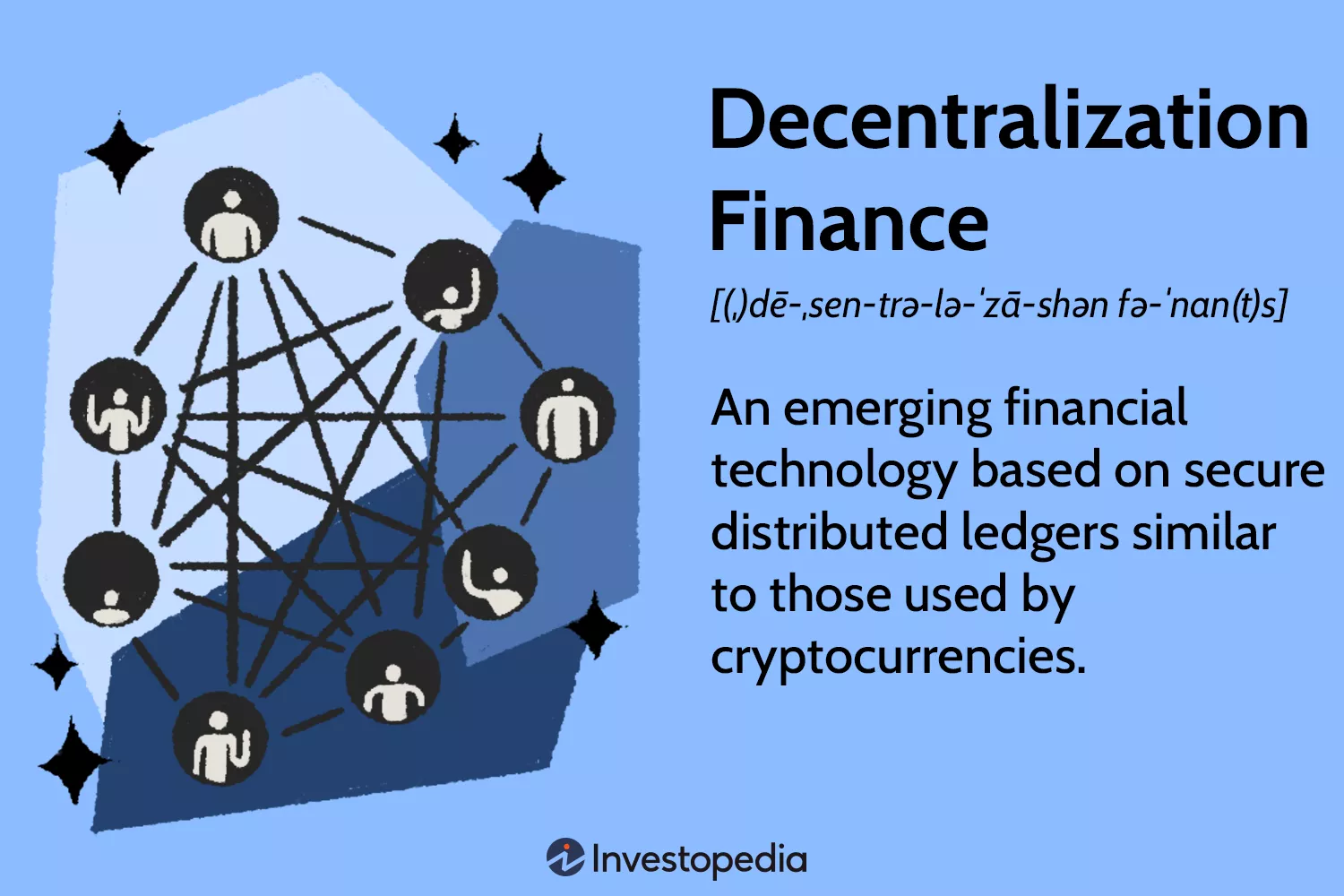
Decentralized finance (DeFi) is an emerging financial system using blockchain and cryptocurrencies to enable direct transactions between individuals and businesses. By eliminating intermediaries like banks, DeFi aims to reduce costs and speed up processes, although it's currently in its infancy and presents security challenges.
In the United States, the Federal Reserve and Securities and Exchange Commission (SEC) define the rules for centralized financial institutions like banks and brokerages, which consumers rely on to access capital and financial services directly. DeFi challenges this centralized financial system by empowering individuals with peer-to-peer transactions.
KEY TAKEAWAYS
Decentralized finance, or DeFi, is an emerging peer-to-peer system attempting to remove third parties and centralized institutions from financial transactions.
DeFi consists of cryptocurrencies, blockchain technology, and software that allows people to transact financially with each other.
DeFi is still in its infancy and subject to hacks and thefts because of sloppy programming and a lack of security testing before applications are launched.
Investopedia / Joules Garcia
Understanding the Mechanics of DeFi
Through peer-to-peer financial networks, DeFi uses security protocols, connectivity, software, and hardware advancements. This system eliminates intermediaries like banks and other financial service companies. These companies charge businesses and customers for using their services, which are necessary in the current system because it's the only way to make it work. DeFi uses blockchain technology to reduce the need for these intermediaries.
How Blockchain Powers DeFi
A blockchain is a distributed and secured database or ledger. In a blockchain, transactions are recorded in files called blocks and verified through automated processes. If a transaction is verified, the block is closed and encrypted; another block is created with information about the previous block and information about newer transactions.
The blocks are "chained" together through the information in each proceeding block, giving it the name blockchain. Information in previous blocks cannot be changed without affecting the following blocks, so blockchains are generally very secure if their networks are large and fast enough. This concept, along with other security protocols, provides the secure nature of a blockchain.
Using applications called wallets that can send information to a blockchain, individuals hold private keys to tokens or cryptocurrencies that act like passwords. These keys give them access to virtual tokens that represent value. Ownership of the tokens is transferred by 'sending' an amount to another entity via a wallet, whose wallet, in turn, generates a different private key for them. This secures their ownership of the token, and the blockchain design prevents the transfer from being reversed.
Exploring DeFi Applications
DeFi applications are designed to communicate with a blockchain, allowing people to use their money for purchases, loans, gifts, trading, or any other way they want without a third party. These applications are programs installed on a device like a personal computer, tablet, or smartphone that make it easier to use. Without the applications, DeFi would still exist, but users would need to be comfortable and familiar with using the command line or terminal in the operating system that runs their device.
DeFi applications provide an interface that automates transactions between users by giving them financial options to choose from. For example, if you want to make a loan to someone and charge them interest, you can select the option on the interface and enter terms like interest or collateral. If you need a loan, you can search for providers, which could range from a bank to an individual who could lend you some cryptocurrency after you agree on terms.
Some applications let you enter parameters for the services you're looking for and match you with another user. Because the blockchain is a global network, you can give or receive financial services to or from anywhere in the world.
IMPORTANT
Decentralized finance does not provide full anonymity. Transactions do not include an individual's name but are traceable by anyone with the knowledge to do so. This includes governments and law enforcement, which, at times, are necessary for protecting an individual's financial interests.
Primary Objectives of DeFi
Peer-to-peer (P2P) financial transactions are one of the core premises behind DeFi, where two parties agree to exchange cryptocurrency for goods or services without a third party involved.
Using DeFi allows for:
Accessibility: Anyone with an internet connection can access a DeFi platform, and transactions occur without geographic restrictions.
Low fees and negotiable interest rates: DeFi enables any two parties to negotiate interest rates directly and lend cryptocurrency or money via DeFi networks.
Security and Transparency: Smart contracts published on a blockchain and records of completed transactions are available for anyone to review but do not reveal your identity. Blockchains are generally immutable, meaning they cannot be altered.
Autonomy: DeFi platforms don't rely on centralized financial institutions. The decentralized nature of DeFi protocols mitigates the need for and costs of administering financial services.
FAST FACT
Peer-to-peer lending under DeFi doesn't mean there won't be any interest and fees. However, it does mean that you'll have many more options since the lender can be anywhere and anyone in the world.
Steps to Engage With DeFi
1. Research activities in DeFi that interest you.
2. Choose a suitable digital wallet for DeFi applications.
3. Purchase cryptocurrency through a reputable exchange.
4. Identify a DeFi app that suits your needs, such as borrowing or yield farming.
5. Begin by integrating your cryptocurrency with the selected app.
Real-World Example of DeFi in Action
DeFi is an all-inclusive term for any application that uses blockchain and cryptocurrency techniques or technology to offer financial services. Some of these applications can provide anything from basic services like savings accounts to more advances services like providing liquidity to businesses or investors. One of the more notable DeFi service providers is Aave, which is a "decentralized non-custodial liquidity market protocol" that allows anyone to participate as a liquidity supplier or borrower.
Aave lets you stake any of your crypto assets to earn interest income from users who might borrow your assets.1
Popular Uses for DeFi Technology
Decentralized finance, originally conceived of as a way to bring financial services like loans and banking to those who don't have access to them, has morphed into an industry where you can take part in many different sectors or endeavors. Here are a few of the most popular:
Decentralized exchanges: The top preference for defi app users is accessing decentralized exchanges. Exchanges like Uniswap and PancakeSwap have apps that let you interact with other cryptocurrency users.
Liquidity providers: Liquidity is the ability to sell assets quickly, a problem many cryptocurrency users have encountered. Liquidity providers are generally pools where users place funds so exchanges can provide selling opportunities for their users.23
Lending/Yield Farming: There are hundreds of defi apps available that provide lending. Generally, they operate the same way as a liquidity pool, where users lock their funds in a pool and let others borrow them, receiving interest on their loans—called yield farming. Many provide flash loans, where no collateral is required from the borrower.
Gambling/Prediction Markets: Everyday, millions of dollars in cryptocurrency are used in DeFi gambling and prediction apps like Polymarket, ZKasino, Horse Racing Slot Keno Roulett, Azuro, and JuicyBet.4 Prediction markets are platforms that let you place bets on the outcome of nearly any event.5
NFTs: The market for non-fungible tokens has cooled somewhat, but they are still popular with niche investors and collectors.
Navigating the Hype Around DeFi
Just like other blockchain- and cryptocurrency-related projects, businesses, and activities, decentralized finance is subject to considerable hype and misinformation, hoping to attract users and their money. Cryptocurrency, blockchain, and all technologies associated with them are also subject to extreme price volatility.
Lots of Money in Crypto, But Not as Much as You'd Think
There is a considerable amount of money flowing through cryptocurrency exchanges, but it isn't nearly as much as you might be led to believe. Most people still use the traditional financial systems we are all used to. For example, less than 1% of all money is tied up in cryptocurrency and decentralized finance—a very small figure that should encourage you to do your research to learn if using or investing in DeFi apps, platforms, and cryptocurrency is worth it.
Crypto Winters
A crypto-winter is a period where crypto prices continuously move down and then stay down—sometimes tens of thousands of dollars. The last one occurred between 2022 and 2023. Prices had been rising significantly before 2022 as investors turned to anything they could find following the initial outbreak of COVID-19 and the ensuing pandemic. During that time, they discovered Bitcoin was not only holding value; it was increasing as well—but this was most likely due to their own self-fulfilling prophecies and hype as they drove the price increases themselves.
But toward the end of 2022, prices began declining and stayed there. Billions of dollars were lost during this time. During this period, there were no rumors of substance or any regulatory developments (in the U.S.) beyond a perceived campaign of persecution orchestrated by the Securities and Exchange Commission. However, when rumors began circulating about a Spot Bitcoin ETF approval in October 2023, the hyping began again, and prices rose. When the approval of 11 Bitcoin Spot ETFs was announced in January 2024, prices climbed steadily for a few months (supposedly ending the winter) until a sideways—yet volatile—market emerged again in March 2024.
Is Decentralized Finance Worth It?
DeFi might be just what you're looking for regarding your finances. However, it might not—the decentralized finance industry is still in its infancy and evolving, making it somewhat of a gamble for most people.
The low amount of actual money invested in cryptocurrency and the effects that hype has on prices should make you consider whether investing in decentralized finance is worth it. If you have money you can afford to lose, the space can be very profitable—but the losses can be just as significant.
If you don't have money to lose and are looking for ways to fund your retirement or grow your portfolio or net worth over time, defi and cryptocurrency should be the last investment you should consider. They are still too new and volatile to risk your future on.
Concerns About DeFi
Decentralized finance is constantly evolving. It is unregulated, and its ecosystem is vulnerable to faulty programming, hacks, and scams. For example, one of the main ways hackers and thieves steal cryptocurrency is through weaknesses in DeFi applications.
Laws have not yet caught up with advances in technology. Most current laws were crafted based on the idea of separate financial jurisdictions, each with its own set of laws and rules. DeFi’s borderless transaction ability presents essential questions for this type of regulation. For example:
Who is responsible for investigating a financial crime that occurs across borders, protocols, and DeFi apps?
Who would enforce the regulations?
How would they enforce them?
Can You Make Money With Decentralized Finance?
Yes, there are ways to make money using DeFi, such as yield farming or providing liquidity. However, there are risks involved, so it pays to do your research before locking money into DeFi.
Is Decentralized Finance Safe?
DeFi is still in its infancy, with hacks and thefts common. There are many people using it to make money and transact, but in its current state it is not yet as safe as traditional finance methods.
How Is DeFi Different From Bitcoin?
Decentralized finance is a blanket term for the global system of blockchains and applications that are being developed to allow people to transact directly with each other using cryptocurrencies such as Bitcoin. Bitcoin is a cryptocurrency that can be used in DeFi.
What Is Decentralized Finance for Dummies?
In a nutshell, DeFi is a way for people, businesses, or other entities to send and receive money directly to each other using their devices and cryptocurrency.
The Bottom Line
Decentralized finance (DeFi) is a groundbreaking alternative to traditional financial systems, aiming to reduce reliance on centralized institutions and promote peer-to-peer transactions using blockchain technology. While promising, DeFi remains in its infancy, presenting vulnerabilities to hacks and regulatory challenges. Potential users should approach cautiously, keeping in mind its risks and the minor proportion of financial capital currently in DeFi. Research and a thorough understanding of DeFi applications can empower individuals to navigate this nascent field effectively. Although traditional financial systems pose challenges, they are well-established and likely to adapt and participate in blockchain-based financial innovations.


