

Key Takeaways
– Bitcoin in DeFi: Lombard Finance mobilizes BTC through LBTC, a fully backed token that integrates seamlessly across major chains.
– Token Utility: The BARD token drives governance, security staking, ecosystem funding, and product access.
– Measured Supply: Capped at 1 billion, with structured vesting, community allocations, and a path to governance-directed buybacks.
– Core Products: LBTC minting and redemption, Bitcoin yield vaults, and a cross-chain DeFi marketplace.
– Access Points: Token holders can participate through airdrops and exchange trading pairs such as BARD/USDT on XT.com.
Press enter or click to view image in full size
Everyone praises Bitcoin’s strength as a store of value. But if that’s all it is, aren’t we leaving opportunity on the table? Lombard Finance quietly raises the question: what if BTC could also be the engine of DeFi?
The answer begins with LBTC, a 1:1 Bitcoin-backed token designed to circulate across Ethereum, Layer 2 networks, and beyond. Unlike traditional wrapped tokens that remain passive, LBTC is built to earn yield, provide liquidity, and serve as collateral. At the center of this design is the BARD token, which coordinates governance, secures cross-chain operations, and funds ecosystem expansion.
For investors and builders, this creates an intriguing proposition: a bridge between Bitcoin’s unmatched scale and the innovation of DeFi. In this piece, we explore the foundations of Lombard Finance, the mechanics of the LOMBARD token, and why this model may redefine Bitcoin’s role in decentralized markets.
Lombard Finance Project Overview
Lombard Finance is designed to unlock Bitcoin’s potential in decentralized finance by turning idle BTC into active onchain capital. The project issues LBTC, a token backed 1:1 by custodied Bitcoin, which can then be used across lending, borrowing, liquidity provision, and structured yield strategies. This process is secured by a consortium of institutional validators, with Chainlink providing proof-of-reserve and cross-chain messaging to maintain transparency and reliability.
How Lombard Finance Works
– LBTC as the Core Asset: Minted against Bitcoin deposits and redeemable at any time.
– Cross-Chain Access: Integrated across Ethereum, L2s, and other leading blockchains where liquidity is concentrated.
– Infrastructure Support: Chainlink oracles and secure custody models keep reserves verifiable.
Lombard Finance’s Developer and User Tools
Builders gain access to a software development kit that simplifies BTC deposits, LBTC minting, and yield integrations. Users interact through Lombard’s web application, which offers minting and redemption, curated vaults managed by professionals, and a marketplace highlighting yield and collateral opportunities. Institutions can access the same tools with added compliance and reporting features.
The Role of LOMBARD
The BARD token ties the system together. Holders participate in governance, stake to secure cross-chain operations, and direct ecosystem funding. Over time, governance can activate fee capture and buyback programs, aligning token value with platform growth.
BARD Tokenomics, Distribution, Burning
The LOMBARD token supply is capped at 1,000,000,000. At the Token Generation Event, a portion entered circulation, while the rest follows multi-year vesting schedules to align long-term stakeholders. This design balances community access with gradual unlocks for contributors and investors.
Press enter or click to view image in full size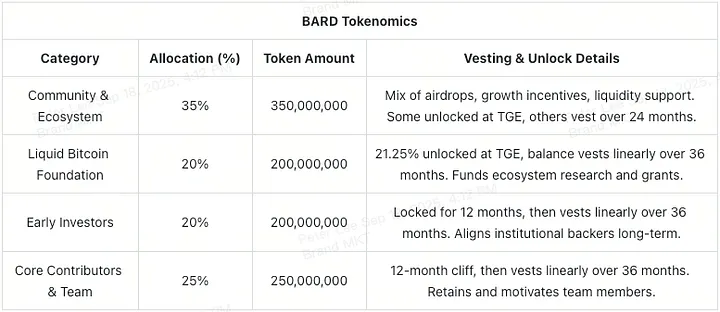
Distribution Highlights
– Community and Ecosystem: Allocations fund airdrops, growth incentives, and partnerships.
– Foundation: A large reserve is directed to the Liquid Bitcoin Foundation, which supports grants and ecosystem initiatives.
– Investors and Team: Early backers and core contributors receive allocations subject to cliffs and linear vesting over four years.
– Liquidity and Incentives: Dedicated pools ensure trading depth and bootstrap adoption.
Press enter or click to view image in full size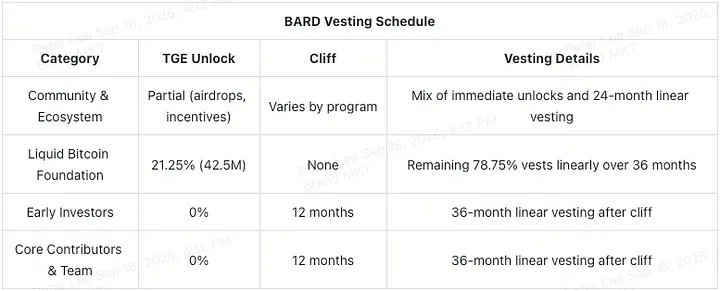
Utility in Practice
– Governance: Token holders vote on bridge parameters, treasury allocation, and incentive structures.
– Security Staking: Staked tokens strengthen cross-chain operations and reward participants.
– Ecosystem Development: Tokens fund integrations, developer grants, and liquidity programs.
– Product Access: Holders can enjoy early access and favorable terms across Lombard Finance’s dApps and vaults.
Burning and Value Flow
Burning is not central at launch. Instead, Lombard Finance plans fee-based buybacks once services like minting, vaults, and ledger transactions generate revenue. Governance will decide whether repurchased tokens are distributed, returned to treasuries, or retired, ensuring value capture remains community-driven.
Lombard Finance dApp Core Applications and Ecosystem dApps
Lombard Finance provides a growing set of applications designed to make Bitcoin liquid, productive, and secure in DeFi. Together, these products create a loop where BTC enters, LBTC circulates, yields accrue, and liquidity deepens.
Press enter or click to view image in full size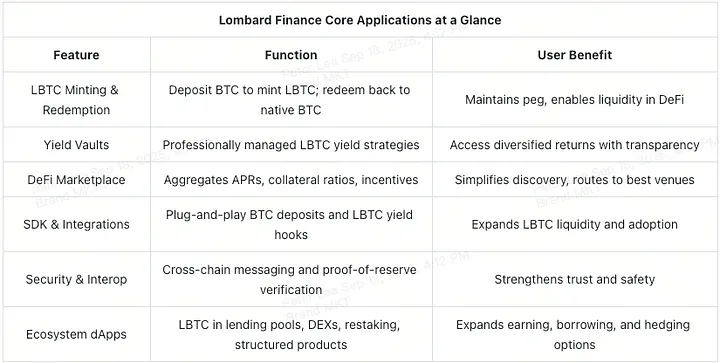
LBTC Minting and Redemption
Users deposit Bitcoin to mint LBTC at a one-to-one ratio. A distributed consortium verifies custody, while proof-of-reserve data ensures every LBTC is fully backed. Redemption reverses the process, allowing holders to exit positions back to native BTC. This two-way door supports arbitrage and helps LBTC maintain a tight peg.
Yield Vaults
Lombard Vaults are curated strategies that put LBTC to work. Funds may flow into lending markets, liquidity pools, or yield optimization protocols. Vaults are actively managed, with transparent onchain receipts so users can track performance and exit when needed. Yields are net of fees and vary with market conditions.
DeFi Marketplace
The marketplace aggregates LBTC opportunities across multiple chains. Users can scan lending APRs, collateral factors, and liquidity incentives in a single dashboard, then route funds into Aave-style lending, Pendle-style yield trading, or stablecoin borrowing. By surfacing these options, Lombard Finance reduces the friction of finding reliable LBTC use cases.
SDK and Integrations
For builders, Lombard offers a software development kit that simplifies native Bitcoin deposits, LBTC minting, and yield integration. Wallets, exchanges, and apps can integrate with minimal overhead. Each new integration broadens LBTC’s reach and strengthens liquidity across the ecosystem.
Security and Interoperability
Cross-chain messaging runs on production-grade infrastructure, while proof-of-reserve feeds confirm BTC collateralization. Governance can adjust validator sets, staking rewards, and fee structures to continually enhance security.
Ecosystem dApps
Beyond Lombard’s own platform, LBTC is already circulating in lending pools, DEX pairs, restaking frameworks, and structured products. Developers can compose new primitives like BTC basis vaults, options strategies, or stablecoin collateral modules. For end users, this translates into expanded ways to earn, hedge, or borrow against Bitcoin exposure directly in DeFi.
How to Participate & Acquire the BARD Token
There are several ways to access the BARD token, whether you are claiming early allocations, trading on exchanges, or using DeFi directly.
Step 1: Check Eligibility and Claims
If you interacted with LBTC before snapshot dates, you may be eligible for token allocations.
– Visit the official LOMBARD claim portal.
– Review tranche schedules carefully.
– Track deadlines to avoid missing unclaimed tokens.
Step 2: Exchange Access
Centralized exchanges such as XT.com now support BARD/USDT spot trading pair.
Press enter or click to view image in full size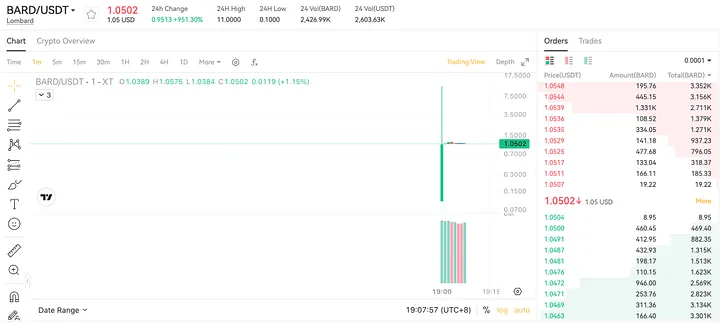
Step 3: Onchain Liquidity
After launch, liquidity pools form on decentralized exchanges.
– Verify the official contract address.
– Assess pool depth and potential slippage.
– Use aggregators for efficient routing.
– Begin with small test swaps to ensure accuracy.
Step 4: Staking and Utility
Holding BARD unlocks more than trading access:
– Stake tokens to support cross-chain operations.
– Gain governance rights, fee tier benefits, and vault incentives.
– Monitor governance forums for updates on emissions, buybacks, or incentive programs.
Security Reminder: Always rely on official links, double-check tickers, and consider hardware wallets for added protection.
Lombard Finance Competitive Landscape
Lombard Finance competes with several approaches to bringing Bitcoin into DeFi. Each model has trade-offs between custody, decentralization, liquidity, and usability.
Press enter or click to view image in full size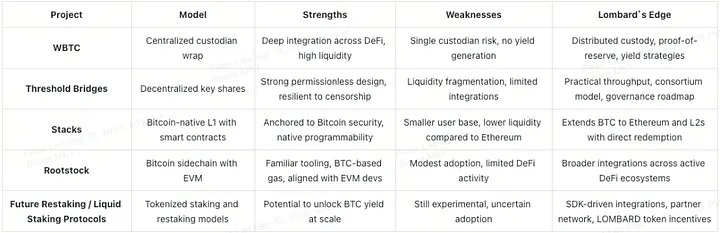
Key Takeaways
– WBTC dominates liquidity but sacrifices decentralization and yield.
– Threshold bridges are innovative but still small in scale.
– Stacks and Rootstock expand Bitcoin programmability yet lag in liquidity.
– Lombard Finance combines distributed custody, verifiable reserves, multi-chain reach, and yield-focused design, while the LOMBARD token adds governance and funding tools to accelerate adoption.
LOMBARD Token Risks & Considerations
Like any bridge and staking system, Lombard Finance carries risks that investors should evaluate carefully.
Custody and Technical Risks
– LBTC depends on secure custody and validator performance. Failures, slashing, or operational errors could disrupt backing.
– Cross-chain complexity introduces smart contract vulnerabilities and potential temporary depegs under stress.
Regulatory and Market Risks
– Evolving regulation may impact custody partners, exchange listings, or how fee programs are implemented.
– Early trading often faces thin liquidity, while scheduled unlocks can create supply pressure. Valuation can also get ahead of fundamentals.
Governance Risks
Concentration of voting power is possible as insider tokens vest. A balanced shift toward community ownership is important to monitor.
Mitigation Tips
1. Use official links and verify contract addresses.
2. Start with smaller positions before scaling.
3. Treat vault yields as variable and monitor governance forums for changes to emissions, buybacks, or fee structures.
Lombard Finance Outlook
Lombard Finance is positioning itself as a key layer for making Bitcoin productive in DeFi. The strategy is straightforward: unlock BTC liquidity, bring it to the chains users already rely on, and coordinate ecosystem growth through the BARD token.
Near-Term Signals
– Watch for new listings, including BARD/USDT spot trading pairs.
– Expanded vault offerings will give users more curated yield options.
– Partner rollouts are expected to broaden LBTC’s role in lending and collateral markets.
Medium-Term Development
Governance may activate fee switches and structured buyback programs, creating direct value flow into the token economy. These steps will test how well the community can manage incentives and treasury deployment.
Long-Term Potential
If Lombard Finance continues to strengthen liquidity, integrations, and decentralization of its bridge model, it could establish itself as the standard for Bitcoin liquidity in DeFi, with the LOMBARD token serving as the coordination engine.


