

Oracle’s upcoming earnings release arrives at a moment when its story has flipped dramatically. The same AI wave that once lifted the stock to record highs has now become the source of its biggest questions.
Back in September, Wall Street couldn’t get enough of Oracle’s cloud optimism — its shares logged their strongest single-day performance in 30 years. Since then, enthusiasm has evaporated. The stock has plunged more than 30%, and analysts no longer talk about limitless growth but instead whether Oracle has stretched itself too thin chasing AI demand.
Key Takeaways
Oracle faces debt and spending concerns ahead of earnings.
Growth is expected, but margins and cash flow are under pressure.
Its OpenAI deal is now seen as a risk, not just a win.
Traders expect big share price moves after results.
Portfolio managers now frame Oracle as a company racing ahead faster than its balance sheet can carry. Heavy borrowing, swelling project financing and negative free cash flow have moved to the foreground, overshadowing upbeat revenue projections.
What Investors Fear Most Isn’t Earnings — It’s the Bill Behind Them
There is little debate over whether Oracle can post another quarter of expansion. Consensus expects higher earnings and double-digit revenue growth. Margin erosion, however, has become impossible to ignore, and capex has exploded to more than double last year’s spend. The firm is now expected to burn billions in cash as its data-center ambitions accelerate.
That story is feeding anxiety in credit markets. The cost of safeguarding Oracle debt from default just jumped to levels last seen during the 2009 crisis — hardly the image of a carefree AI champion.
The company’s blockbuster arrangement to host OpenAI workloads once symbolised its ascent into the AI elite. Now investors ask whether anchoring a strategy to a partner embroiled in internal uncertainty is wise. Strategists warn that if OpenAI stumbles, Oracle may struggle to show that its growth pipeline isn’t overly concentrated.
A Split Market Ahead of Earnings
Despite the gloom surrounding leverage and spending, traders are positioning for volatility rather than a quiet shrug. Options pricing implies the shares could swing 10% in either direction after the report lands. Oracle’s stock has recovered roughly 10% so far this month, suggesting some investors see the recent collapse as overshooting.
But valuation may act as a ceiling — the shares trade around 30× forward earnings, far above their decade average and richer than major tech indices. Several fund managers have publicly admitted they’re waiting for proof rather than promises.
Oracle’s Moment of Reckoning
What once looked like a pure AI momentum play has turned into a test of financial discipline. The business may still be growing, but now Wall Street wants answers about stability, diversification and execution — not just bookings.
As the tech sector continues pushing forward — with Cisco revisiting dot-com highs, Amazon deepening its India footprint and SpaceX lining up a potentially record-shattering IPO — Oracle faces a defining earnings night that will determine whether it is part of tech’s next chapter, or a warning about the cost of chasing AI glory too quickly.
Oracle Stock
On the technical side, Oracle shares are hovering around $221, showing a modest rebound from November’s lows. The RSI has climbed back toward the mid-40 range, signalling stabilizing momentum after a prolonged downturn. MACD levels have also begun to turn upward, hinting that bearish pressure may be easing as trading volume improves.
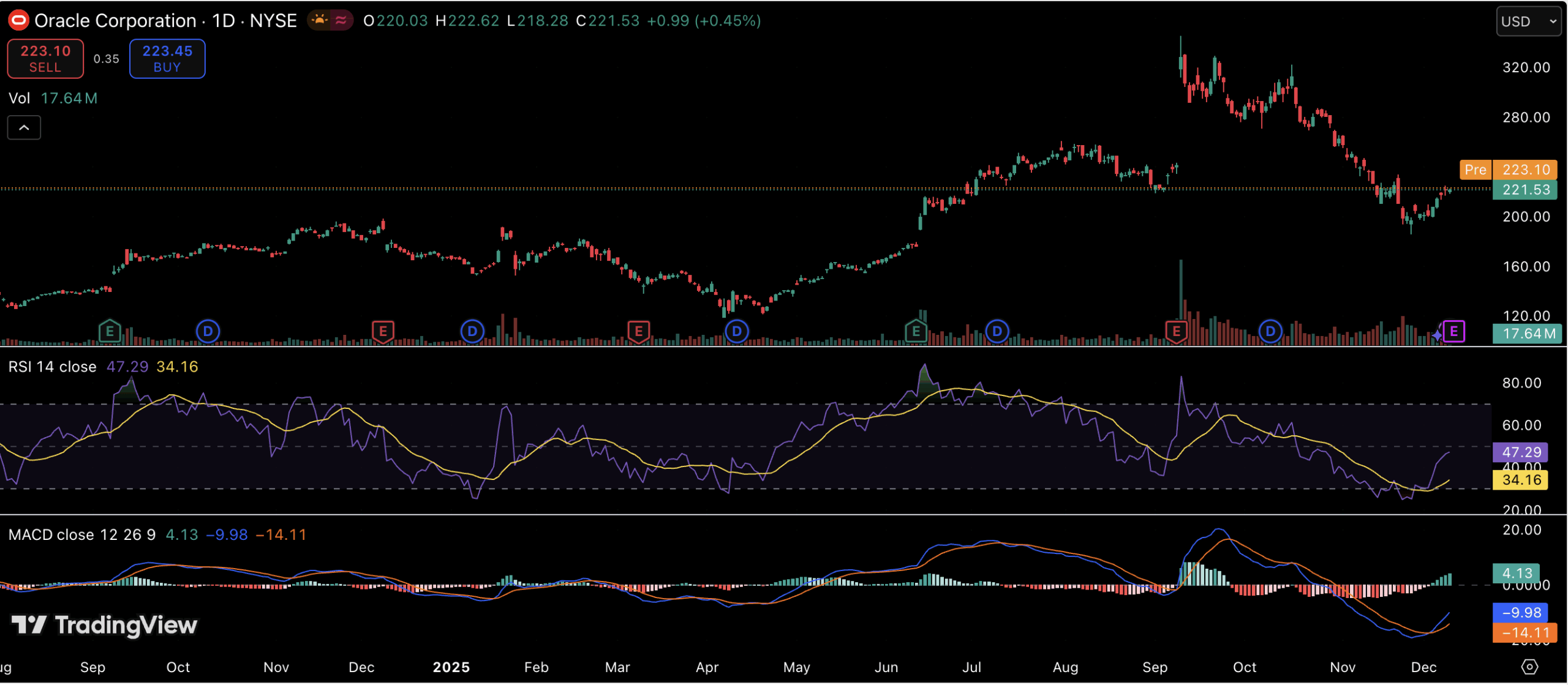
Although the stock remains well below its September peak, the recent price structure suggests attempts to build a base — something traders are watching closely ahead of earnings to assess whether sentiment is shifting or simply pausing before the next move.


