

DeFi protocols achieved one major shift in 2025 – they tripled the amount of value returned to token holders. In the past few months, various forms of revenue sharing accelerated.
DeFi protocols had one of their strongest years, bringing peak fees for some of the protocols. The big shift in 2025 is that more DeFi platforms introduced forms of revenue sharing.
As token prices stagnated, revenue sharing turned into an incentive for users to continue adopting new protocols. The shift started with Hyperliquid, later putting pressure on other protocols to distribute fees.
Widely used hubs like Pump.fun and Uniswap also moved toward revenue sharing. The apps were also pressured for their perceived extraction, without returning value to the crypto space.
DeFi protocols distributed 15% of fees
A growing share of DeFi revenues flowed back to token holders. Protocols removed previous forms of inflationary rewards, instead moving to buybacks, token burns, and other forms of value distribution. Fees were a game-changer in DeFi, showing blockchains could generate real revenues. The distribution did not come from new token minting, as in previous profit-sharing tools.
Only around 5% of protocol fees were distributed to holders before 2025. In the past year, the amount tripled to 15%, according to the DeFi Llama report on the industry.
Token holders could receive forms of revenue sharing, treasury yield, or general support from buybacks and burns. Not all buybacks had the same effect, as some tokens remained stagnant.
The trend has also reached major protocols like Aave, holding 60% of DeFi deposits, as well as the Uniswap DEX. More protocols resemble traditional financial markets and aim to bring intrinsic value to their tokens.
DEX and perp trading boosted fee sharing
Fee sharing came from many different decentralized protocols, but trading venues were the biggest producers.
Decentralized markets and perpetual futures DEXs became more competitive in 2025, increasing fee capture. Some of the protocols managed to become sustainably profitable, despite the slide in their token price.
The ability to become profitable meant DeFi protocols had more space to explore incentive models and new products.
As some networks scaled and offered lower costs, the revenue model no longer depended on token valuations. With low transaction fees, apps could afford to ask for fees in exchange for their services and access to liquidity.
The sliding gas fees on Ethereum and its L2 chains and the low fees on Solana encouraged DeFi innovation and brought more users to the space.
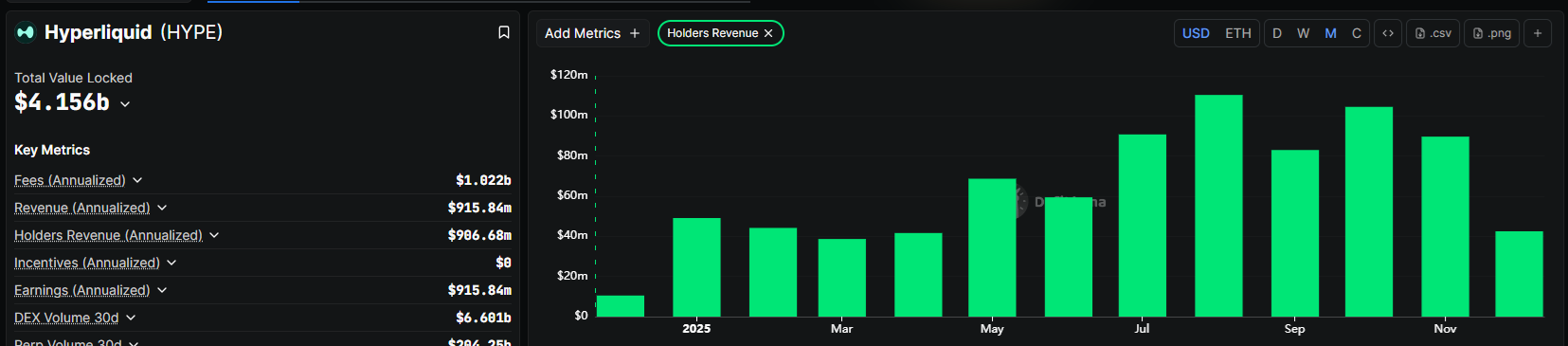
As of December 2025, Hyperliquid produces the highest holder revenues. For the past month, the platform distributed over $74M to holders. Hyperliquid peaked with $9.8M in daily distributions on October 10.
In 2025, the barrier to entering DeFi is no longer about the availability of infrastructure. Any project could build apps for yield, staking, liquid staking, or trading. However, some of the biggest protocols established themselves as leaders, securing the biggest share of users and the highest revenues.
As a result, communities could also pressure protocols into sharing some of their fees.
Join Bybit now and claim a $50 bonus in minutes


