

Cardano’s ADA token continued to trade under pressure this week, slipping below the $0.37 level after reaching a two-month low in the previous week. The decline comes amid growing evidence of sell-side activity from both large holders and derivatives traders, reinforcing a cautious market tone around the asset.
$ADA update:
Cardano remains under pressure, trading around $0.36–$0.37 after a deep 2025 drawdown. Sentiment is still bearish, but whales are accumulating near support, hinting at a potential rebound if the market stabilizes. #Cardano #ADA #Crypto pic.twitter.com/pvDuP2xygA— Crypto?tasis (@CryptoXtasis) December 22, 2025
The move is drawing attention because Cardano is one of the largest smart contract platforms by market capitalization, and shifts in holder behavior are often viewed as signals of broader sentiment across the layer-1 ecosystem.
Large Holders Reduce Exposure
On-chain data from Santiment indicates that Cardano’s largest wallet cohorts have reduced their holdings over recent days. Supply distribution metrics show that addresses holding between 100,000 and 1 million ADA, 1 million to 10 million ADA, and 10 million to 100 million ADA collectively shed around 90 million tokens between Saturday and Tuesday.
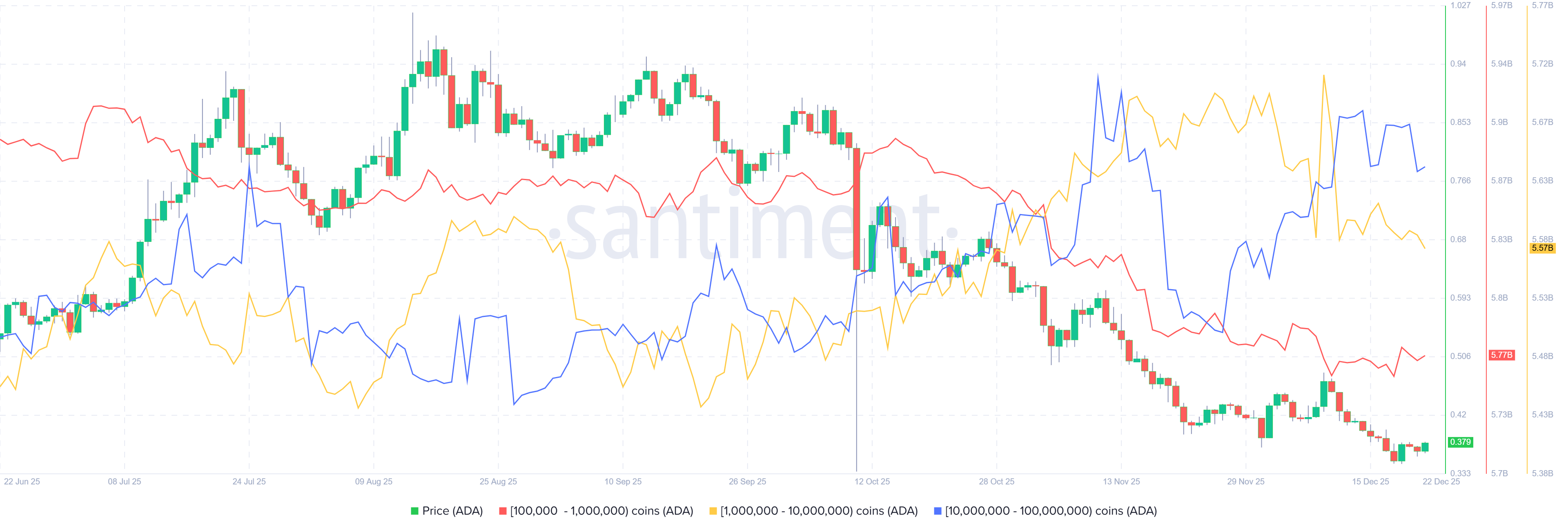
This decline in large-wallet balances suggests distribution rather than accumulation, increasing available supply in the market. Historically, similar trends have coincided with periods of heightened downside pressure, particularly when retail demand remains subdued.
Derivatives Positioning Reflects Bearish Sentiment
Data from derivatives analytics platform Coinglass adds to the picture of weakening sentiment. ADA’s long-to-short ratio stood at approximately 0.89 on Tuesday, indicating that short positions outweighed long positions across tracked derivatives markets.

Image Courtesy: Coinglass
A ratio below one typically reflects expectations of further downside among leveraged traders. While derivatives positioning can shift quickly, sustained imbalances often amplify spot market trends during periods of low liquidity or weak momentum.
Technical Structure Remains Fragile
From a technical perspective, ADA has struggled to regain footing after being rejected from the upper boundary of a falling wedge pattern earlier this month. Following that rejection on December 9, the token declined sharply over the next nine days, eventually touching a two-month low near $0.34.
Momentum indicators continue to reflect caution. The daily Relative Strength Index (RSI) remains below the neutral midpoint, while the Moving Average Convergence Divergence (MACD) has maintained a bearish crossover, signaling persistent downside momentum.
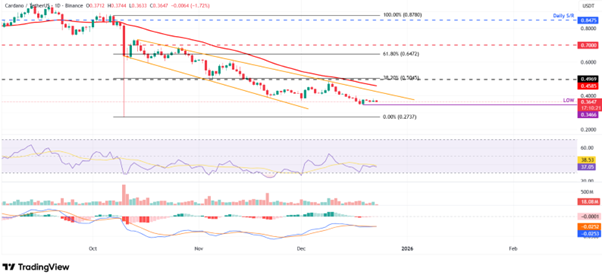
Image Courtesy: TradingView
Broader Context for Cardano
Cardano has faced increasing competition from other layer-1 and layer-2 networks, particularly as developers and users prioritize throughput, fees, and ecosystem incentives. While the network continues to evolve through protocol upgrades, market participants have remained sensitive to broader risk-off conditions across crypto assets.
Similar patterns of whale distribution and derivatives-driven pressure have appeared in other major altcoins during periods of market consolidation.
Implications for the Crypto Market
The current combination of on-chain distribution, bearish derivatives positioning, and weak technical momentum underscores the challenges facing ADA in the near term. For investors and builders, the data highlights how shifts in holder behavior can quickly influence market structure, especially in an environment where capital remains selective across the digital asset space.
Bitcoin Hyper: Positioning For Wider Adoption
While on-chain metrics from networks like Cardano point to a widening distribution of tokens among holders, a separate thread of market interest has been forming around Bitcoin-focused infrastructure aimed at extending its functionality within DeFi.
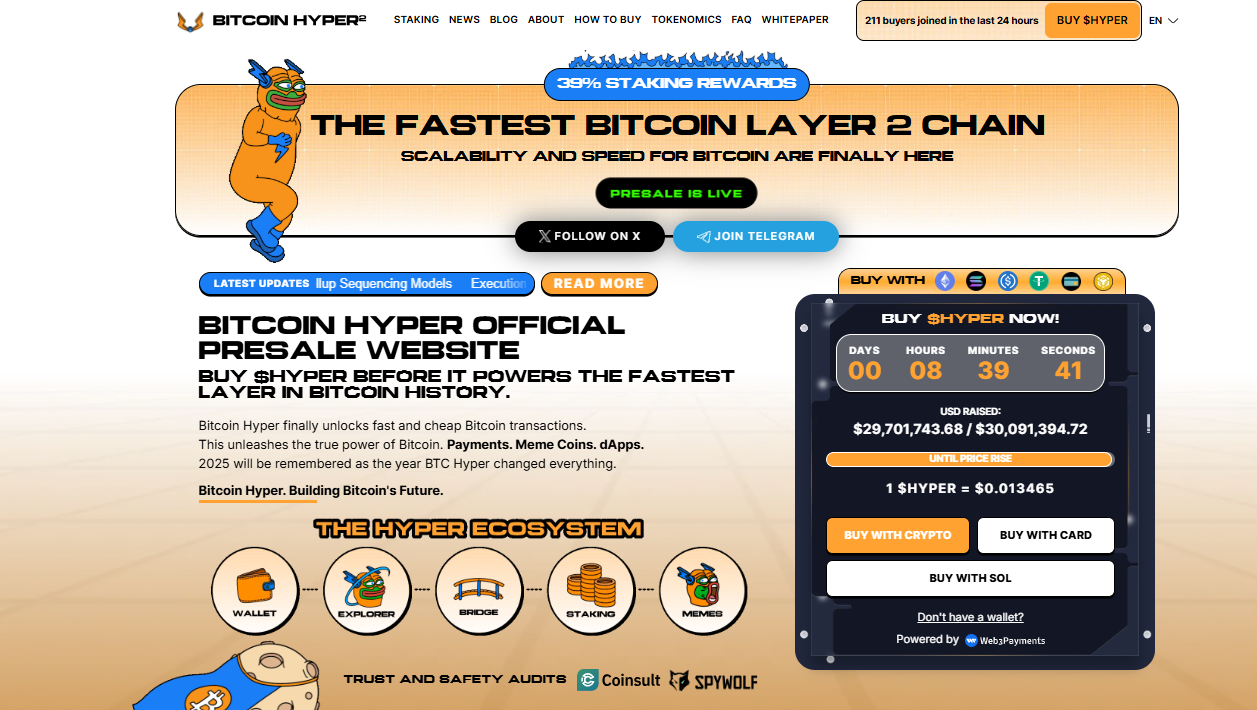
Bitcoin Hyper (HYPER) falls into this category, describing itself as a Solana-based Layer-2 that introduces smart contract capabilities and higher transaction throughput, with final settlement anchored to the Bitcoin blockchain.
The approach reflects the growing BTCFi narrative, which explores ways to broaden Bitcoin’s use cases without modifying its core protocol. Based on disclosed data, the Bitcoin Hyper presale has accumulated roughly $29.71 million so far.


