


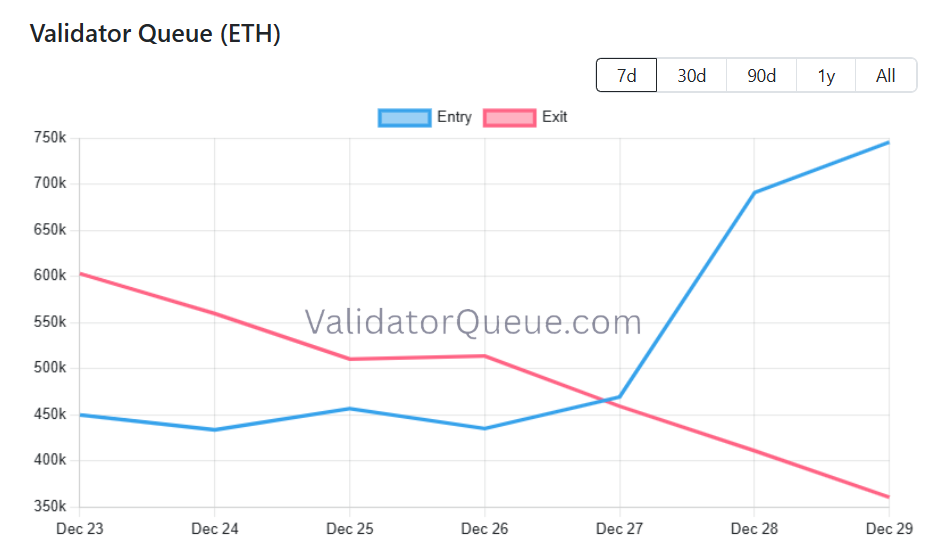
Ethereum’s staking dynamics have shifted sharply, with demand to lock up ETH now overwhelming requests to exit the network for the first time in roughly six months.
The change points to a renewed preference for long-term positioning over short-term liquidity, coinciding with increased activity from large capital allocators.
Key takeaways:
More ETH is waiting to be staked than withdrawn for the first time in six months
The validator entry queue is nearly double the size of the exit queue
Institutional staking activity is absorbing previously unstaked ETH
The shift reduces near-term sell pressure on the market
Data from the validator queue shows that more than 745,000 ETH is currently waiting to enter staking, translating into an estimated wait of nearly thirteen days. By comparison, the exit queue has dropped to roughly 360,000 ETH, with a shorter waiting period. The reversal happened quickly: both queues were roughly balanced days earlier before staking demand accelerated and exit activity continued to thin.
Institutional Accumulation and Network Changes
Several forces appear to be driving the flip. One of the most visible is growing participation from digital asset treasury firms. Companies such as BitMine—linked to prominent market strategist Tom Lee—have been accumulating large quantities of ETH and committing them directly to staking, removing supply from circulation rather than preparing it for sale.
On-chain data shows that BitMine alone has staked hundreds of thousands of ETH in a short period, soaking up supply that had previously entered the market through validator exits. This has helped offset months of steady unstaking that followed large withdrawals earlier in the year, including exits by major staking providers.
Protocol-level changes may also be reinforcing the trend. Ethereum’s Pectra upgrade improved the staking experience for large holders by increasing validator limits and simplifying restaking for sizeable balances. These adjustments lower friction for institutions deploying capital at scale and may have made staking more attractive relative to holding liquid ETH.
Additional dynamics from decentralized finance likely played a role as well. Rising borrowing costs on lending platforms forced some leveraged staking strategies to unwind, temporarily pushing ETH into circulation. That supply now appears to be getting reabsorbed through renewed staking demand.
What the Queue Flip Signals
Because Ethereum operates as a proof-of-stake network, shifts in validator queues are closely watched as indicators of market intent. A rising exit queue often signals potential selling, while a growing entry queue suggests confidence and a willingness to lock up ETH for longer periods.
With the exit queue shrinking and staking demand accelerating, some analysts believe near-term sell pressure could ease if the trend persists. Similar reversals in the past have coincided with periods of price strength, though outcomes are never guaranteed.
For now, the data sends a clear signal: more ETH is being committed to securing the Ethereum than being prepared for withdrawal. Whether driven by institutional accumulation, protocol upgrades, or shifting DeFi conditions, incentives have tilted back toward staking—reshaping Ethereum’s short-term supply outlook.
Ethereum’s price action reflects this shift in staking dynamics but remains mixed in the short term. ETH is trading near $3,010, posting a modest daily decline while still holding onto gains on a longer intraday basis. Trading volume remains elevated, signaling active participation despite recent volatility. The ability of ETH to stay above the psychologically important $3,000 level suggests underlying demand remains intact, especially as more supply is locked into staking. If the reduction in exit pressure continues, price stability could improve, though near-term moves are still likely to be sensitive to broader market sentiment and macro-driven risk appetite.


