


Fresh on-chain data suggests Bitcoin is entering 2026 without a decisive trend, as selling pressure continues to meet steady absorption rather than triggering a breakdown.
Multiple indicators point to a market in equilibrium — where downside forces are present, but structural demand is preventing a clear collapse or breakout. Data shared by CryptoQuant shows that Bitcoin’s recent behavior is defined less by momentum and more by balance, with sellers active but far from distressed.
Key takeaways
On-chain metrics show profit-taking and breakeven selling, not capitulation
U.S. spot demand has softened, but has not disappeared
Bitcoin continues to flow off exchanges, signaling long-term holding behavior
Analysts see range-bound trading as the most likely 2026 scenario
SOPR Points to Controlled Selling, Not Panic
One of the clearest signals comes from the Spent Output Profit Ratio. Into late December, SOPR hovered just below the neutral 1.0 level, with the most recent reading around 0.994. This indicates that coins are being spent close to their cost basis.
Historically, prolonged SOPR readings well below 1.0 are associated with capitulation events, where holders sell at significant losses. That pattern is absent here. Instead, the data points to orderly profit-taking and breakeven exits, even as Bitcoin traded near $87,600 after a volatile 2025.
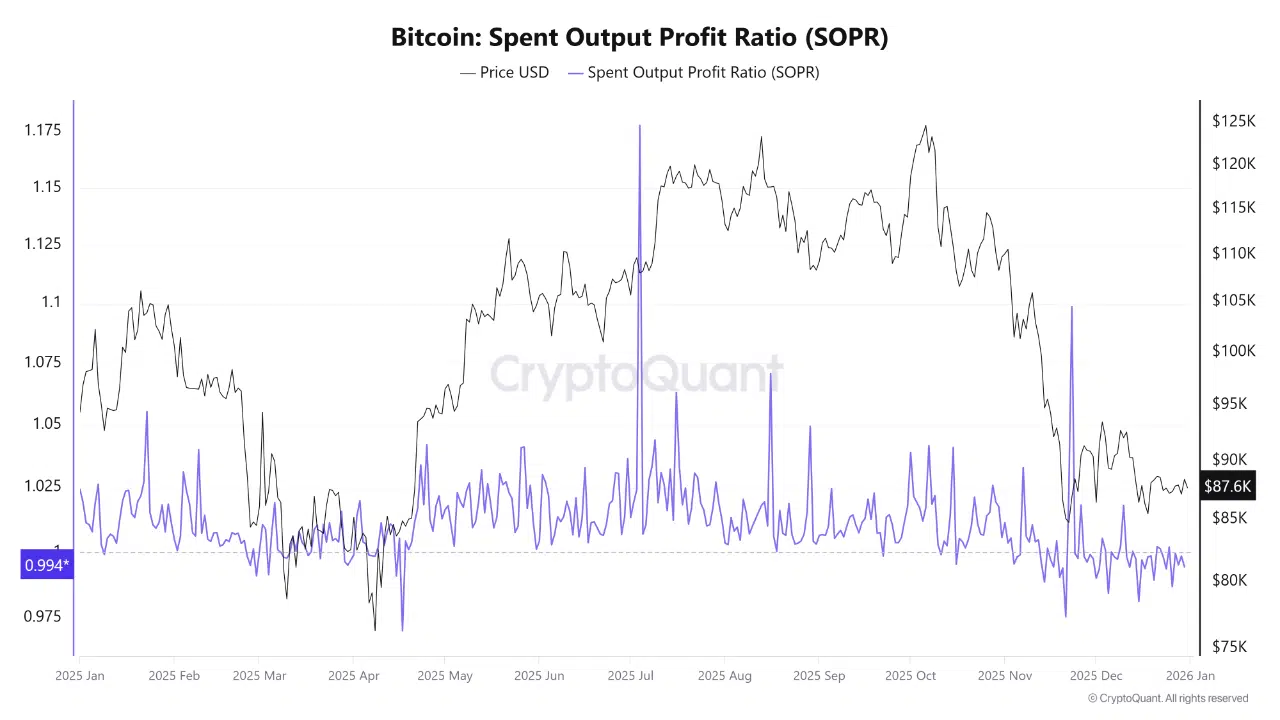
The implication is structural: selling pressure exists, but it is not being driven by fear.
U.S. Spot Demand Cools, But Doesn’t Collapse
The Coinbase Premium Index adds another layer to the picture. Heading into year-end, the indicator slipped to roughly -0.09, meaning Bitcoin traded at a slight discount on Coinbase compared with offshore exchanges.
This negative premium reflects softer U.S. spot demand, aligning with ETF outflows and reduced institutional urgency. Still, the premium has oscillated around zero for most of 2025, suggesting intermittent participation rather than a full withdrawal by U.S.-based buyers.
In other words, demand has cooled — but the market structure remains intact.
Exchange Netflows Undercut Bearish Narratives
Exchange netflow data further complicates a bearish case. Persistent net outflows continue to dominate, with recent readings near -1,600 BTC. Coins are consistently leaving exchanges, even during periods of price weakness.
Such behavior typically signals long-term custody or holding, not preparation for immediate selling. The fact that outflows persist while price struggles suggests that selling pressure is being absorbed elsewhere rather than funneled through exchanges.
From an on-chain perspective, this does not resemble a classic distribution phase.
Scenario Outlook: Range Is the Base Case
Adding a macro framework, XWIN Research Japan outlines three potential paths for Bitcoin in 2026. Their highest-probability scenario envisions a wide trading range between $80,000 and $140,000, with $90,000–$120,000 acting as the core zone. Under this view, ETF flows remain choppy, macro recovery stays weak, and derivatives markets continue to drive short-term moves.
A second, lower-probability scenario involves a macro shock, where recession-driven deleveraging could push Bitcoin below $80,000 and potentially toward $50,000 if ETF outflows accelerate. The least likely outcome, according to XWIN, is a strong risk-on expansion that could carry Bitcoin toward $120,000–$170,000 — but only if multiple favorable conditions align.
At present, XWIN characterizes the market as neutral to slightly bearish, citing insufficient confirmation for a sustained upside trend.
Balance, Not Breakout, Defines Early 2026
Taken together, the on-chain signals tell a consistent story. Bitcoin is neither unraveling nor accelerating. Sellers are active, but not distressed. U.S. demand has cooled, but long-term holders continue to withdraw coins from exchanges. ETF flows, spot demand, and derivatives positioning have yet to align in a way that would define a new trend.
As 2026 begins, Bitcoin’s defining feature is not direction — it is balance.


