

At some point, you might have grasped the difference between coins and tokens. But then, you learn about something like WETH — Ether… on Ethereum?! What is wrapped Ethereum and how does it even work? What is the point? It’s not as confusing as it might seem: let’s unpack it in this guide!
Key Takeaways
Tokens are customizable blockchain assets that use smart contracts or similar features of an underlying blockchain. Coins are their native assets, often used for gas, consensus, or governance.
Wrapped tokens are a subset of tokens that track the price of a blockchain asset 1:1. They require the underlying assets to be locked while the corresponding amount of a wrapped token exists.
What is wrapped ETH? Wrapped Ethereum is a wrapped token that tracks the value of Ether (ETH). In addition to interoperability reasons, WETH is also available on the Ethereum blockchain because only tokens can be used in some DeFi functions, and ETH is a coin.
Coins and Tokens: What’s the Difference?
Newcomers to crypto sometimes have to learn the difference between the two through context, usage, or just pretend there is none. But if you want clarity, they are indeed two different concepts.
The “coin” part is on the surface, considering that Bitcoin is still the first cryptocurrency most people encounter. However, this has been drifting away from being universal ever since tokens became a thing. It is very likely that your first “coin”, especially if it was a meme (but not Dogecoin!), was actually a token.
Let’s not muddy the waters any more: coin in a crypto context means the native cryptocurrency of a blockchain or decentralized network. BTC runs on its own blockchain, so it is a coin. Ethereum blockchain’s native currency is Ether (ETH), so ETH is a coin.
Ethereum is also where tokens enter the picture: this blockchain supports smart contracts, which enable a different type of cryptocurrencies. A smart contract can determine properties of a new kind of crypto asset, which can have little to nothing with the underlying coin. This type of cryptocurrency, one that does not use a blockchain of its own, is a token.
To recap: if it is a native unit of a blockchain, like in Ethereum or Bitcoin, it’s a coin. If it uses a smart contract or similar features of the underlying blockchain, it is a token. Some of the better known examples of tokens are Tether USD (USDT), Chainlink (LINK), and Shiba Inu (SHIB).
What is a Wrapped Token?
As we have mentioned, tokens can be ascribed properties through a smart contract. They range from basic ones like total supply to more complex, like the way they are supposed to interact with the blockchain’s infrastructure.
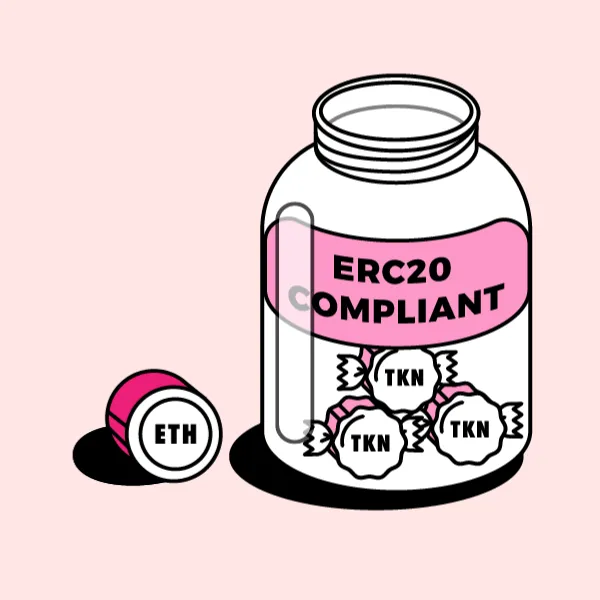
Nevertheless, all tokens follow standards that set the foundation for their qualities and properties. For example, stablecoins and non-fungible tokens (NFTs) use different token standards. Tokens that act like financial assets on Ethereum follow the ERC-20 standard. If you see this next to the name of the token, it usually means this is a fungible token on Ethereum. Other blockchains like Solana or TRON have their own designations and standards.
Therefore, a wrapped token has to be a certain kind of token. What is wrapped crypto, then? Well, this term refers to a very specific group of tokens: they exist to represent other blockchain assets. Take Wrapped Bitcoin (WBTC) for example: this is a token (on Ethereum but also on other chains) that represents Bitcoin on another blockchain. It adheres to strict rules not to disrupt supply dynamics across chains: every WBTC token corresponds to a BTC locked in a bridge contract in a 1:1 ratio. Since 1 original token equals 1 wrapped one, their value is also equal. Some argue that wrapped tokens are a type of stablecoins, which is technically true: they track the value of the underlying asset and are therefore pegged to it.
Wrapping refers to the lock-mint process, and unwrapping to the burn-unlock one. In the former, an asset is locked on its original chain and its representation is minted on the other. In the latter, the reverse happens: to unlock the original coins or tokens, their wrapped versions have to be burned (sent to an inaccessible address).
What is WETH or Wrapped Ether?
So, the point of wrapped tokens is to use assets from another chain, right? Yes, but it’s not the limit of their utility. Enter WETH, or Wrapped Ether (or Wrapped Ethereum, as it’s also commonly called) – a ERC-20 token that represents Ether (ETH). Yes, you’ve read that right – on the same blockchain.
The WETH contract address on Ethereum is 0xc02aaa39b223fe8d0a0e5c4f27ead9083c756cc2; it hosts the smart contract for the token and the bridge. What is WETH crypto used for? Let’s unpack right away.
What is the Point of WETH?
Source: weth.io (via web.archive.org)
Why would you need to wrap the native token on the same network? WETH can represent Ether where ETH can’t because WETH is a token and ETH is a coin.
Where would that be necessary? In many decentralized apps (dApps) in the Ethereum ecosystem: they usually require assets to comply with the ERC-20 token standard. Even ubiquitous decentralized finance (DeFi) applications of Ether might require you to wrap it, like contributing to a Uniswap liquidity pool or bidding in an OpenSea auction. In some cases, for user convenience, the wrapping is done behind the scenes.
WETH on other blockchains is even more of a no-brainer: it is a version that makes ETH usable in other blockchain ecosystems. BNB Chain or Solana users can gain exposure to Ether’s price movements and trade it with lower fees on their respective networks. These wrapped tokens are interoperable thanks to a centralized issuer and custodian, though, so the vision as it is now works with some compromises.
How Does WETH Compare vs ETH?
| Feature | ETH | WETH |
| Interoperability | Ethereum blockchain | Dozens of L1+L2s |
| Usage | Gas, staking, direct transactions | DApps, DeFi |
| Supply (Time of Writing) | 120.72M | 3.37M |
| Liquidity (Vol/Mkt Cap, Time of Writing) | 11.8% | 20.9% |
Summing up the wrapped ETH vs ETH comparison, the latter is the native coin and the core part of the Ethereum ecosystem, so using it is essential for things like gas and value transfers. WETH is a crutch that you might not even realize you are using, but it is still necessary to use Ether in DeFi, with an added benefit of relatively better liquidity.
Conclusion
WETH is a shining example of how unconventional the crypto market and decentralized finance can be. It might seem excessive without knowing what it actually does but once you do, it becomes a vital puzzle piece to the whole experience.
Browse the ChangeHero blog to get to know the crypto world and other coins better. Subscribe to us on social media to stay tuned to the updates: we’re on X, Facebook, and Telegram.


